When groups come to me wanting Spain but only have a long weekend, or wanting a shorter heritage trail that does not cross the whole country, I send them to Catalonia. The northeast corner of Spain holds one of the best-preserved Jewish quarters in Europe, a perfect small medieval town, and a mountain monastery that has drawn pilgrims for over a thousand years, and all three sit within easy reach of Barcelona. It is a compact, deep trail, and it surprises people.
I have walked this route with many groups, and the thing I love about it is the contrast. You move from the dense, intact Jewish streets of Girona, to the quiet stone bridges of tiny Besalu, up into the jagged mountains to Montserrat. Jewish and Christian heritage, side by side, in a few short days. Let me show you how it fits together.
Girona: One of Europe’s Finest Jewish Quarters
Girona is the heart of this trail and the reason most groups come. About an hour north of Barcelona, it holds the Call, the old Jewish quarter, which is one of the best-preserved medieval Jewish neighborhoods in all of Europe. Walking it is unlike anything else in Spain.
The Call is a labyrinth of narrow stone streets and stepped passages, tightly packed and remarkably intact, climbing the hillside in the old town. For centuries before the 1492 expulsion, Girona held an important and learned Jewish community. It was a major center of Kabbalah, the mystical tradition of Judaism, and the great thirteenth-century scholar Nachmanides, known as the Ramban, was associated with the city. For a rabbi bringing a congregation, standing in these streets, in a Kabbalistic center this well preserved, is profound.
The Bonastruc ca Porta center sits at the heart of the Call and houses the Museum of Jewish History, which tells the story of the community and the wider Sephardic experience. I always build time here, because it gives the streets their meaning. Above the Call rises Girona’s cathedral, with one of the widest Gothic naves in the world, and the old town as a whole, with its painted riverfront houses, is one of the loveliest in Catalonia. Christian and Jewish heritage stand directly beside each other here.
Besalu: A Medieval Town Frozen in Stone
A short drive inland from Girona brings you to Besalu, and it is the kind of place that makes a group fall quiet as they walk in. It is a tiny, perfectly preserved medieval town, entered across a fortified Romanesque bridge that spans the river, and it looks almost exactly as it did eight hundred years ago.
Besalu’s Jewish heritage is its rare treasure. The town holds a mikveh, a Jewish ritual bath, one of very few medieval mikvehs to survive in Europe and among the oldest known in Spain. Discovered in the twentieth century, it sits below street level near the river, simple and stone and moving. There was a synagogue here too, and the remains of the Jewish quarter survive in the old town. For a group, Besalu offers something Girona’s larger Call cannot, the intimacy of a complete small medieval world where the Jewish presence is woven into a few short streets.
I usually pair Besalu with Girona as a single day or two, since they sit close together and complement each other, one a major urban quarter, the other a quiet preserved town.
Montserrat: The Mountain Monastery
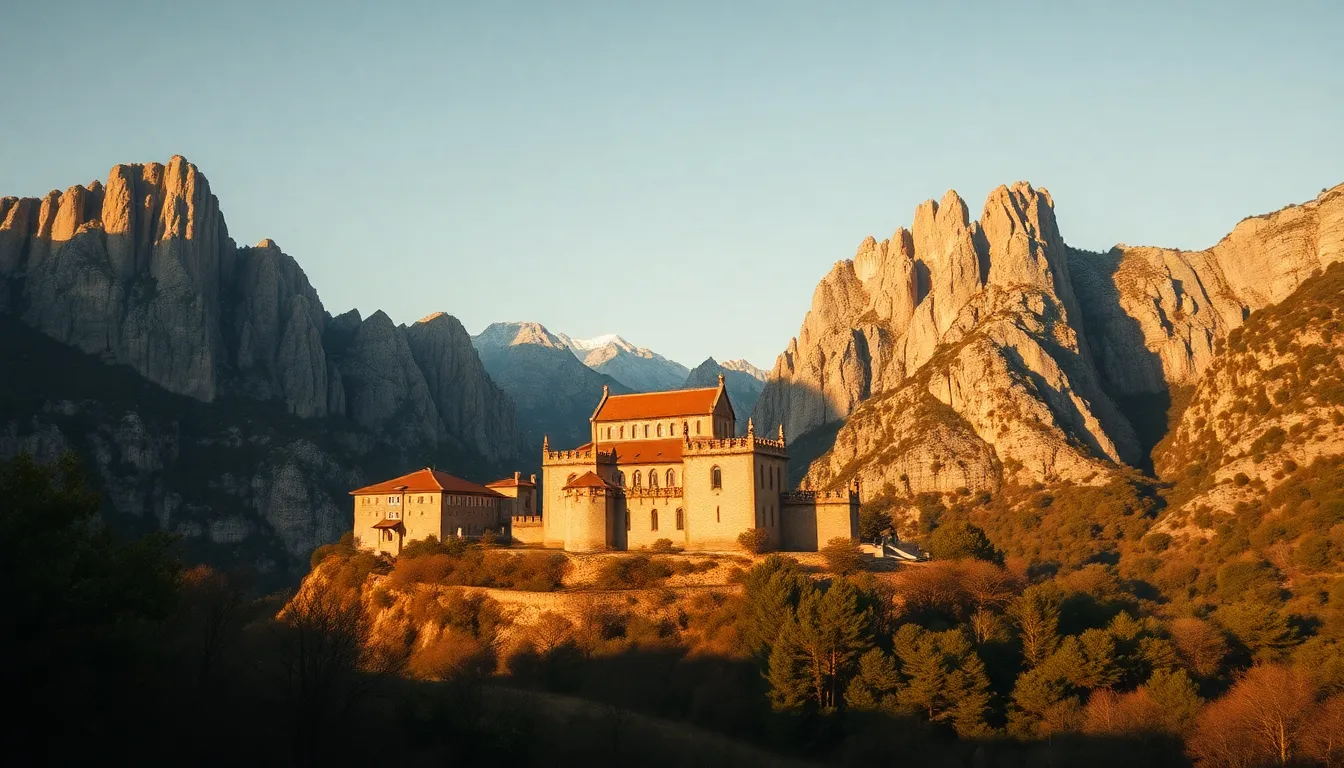
The third stop changes the register entirely. Montserrat is a Benedictine monastery set high in a range of jagged, rounded peaks that look like nothing else in Spain, about an hour northwest of Barcelona. It has been a site of Christian pilgrimage and devotion since the early Middle Ages, and it remains a living, working monastery today.
The monastery is home to the Black Madonna, a revered medieval statue of the Virgin and child, and pilgrims have climbed to venerate her for centuries. The setting alone is moving, the basilica tucked into the mountains, the views stretching across Catalonia, the famous boys’ choir whose voices fill the church. For Christian groups, Montserrat is the spiritual peak of the Catalonia trail, a place built specifically to draw people up and out of the everyday.
Getting to Montserrat is part of the experience. The monastery sits high in the mountains, reached by a winding road or by a cable car and rack railway that climb the cliff face. I plan the approach carefully for groups, and the arrival, emerging into the mountain sanctuary, is one people remember.
What makes Montserrat land so hard at the end of this trail is the shift in scale. You have spent days in tight medieval streets, in the dense Call of Girona and the narrow lanes of Besalu, close in among the stones. Then you climb into the mountains, and everything opens. The walls fall away, the peaks rise around you, and the singing of the choir fills a space that feels carved by something larger than human hands. For a Christian group, it is the natural spiritual summit of the route. And for a mixed group of Jewish and Christian travelers, which I lead often, the contrast between the intimate Jewish quarters below and the soaring Christian sanctuary above frames the whole heritage of Catalonia in a single arc.
Why Barcelona Anchors the Trail
All three stops sit within reach of Barcelona, which makes the city the natural base and gateway for this trail. Barcelona itself holds heritage worth time, the Sagrada Familia, Gaudi’s unfinished basilica and an act of faith in stone, and the old Gothic quarter, which includes the remains of a medieval Jewish quarter of its own. Many groups build a day or two in Barcelona around the trail, using it as the entry and exit point and seeing the Sagrada Familia as part of the wider Christian heritage of the region.
Practical Orientation for the Trail
This is the most compact of the Spanish heritage trails, which is its great strength. Girona, Besalu, and Montserrat all lie within roughly an hour or so of Barcelona, so you can base in or near the city and take day trips, or string the stops together with short drives. For a group, pre-arranged coach transport is the smoothest way to handle the mountain road to Montserrat and the inland route to Besalu.
A typical Catalonia trail runs four to six days, which is comfortable for the three core stops plus time in Barcelona. The compactness makes it ideal for groups with limited time or for a first heritage trip to Spain.
Catalonia’s coastal climate is milder than the Castilian interior, but spring and autumn are still the best seasons for comfortable walking, and Montserrat’s altitude means cooler temperatures up the mountain in any season, so I advise groups to bring a layer.
The Catalonia trail works beautifully on its own and also connects to the wider country. Many groups pair it with the full Spain heritage journey, combine it with the Andalusia trail in the south for a trip spanning both corners of Spain, or add Santiago de Compostela for groups drawn to the pilgrim tradition.
FAQ: The Catalonia Heritage Trail
What makes Girona’s Jewish quarter special?
Girona’s Call is one of the best-preserved medieval Jewish quarters in Europe, a dense labyrinth of intact stone streets. The city was an important center of Kabbalah, associated with the great scholar Nachmanides, and the Museum of Jewish History at its heart tells the community’s story. For groups, walking these streets is one of the most moving Jewish heritage experiences in Spain.
Why include Besalu on the trail?
Besalu holds a medieval mikveh, a Jewish ritual bath, one of very few to survive in Europe and among the oldest known in Spain. The town itself is a perfectly preserved medieval world entered across a fortified Romanesque bridge. It offers an intimacy that the larger Girona quarter cannot, and the two pair naturally as a single stretch of the trail.
How long does the Catalonia trail take?
Four to six days is comfortable for the three core stops, Girona, Besalu, and Montserrat, plus time in Barcelona as your base and gateway. It is the most compact of the Spanish heritage trails, since all three sit within about an hour of Barcelona, which makes it ideal for groups with limited time or a first trip to Spain.
When is the best time to travel the Catalonia trail?
Spring (April through June) and autumn (September through October) are the best seasons, with mild, comfortable weather for walking. Catalonia’s climate is gentler than the Castilian interior, but Montserrat sits high in the mountains and is cooler in any season, so I advise groups to bring a layer for the monastery.
Does the group leader travel free on the Catalonia trail?
Yes. On all Heritage Tours group itineraries through Catalonia, the group leader travels free with fifteen or more participants. It is our way of honoring the work you put into bringing your community together for the journey.
If the northeast trail is calling your community, I would be glad to help you shape it, from the Call in Girona to the mountain sanctuary of Montserrat. Reach out whenever you are ready and we can plan the route around your group.