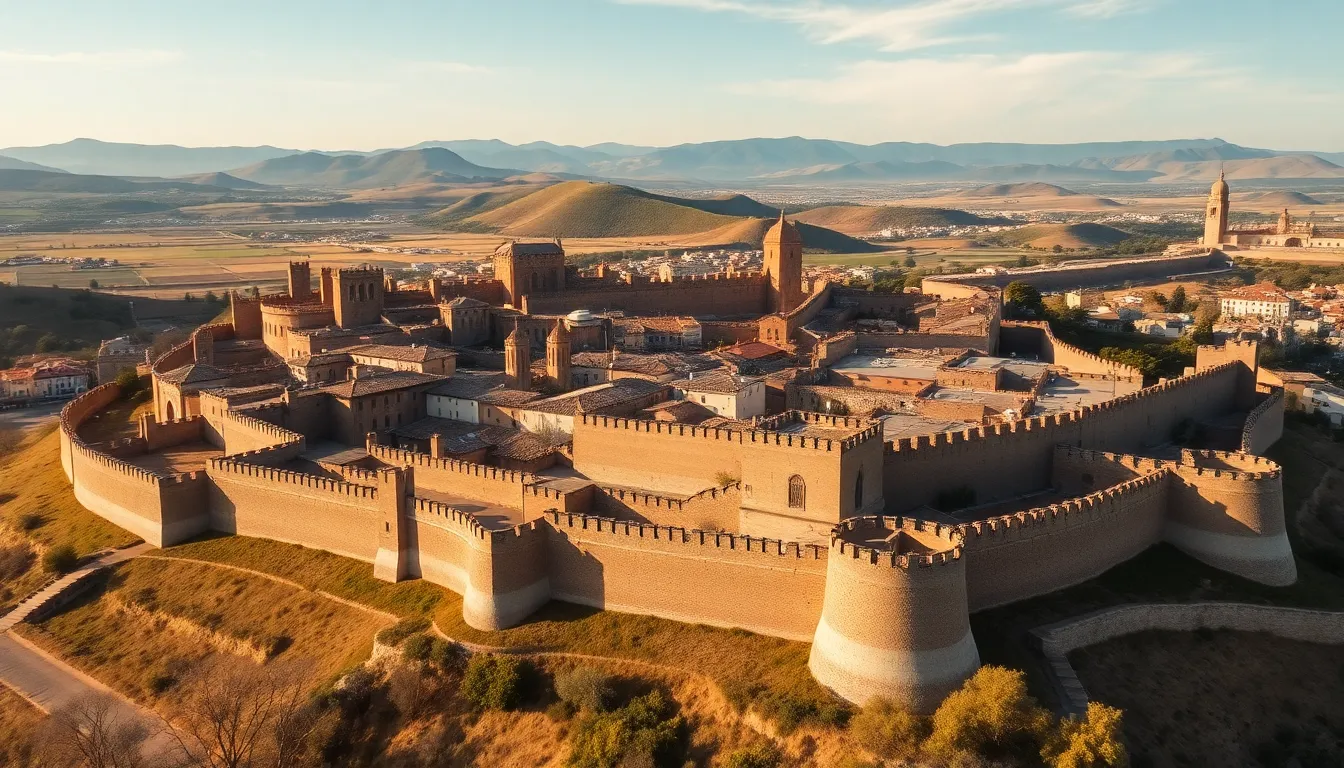
I have brought a lot of groups to Avila over the years, and there is a moment that happens almost every time. The bus comes around a bend, the city appears on its ridge above the plain, and the whole group goes quiet. Avila still wears its complete medieval walls, every tower, every gate, unbroken all the way around. There are not many places in Europe where you see a walled city whole like that. For a faith community, it sets the tone before anyone has stepped off the bus.
Avila is small. You can walk it in a day. But it holds more spiritual weight per square foot than almost anywhere else in Spain, because this is the city of Saint Teresa, one of the most important mystics in the Christian tradition. If you lead a church group, or even a mixed heritage group, Avila deserves a serious look. Let me walk you through what is here.
Where Avila Sits
Avila is in the Castilian highlands, about an hour and a half northwest of Madrid by road or train. It sits high, over 1,100 meters, which makes it one of the highest provincial capitals in Spain. That altitude matters for planning. Summers are warm but the air stays drier than the central plains, and evenings cool down. Winters are genuinely cold, with real frost and sometimes snow. The light up here is clear and sharp, the kind of light that makes the stone glow at the end of the day.
For a group, Avila works as a half-day or full-day stop, and it pairs naturally with Madrid or with the Castilian towns nearby. It is compact, walkable, and the major sites sit close together inside the walls.
Christian Heritage: Saint Teresa and the Walls
Avila’s Christian heritage is the reason most groups come, and it runs deep.
Saint Teresa of Avila
Teresa of Avila, born here in 1515, reformed the Carmelite order and wrote some of the most enduring works of Christian mysticism, including the Interior Castle. She was later named a Doctor of the Church, one of the first women to hold that title. Her presence is everywhere in this city.
The Convent of Saint Teresa stands on the site of her birthplace. The Monastery of the Incarnation, just outside the walls, is where she lived as a nun for nearly thirty years and where much of her spiritual transformation happened. For a group interested in the contemplative tradition, walking these spaces is not a museum visit. It is standing in the rooms where one of the great spiritual teachers of the Church did her work.
I always tell pastors and group leaders to leave room in the schedule here. Avila is not a place to rush. The whole point of Teresa’s writing is interior stillness, and a group that moves through her city at a sprint misses what the place is for.
The Walls and the Cathedral
The walls of Avila, built mainly in the eleventh and twelfth centuries, are the best-preserved medieval city walls in Spain and among the finest in Europe. You can walk along sections of them and look out over the plain the way watchmen did nine hundred years ago. The full circuit, with its dozens of towers, is the image that defines the city.
The Cathedral of Avila is built right into the walls, its apse forming part of the fortifications. It is often called the first Gothic cathedral in Spain. Standing inside, you feel the way faith and defense were woven together in this frontier city during the centuries of the reconquest.
Jewish Heritage: The Sephardic Memory of Avila
Avila had a significant Jewish community in the medieval period, and its memory has not been erased. Before 1492, Jews lived and worked here as part of the city’s life, and Avila was actually a center of Jewish learning, with connections to important Kabbalistic thought.
Today the old Jewish quarter can still be traced in the street layout near the southern part of the walls. There is a memorial and interpretive effort that walks visitors through where the synagogue stood and how the community lived. After the expulsion, Avila, like every Spanish city, lost that community in a single decree.
For a rabbi building a Sephardic itinerary, Avila is not one of the headline sites the way Toledo or Girona are, but it adds something. It shows that Jewish life in Spain was not confined to a few famous quarters. It reached into the high Castilian towns too, and the loss in 1492 was felt across the whole country. For the wider picture, our Spain heritage travel guide maps how these communities connected.
Moorish Heritage: The Frontier Context
Avila does not have the great Moorish monuments you find in the south. It was a frontier city of the Christian kingdoms during the reconquest, and its character is shaped by that, the walls, the fortified cathedral, the sense of a city built to hold a line. The Moorish chapter of Spain’s story lives in Granada, Cordoba, and Seville, not here.
What Avila gives you instead is the other side of that same history: the Christian Castile that pushed the frontier south. Understanding Avila helps a group understand why Spain looks so different from one region to the next. If your itinerary also reaches the Moorish south, the contrast is part of what makes the trip meaningful. And if you are moving north toward the pilgrim country, our Galicia heritage guide picks up that thread.
Planning an Avila Heritage Visit
A few practical notes.
First, Avila pairs well. Because it sits close to Madrid, many groups visit Avila as part of a Castilian leg, often alongside Segovia or Toledo. It rarely anchors a trip on its own, but it is a strong, meaningful stop within a larger Spain itinerary. Our Madrid heritage guide covers the city most groups use as a base.
Second, plan for the altitude and the season. Avila is high and cold in winter. Spring and autumn are ideal. Summer is comfortable in the day but bring a layer for the evening.
Third, give Teresa room. If your group has any interest in the contemplative tradition, do not treat Avila as a quick photo stop at the walls. The convents and the saint’s spaces reward an unhurried visit.
Fourth, the right operator handles the details that make a small city visit work, timed access, a guide who knows Teresa’s story, and a schedule that fits Avila into the wider trip without rushing it. At Heritage Tours, we build every itinerary around what matters to your specific community, and with 15 or more participants, the group leader always travels free.
If Avila is calling to your community, I would love to talk about what that trip could look like. Explore our Spain heritage tours or take a look at how our group heritage tours work. There is no obligation, just a conversation.
FAQ: Avila Heritage Travel
Why is Avila important for Christian heritage travel?
Avila is the city of Saint Teresa, the Carmelite reformer, mystic, and Doctor of the Church. Her birthplace, the convent built on it, and the Monastery of the Incarnation where she lived for nearly thirty years are all here. For groups interested in the contemplative and mystical tradition, Avila is one of the most significant cities in Spain.
What are the walls of Avila?
Avila’s medieval walls are the best-preserved city walls in Spain, built mainly in the eleventh and twelfth centuries and standing complete around the old city, with dozens of towers. You can walk along sections of them. The cathedral is built into the walls themselves, which tells you how closely faith and defense were tied in this frontier city.
Is there Jewish heritage in Avila?
Yes. Avila had a significant medieval Jewish community and was a center of Jewish learning, including Kabbalistic thought. The old Jewish quarter can still be traced near the southern walls, with memorial and interpretive work that explains where the community lived. It was lost, like every Spanish Jewish community, in the 1492 expulsion.
How much time does a group need in Avila?
Avila is compact and walkable, so a half-day covers the walls and the main sites. But if your group has real interest in Saint Teresa and the contemplative tradition, a full day lets you visit the convents at an unhurried pace, which is the right way to experience this city. Avila usually fits within a larger Spain itinerary rather than anchoring one.
Do group leaders travel free on Heritage Tours Spain trips?
Yes. When your group includes 15 or more participants, the group leader travels free. This applies to all Heritage Tours group itineraries, including any trip that features Avila. It is our way of honoring the work spiritual leaders put into bringing their communities together for these journeys.