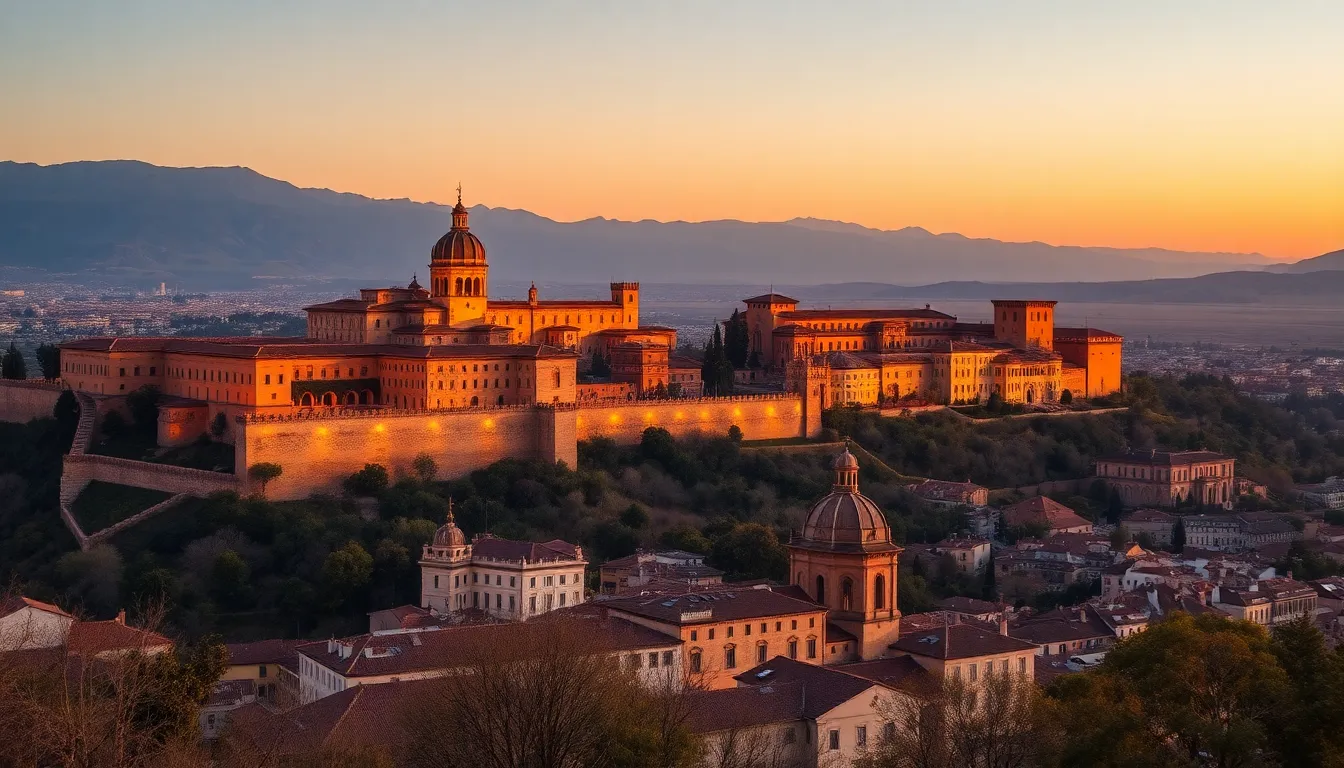
I have stood with groups inside the Alhambra many times, and I have learned to slow down before we go in. Most people arrive expecting a beautiful palace, and they are right. The Alhambra is one of the most beautiful buildings human beings have ever made. But for a heritage group, the beauty is not the whole story. This is the place where the medieval world of Spain ended and where, in the same season, two of the hardest decisions in Jewish and Spanish history were set in motion. If you walk in knowing that, you see the rooms differently.
So before your group steps through the gate, let me tell you what these walls hold.
What the Alhambra Actually Is
The Alhambra is a fortified palace city built on a hill above Granada by the Nasrid dynasty, the last Muslim rulers of Spain. Most of what you see today went up in the 13th and 14th centuries. The name comes from the Arabic for “the red one,” after the color of the walls in the late light.
It is not one building. It is a walled complex of palaces, courtyards, gardens, baths, and a fortress called the Alcazaba. The Palace of the Lions, with its slim columns and the famous fountain ringed by carved lions, is the part most people picture. The Court of the Myrtles, with its long still pool, is the part that stays with most of my travelers. Every surface that can be carved is carved. The walls are covered in geometric tile, in Arabic calligraphy, in plaster worked so finely it looks like lace.
The Nasrid kingdom of Granada was the last piece of Al-Andalus, the Muslim Spain that had lasted nearly eight hundred years. By the late 1400s it was an island. The Christian kingdoms of Castile and Aragon had taken everything else. Granada held on, paying tribute, until it could not.
Why 1492 Happened Here
This is the part I make sure my groups understand before anything else.
In January 1492, after a long siege, the last Nasrid ruler, Muhammad XII, known to history as Boabdil, surrendered Granada to Ferdinand and Isabella, the Catholic Monarchs. He handed over the keys to the city. The terms of that surrender, the Capitulations of Granada, were agreed and the monarchs took possession of the Alhambra itself. The reconquest of Spain, a process of nearly eight centuries, was finished in these rooms.
That alone makes the Alhambra one of the most consequential places in European history. But 1492 was not finished.
On March 31 of that same year, from Granada, Ferdinand and Isabella signed the Alhambra Decree, also called the Edict of Expulsion. It ordered every Jew in their kingdoms to convert to Christianity or leave Spanish soil by the end of July. Communities that had lived in Spain for well over a thousand years were given four months to go. Tens of thousands left, scattering across North Africa, the Ottoman lands, Italy, and beyond. Tens of thousands more converted under pressure and lived for generations under suspicion. The Sephardic world, the Spain of the Jews, ended with a signature in this place.
And in that same year, with the war over and the treasury freed, the monarchs funded a voyage by a Genoese sailor named Columbus. One year. One palace. Three events that remade the map of the world.
How to Read This With a Group
I am careful here, and I would ask you to be careful too. The Alhambra is a Muslim masterpiece that became a Christian trophy, and it is the address on a decree that uprooted the Jewish people from Spain. A heritage group can hold all of that at once, but only if the leader names it plainly rather than rushing past it.
For a Jewish group, the Court of the Myrtles is a place to stop and sit. The expulsion order did not come from a distant capital. It came from here, in the flush of victory, in a building of staggering beauty. The contrast is the lesson. I do not give a speech. I usually read the date, name what was signed, and let the silence do its work. Rabbis I have traveled with have used that pause for a kaddish, for a psalm, for nothing but quiet. All of it has felt right.
For a Christian group, the Alhambra raises honest questions about how faith and power were braided together in 1492, and what the church was willing to do with the authority it had won. Pastors I work with have found it a strong and unflinching place to talk about that history rather than around it.
For everyone, there is the simple human fact of a civilization that built this and then lost it. The Nasrids who carved these walls were gone within a lifetime of finishing them.
Visiting the Alhambra as a Group
Practical truth first: the Alhambra is one of the most tightly controlled major sites in Spain, and you cannot just turn up. Daily visitor numbers are capped, and the Nasrid Palaces, the heart of the visit, require a timed entry ticket for a specific half-hour slot. You must arrive in that window or you lose it. Tickets routinely sell out weeks ahead in spring and fall.
For groups this means booking well in advance and committing to a fixed time. We handle the timed slots and the group entry so your leader is not standing at a kiosk managing a wall of QR codes for forty people. A licensed local guide is worth it here, both for the depth and because the route through the complex is long and easy to lose people in.
Plan for three hours minimum on the grounds, more if your group likes to linger, and they will. There is real walking, much of it on uneven historic stone and some of it uphill, so it is worth flagging to anyone in the group who needs to pace themselves. The Generalife gardens above the palaces are gentle and a good place to regroup. Mornings are cooler and a little quieter than afternoons.
The Alhambra pairs naturally with the rest of Granada and with the wider Andalusian heritage route, including Cordoba and the quieter Jewish sites of the south. It is rarely a destination on its own for a heritage group. It is the hinge the whole story turns on.
FAQ: Visiting the Alhambra With a Heritage Group
Why is the Alhambra important to Jewish history?
The Alhambra Decree, the 1492 order expelling the Jews from Spain, was signed by Ferdinand and Isabella from Granada in the months after they took the Alhambra. The palace is therefore directly tied to the end of Sephardic Jewish life in Spain. For many Jewish groups, standing where that decree was issued is one of the most charged moments of an entire Spain itinerary.
What happened at the Alhambra in 1492?
Three things converged on Granada in 1492. In January the last Muslim ruler surrendered the city and the Alhambra to the Catholic Monarchs, ending nearly eight centuries of Muslim rule in Spain. In March the monarchs signed the decree expelling the Jews. And in the same year they funded Columbus’s first voyage. Granada sat at the center of all three.
Do groups need tickets in advance for the Alhambra?
Yes, and this is not optional. The Alhambra caps daily visitors, and entry to the Nasrid Palaces is by timed slot. Tickets sell out weeks ahead in peak seasons. Groups should book far in advance and arrive within their assigned window. We arrange the timed group entry so your travelers do not risk losing their slot.
How much time should a group plan for the Alhambra?
Plan for at least three hours on the grounds, and more if your group likes to take its time. The complex is large, with the Alcazaba fortress, the Nasrid Palaces, and the Generalife gardens all worth seeing. There is significant walking on uneven historic stone, so build in pacing for anyone who needs it.
Is the Alhambra appropriate for both Jewish and Christian groups?
Yes, and it speaks to each in a different register. For Jewish groups it is the site of the expulsion decree. For Christian groups it raises honest questions about faith and power in 1492. For all groups it is the place where medieval Spain ended. A good leader names the hard history plainly, which is what makes the visit meaningful rather than just scenic.
The Alhambra is one of those places where beauty and grief sit in the same room, and a heritage group is exactly the kind of group equipped to hold both. If you are building a Spain journey and want Granada read with that honesty, I would be glad to help you shape it. You can see our Spain heritage tours, look at how our group journeys work, or read more on Spain’s hidden heritage sites, the Sephardic Museum of Toledo, and the Jewish history museum in Girona.
Contact us when you are ready to start planning.