Why the Lesser-Known Sites Often Hit Harder
Every group leader I work with knows about Toledo. Most have heard of Cordoba’s synagogue and the Alhambra. These are extraordinary places, and they deserve the attention they get. But after twenty years of building heritage itineraries in Spain, I have noticed something: it is often the quieter sites, the ones that do not appear in standard guidebooks, that stay with people the longest.
There is a reason for that. When you stand in a place that most tourists walk past, there is space. Space to reflect, space to ask questions, space for your group to have the kind of conversation that simply cannot happen when you are shoulder to shoulder with three hundred other visitors. The famous sites tell the story. The hidden ones let you feel it.
If you have already taken your community to Toledo, or if you are planning a trip that goes deeper than the standard route, these are the places I would point you toward.
Girona’s Call: Spain’s Best-Preserved Jewish Quarter
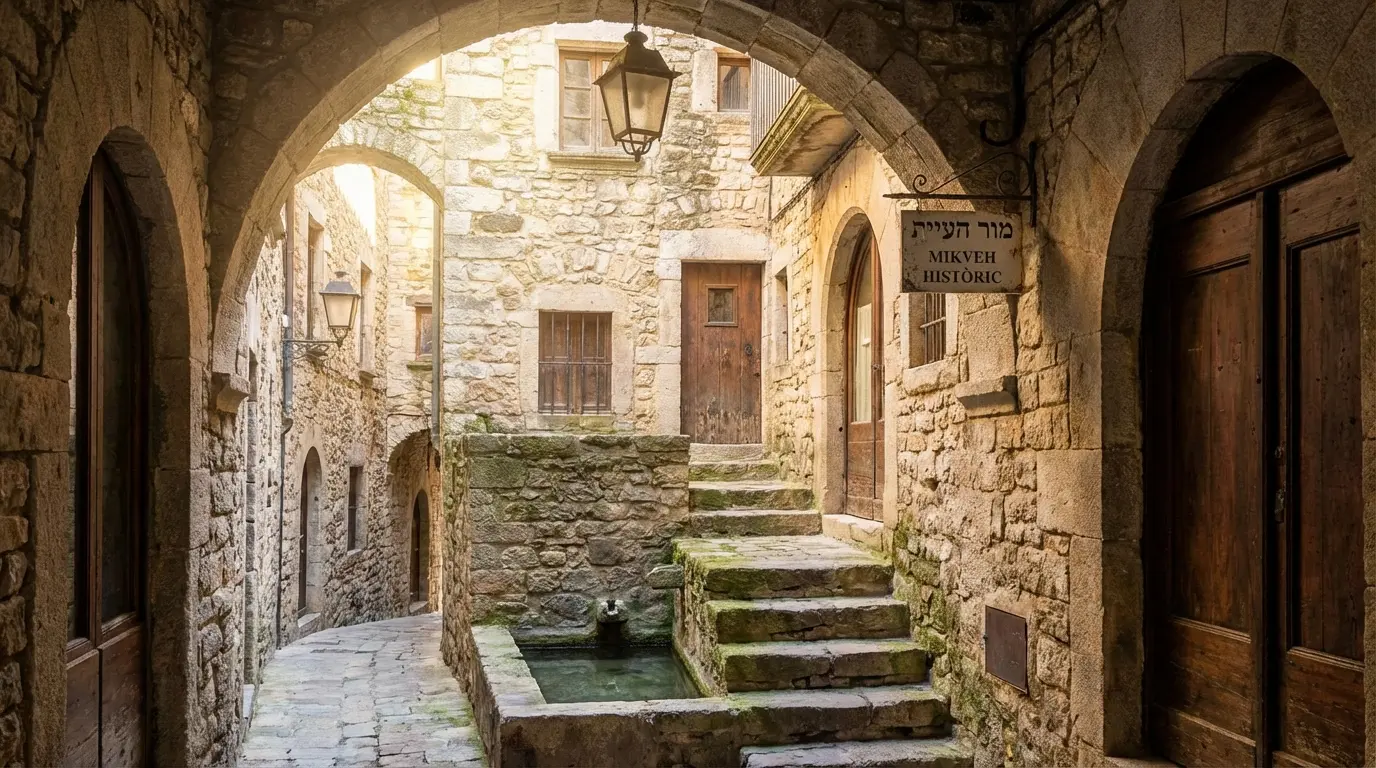
Girona’s Jewish quarter, known as El Call, is one of the finest preserved in all of Europe, and yet most group tours to Spain never include it. The narrow stone streets wind through what was once a thriving Jewish community that lived here for over six hundred years, from the late 9th century until the expulsion of 1492.
What makes Girona different from Toledo is the scale. The Call is intimate. You can walk its lanes in an hour, but you will want much longer. The Museum of Jewish History, housed in the old synagogue area, does remarkable work connecting the physical space to the people who lived in it. There are medieval ritual baths, stone carvings with Hebrew inscriptions, and doorways that have not changed in seven centuries.
For a rabbi bringing a group, Girona offers something Toledo sometimes cannot: quiet. The Call is not overrun. Your group can stand in these lanes and talk without competing with crowds. That matters more than most itineraries account for.
Besalu: A Medieval Jewish Mikveh That Survived the Expulsion
About thirty minutes north of Girona sits Besalu, a small medieval town with a fortified bridge that looks like it belongs in a painting. Beneath the town, discovered only in 1964, is a 12th-century mikveh, a Jewish ritual bath carved directly into the rock.
This is one of the very few medieval mikvehs still intact in Western Europe. It survived because it was underground and forgotten, buried beneath layers of later construction for over four hundred years. When it was finally uncovered, the stone steps leading down to the water were still there. The vaulted ceiling was still standing.
Visiting requires advance arrangement, which is part of what makes it meaningful. This is not a site you stumble into. It is a place you choose to visit because you understand what it represents: the daily spiritual life of a community that was erased from this town but not from history. Heritage Tours coordinates access for groups, so you do not need to navigate the local booking process yourself.
Lucena: The City That Was Once Majority Jewish
Most people have never heard of Lucena, and that is exactly why it belongs on this list. Located in Andalusia, about an hour south of Cordoba, Lucena was known in the medieval period as the “Pearl of Sepharad.” For a time, it was one of the only cities in Spain with a majority Jewish population.
Lucena was a center of Talmudic study and Jewish intellectual life. Scholars came from across the Mediterranean to study here. The city’s importance to Sephardic history is enormous, yet it receives a fraction of the visitors that Toledo or Cordoba do.
Today, Lucena has a small but thoughtful Jewish heritage center and an archaeological site that includes a medieval Jewish necropolis. The cemetery, discovered in 2006, contained over 340 tombs dating back to the 10th through 12th centuries. For a group that wants to understand the depth of Jewish life in Spain beyond the famous cities, Lucena is essential.
Medina Azahara: The Palace That Reveals Al-Andalus at Its Peak
Just outside Cordoba, the ruins of Medina Azahara spread across a hillside. This was the palace city built by Caliph Abd al-Rahman III in the 10th century, intended to be the administrative capital of Al-Andalus. At its height, it was one of the most magnificent complexes in the known world. It lasted less than a century before being sacked and abandoned.
What makes Medina Azahara important for heritage groups is what it represents. This was Al-Andalus at its most ambitious, a place where Muslim, Jewish, and Christian scholars and artisans all contributed to a shared civilization. The carved stone panels, the reconstructed reception hall, and the sheer scale of the ruins make the abstract idea of convivencia feel concrete.
The site earned UNESCO World Heritage status in 2018, but it still sees far fewer visitors than the Alhambra. That makes it ideal for groups. You can walk through the ruins at your own pace, with enough quiet to actually discuss what you are seeing.
Trujillo and the Extremadura Region: Where Conversos Sailed to the Americas
Trujillo, in the western region of Extremadura, is known in Spanish history as the birthplace of conquistadors. Pizarro, who conquered Peru, was born here. But there is a deeper story that most guides skip entirely.
After the 1492 expulsion, many Jews who converted to Christianity, known as conversos, settled in Extremadura. Some of them eventually sailed to the Americas, carrying their hidden faith with them. The connection between Spain’s expulsion, the converso experience, and the early settlement of Latin America is one of the most fascinating threads in Sephardic history.
Trujillo itself is a beautiful medieval town with a castle, a main plaza, and architecture that has barely changed in five hundred years. For groups interested in the converso story, or in understanding how the expulsion rippled outward across continents, Extremadura adds a dimension that the more famous cities cannot.
FAQ: Planning a Spain Heritage Tour Beyond the Famous Sites
What is Girona’s Jewish quarter and why is it significant?
Girona’s Call is one of the best-preserved medieval Jewish quarters in Europe. Jewish communities lived here for over six hundred years. The narrow stone streets, Hebrew inscriptions, and the Museum of Jewish History make it a deeply moving site for groups. It is far less crowded than Toledo, which allows for more reflection and group conversation.
Are there heritage sites in Spain related to the 1492 expulsion?
Yes, many. Besalu’s underground mikveh survived because it was buried and forgotten after the expulsion. Lucena’s Jewish necropolis dates to the centuries before it. Trujillo and the Extremadura region reveal the converso story, the Jews who converted under pressure and later sailed to the Americas. These sites bring the human cost of the expulsion into sharp focus.
Can group tours visit sites that are not open to the general public?
Some sites, like Besalu’s mikveh, require advance coordination and are not always accessible to walk-in visitors. Heritage Tours works with local operators who can arrange access for groups. This is one of the reasons working with a heritage-focused operator matters. We know which doors to open and how far ahead to arrange it.
What is the Sephardic citizenship law in Spain?
In 2015, Spain passed a law offering citizenship to descendants of Sephardic Jews expelled in 1492. The application window has closed for new applicants, but the law itself is historically significant. It represents an official acknowledgment by Spain of what happened. Several heritage sites now reference this law in their exhibits, particularly in Toledo and Girona.
How do I plan a heritage tour that goes beyond the main tourist sites?
Start by telling your tour operator what your group already knows and what they want to explore further. If your community has already visited Toledo, say so. A good heritage operator will build an itinerary around the deeper sites, places like Girona, Besalu, Lucena, and Medina Azahara, that reward curiosity and offer space for group reflection. See our Spain heritage tour options or reach out to start a conversation.