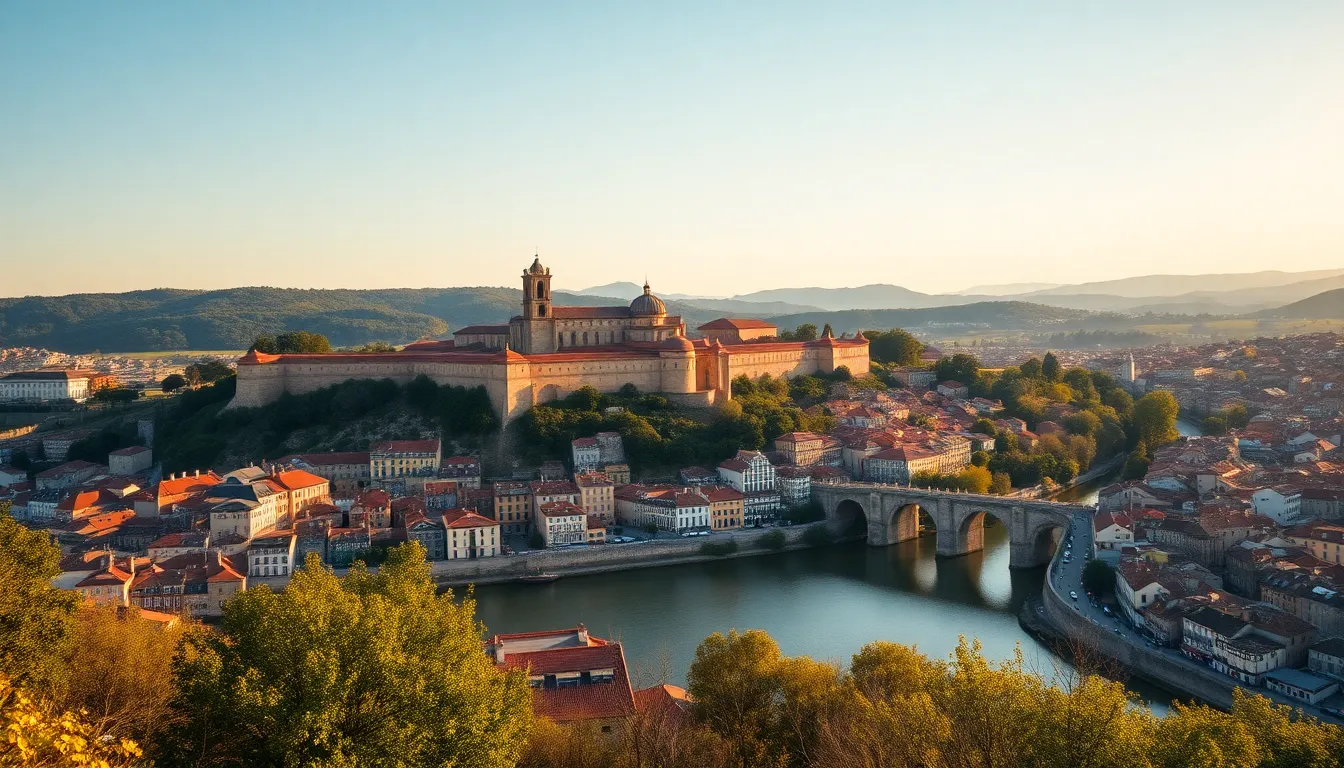
Coimbra is the city groups underestimate until they are standing in it. On a map it looks like a convenient stop between the Lisbon area and the northern interior, and that is how a lot of itineraries treat it. Then you climb the hill to the old university, stand in a library that has barely changed in three hundred years, and realize Coimbra is not a waypoint. It is one of the oldest centers of learning and faith in Europe, and it carries a Jewish heritage layer most visitors never hear about.
I think of Coimbra as the bridge city of a Portugal trip, the natural hinge between the coast and the interior, between the great Christian monuments and the hidden Jewish towns. Used well, it gives a group both a magnificent set of sites and a moment to draw the whole story together. Let me walk you through it.
For the national picture, start with our Portugal heritage travel guide. This guide stays in Coimbra.
The University of Coimbra: Faith and Learning
The University of Coimbra is one of the oldest universities in the world in continuous operation, founded in the late thirteenth century. For most of its history it was the only university in Portugal, the place that trained the country’s clergy, jurists, physicians, and scholars. Its hilltop campus is a UNESCO World Heritage Site, and walking it you feel the weight of seven centuries of European learning.
The centerpiece is the Joanina Library, an eighteenth-century Baroque hall of gilded wood and painted ceilings that ranks among the most beautiful libraries on earth. Nearby, the ornate university chapel reminds you that this was an institution where faith and scholarship were inseparable for most of its life.
For Christian groups, the university tells a particular story: the long marriage of the church and the life of the mind in Catholic Europe. For any group, it is simply a place that makes people fall quiet. I give it a proper visit, not a rushed one, because the library and the old halls reward time.
There is a harder layer here too, and a good guide names it. Coimbra was also a center of the Inquisition’s intellectual machinery, the place where doctrine was taught and enforced. The same institution that produced extraordinary learning also helped power the persecution that destroyed Portugal’s Jewish community. Holding both truths is part of reading Coimbra honestly.
The Two Cathedrals
Coimbra has two cathedrals, the Old and the New, and the contrast between them tells the city’s Christian story.
The Old Cathedral, the Se Velha, is one of the finest Romanesque buildings in Portugal, built in the twelfth century shortly after the Christian reconquest. Like the cathedrals of Lisbon and Porto, it has the heavy, fortress-like character of its age, a church built to stand against an enemy. It is austere and powerful, and for many of my travelers it is the more moving of the two, precisely because of that restraint.
The New Cathedral, the Se Nova, came centuries later, a Baroque building originally constructed for the Jesuits. The two cathedrals, a few minutes apart, let a group read the change in Portuguese Catholicism across five hundred years: from the stark certainty of the reconquest to the elaborate confidence of the Counter-Reformation. Walking from one to the other is a small lesson in church history written in stone. Our Coimbra cathedrals guide covers both in detail.
The Old Jewish Quarter
Here is the layer the guidebooks skip. Coimbra had a significant medieval Jewish community, with its quarter, the Judiaria, in the streets of the old lower town between the university hill and the river. Jewish scholars, physicians, and merchants were part of Coimbra’s life for centuries before 1497.
As in Lisbon, you will not find a preserved quarter behind glass. You will find the shape of the medieval streets and the knowledge, carried by a good guide, of where the community lived and where its synagogue likely stood. The forced conversion of 1497 ended open Jewish life here as it did across Portugal, and many converso families remained, blending into the city while some kept the old practices in secret.
What gives Coimbra’s Jewish layer particular meaning is its proximity to the interior. From Coimbra, you are at the doorstep of the highland towns, Guarda, Trancoso, Belmonte, where crypto-Jewish life survived for five hundred years. Standing in Coimbra’s old quarter and then driving up into the Beira Interior, you trace the path of a community pushed from the centers of power into the remote hills. Our Belmonte and Beira Interior guide picks up exactly where Coimbra leaves off, and the Jewish heritage of Portugal guide sets the wider frame.
Reading Coimbra as a Whole
What I want group leaders to see is that Coimbra holds the entire Portuguese story in one compact city. The university embodies the church’s intellectual power, for good and for ill. The two cathedrals trace the arc of Portuguese Catholicism. The old Jewish quarter marks the community that lived here and was erased, and the road to the interior shows where its descendants kept the faith alive.
That completeness is why I treat Coimbra as more than a lunch stop. Used thoughtfully, it is the place where a group can pause and see how the threads of the trip connect: Christian and Jewish, learning and faith, glory and persecution, all in a single afternoon’s walk.
How to Visit Coimbra with a Group
Coimbra sits roughly halfway up the country and works beautifully as a connecting stop between the Lisbon-Fatima-Tomar cluster and the northern interior or Porto.
I usually give it a half day to a full day. A focused visit covers the university and the Joanina Library in the morning, the two cathedrals and the old quarter in the afternoon. If the group wants more time on either the university or the Jewish layer, a full day is comfortable.
A few practical notes. Coimbra is built on a steep hill, with the university at the top and the old town and Jewish quarter below, so plan for climbing and uneven streets with mixed-age groups; the coach can handle the steepest stretches. The Joanina Library limits how many people enter at once and often requires timed entry, so group visits need advance booking. And because Coimbra is a working university city, the rhythm of the academic year affects how busy it feels.
For groups of fifteen or more, the group leader travels free with Heritage Tours. With Coimbra usually sitting inside a fuller Portugal route, that threshold is easy to reach. You can see how the regions connect in our 9-day Portugal heritage itinerary and on the Portugal destination page.
FAQ: Coimbra Heritage Travel
Why is the University of Coimbra significant?
It is one of the oldest universities in the world in continuous operation, founded in the late thirteenth century, and for most of Portugal’s history it was the country’s only university. Its hilltop campus is a UNESCO World Heritage Site, and its Joanina Library is among the most beautiful in the world. For faith groups, it embodies the long union of the church and learning in Catholic Europe, including the harder history of the Inquisition’s intellectual role.
What are the two cathedrals of Coimbra?
The Old Cathedral, the Se Velha, is a twelfth-century Romanesque building, austere and fortress-like, dating from just after the Christian reconquest. The New Cathedral, the Se Nova, is a later Baroque church originally built for the Jesuits. The two, minutes apart, let a group read the change in Portuguese Catholicism from the reconquest to the Counter-Reformation.
Did Coimbra have a Jewish community?
Yes. Coimbra had a significant medieval Jewish community, with its quarter in the streets of the old lower town between the university hill and the river. Jewish scholars, physicians, and merchants were part of the city for centuries before the forced conversion of 1497 ended open Jewish life. Today the quarter survives in the shape of the streets rather than as a preserved site, so a knowledgeable guide is needed to surface it.
How does Coimbra connect to the rest of a Portugal trip?
Coimbra sits roughly halfway up the country and is the natural hinge between the Lisbon-Fatima-Tomar cluster and the northern interior or Porto. Its old Jewish quarter also connects directly to the highland crypto-Jewish towns of Guarda, Trancoso, and Belmonte, which lie just inland, so it works well as a bridge between the coastal and interior legs of a route.
How long should a faith group spend in Coimbra?
A half day to a full day. A focused visit covers the university and Joanina Library in the morning and the two cathedrals and old quarter in the afternoon. The Joanina Library limits entry and often requires timed, advance-booked tickets for groups, so plan that ahead.
Coimbra rewards the groups that give it real time rather than treating it as a stop on the way to somewhere else. If you want a Portugal route where the whole story comes together in one city, Coimbra is where I would build that moment. I would be glad to help you place it well.
Contact us when you are ready to start planning.