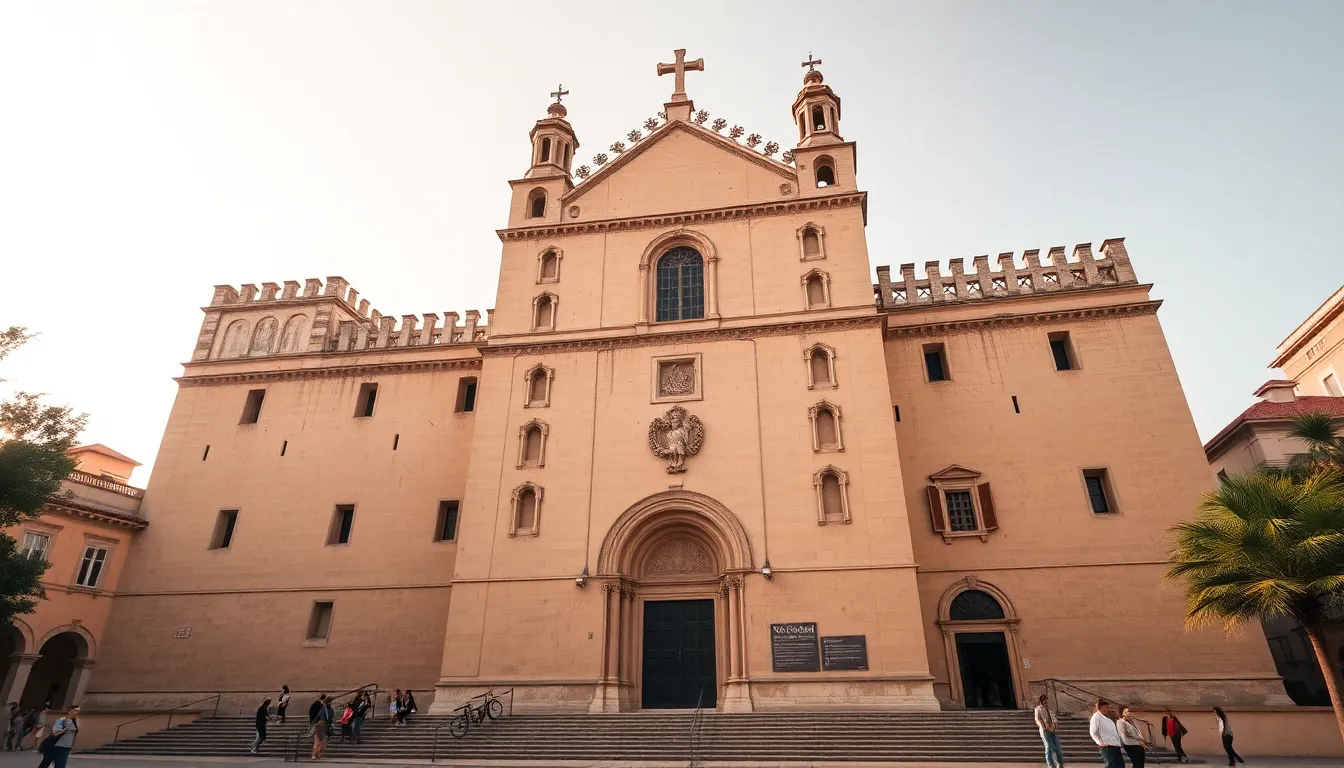
Groups arrive in Coimbra expecting a university town, and they get one, the oldest in Portugal and one of the oldest in the world. What surprises them is the faith history layered underneath it. This is the city where Saint Anthony studied before he became a Franciscan, where a queen who became a saint chose to be buried, and where two very different cathedrals stand within a short walk of each other, telling the story of how Portuguese worship changed across five hundred years. Coimbra is not just a stop between Lisbon and Porto. For a faith group it is a destination in its own right.
Let me give you the two cathedrals, the saints, and the city, in the order I would walk them with a group.
A City Built on a Hill, and on Faith
Coimbra rises steeply from the Mondego River, and its history climbs with it. For a time in the twelfth century it served as the capital of the young Kingdom of Portugal, before Lisbon took that role. The first kings of Portugal are tied to this city, and so is the university, founded in 1290, which has shaped the religious and intellectual life of the country for more than seven centuries. To walk Coimbra is to walk through layers: Roman foundations, a Romanesque cathedral, a medieval university, a baroque library, and the living student traditions that still fill the streets at night with the mournful sound of Coimbra fado.
For a faith group, the through-line is education and devotion intertwined. This was a place where young men came to study theology and scripture, and several of them became saints. Anthony of Lisbon studied here before joining the Franciscans. That connection alone makes Coimbra meaningful for any group following his footsteps.
The Se Velha: The Old Cathedral
The first cathedral I take a group to is the Se Velha, the Old Cathedral, and it does not look like a cathedral at first. It looks like a fortress, and that is exactly what it was meant to convey.
Built in the twelfth century, begun around 1140 during the reign of Afonso Henriques, the first king of Portugal, the Se Velha went up while the Christian reconquest of the peninsula was still underway. The Moorish frontier was not far. So the builders gave it thick stone walls, narrow windows, and battlements along the top, a church that could double as a stronghold. It is one of the most important and best-preserved Romanesque buildings in Portugal, and almost nothing about it has been softened over the centuries.
Inside, the Romanesque austerity holds. The nave is solid and dim, the arches heavy and round, the decoration restrained. There is a magnificent gilded altarpiece, a later Gothic and Flamboyant work that catches the eye against all that bare stone. The cloister, added in the early thirteenth century, is one of the earliest Gothic cloisters in the country and a quiet, beautiful place to gather a group.
I tell groups to feel the difference between this and the cathedrals they have seen elsewhere. The Se Velha was built by a kingdom still fighting for its existence, a church and a fort in one, faith and survival in the same walls. That tension is something your people can stand inside.
The Se Nova: The New Cathedral
A short uphill walk brings you to the Se Nova, the New Cathedral, and the contrast could hardly be sharper. Where the Se Velha is a Romanesque fortress, the Se Nova is an expansive baroque church, begun in 1598 for the Jesuits.
The Jesuits, the Society of Jesus, were the great teaching and missionary order of the Counter-Reformation, and their church reflects their confidence and their commitment to education. The facade is grand and ornate, the interior wide and bright, the high altar elaborately gilded. In 1772, the cathedral seat was officially transferred here from the old cathedral, which is how the two came to share the names Old and New.
Walking a group from the Se Velha to the Se Nova in twenty minutes is one of the most useful things you can do in Coimbra, because it puts five hundred years of changing Catholic spirituality in front of them as a single walk. The fortress church of a kingdom fighting for survival, and the confident teaching church of the Counter-Reformation, stand within sight of each other on the same hill. You do not have to explain the history in a lecture. You can walk it.
The Saints of Coimbra
Two saints give Coimbra special weight for a faith group.
The first is Anthony of Lisbon. Before he was a Franciscan, before Padua, he was an Augustinian canon studying at the Monastery of Santa Cruz here in Coimbra, where he gained the deep grounding in scripture that later made him one of the great preachers of the Middle Ages. It was here, too, that the relics of the Franciscan martyrs arrived and set his life on a new course. For groups following his story, Coimbra is an essential chapter.
The second is Queen Saint Isabel, Isabel of Aragon, queen of Portugal and one of the country’s most beloved saints. Known for her charity to the poor and her work as a peacemaker, she became a Franciscan tertiary in her widowhood and chose Coimbra as the place of her devotion and burial. Her body rests in the city, and she is the patron saint of Coimbra. Her tomb and the convent associated with her are meaningful stops, especially for groups drawn to women of faith in Christian history.
The University and the Living City
No visit to Coimbra is complete without the university on the hilltop, and within it the Biblioteca Joanina, the baroque library, one of the most beautiful libraries in the world. Its gilded halls held theological and scholarly works, and the building includes a chapel, a reminder that learning and worship were never separated here. The university’s chapel, the Capela de Sao Miguel, with its painted ceiling and great organ, is worth seeing on its own.
Then there is the living city. In the evening, Coimbra fado drifts out of small venues in the old town, a distinct, melancholy student tradition sung by men, different from the Lisbon fado most visitors know. It is not religious music, but it carries something of the city’s soul, and a group that ends a day with it leaves Coimbra understanding the place far better than the monuments alone would teach them.
Where Coimbra Fits on Your Itinerary
Coimbra sits almost exactly halfway between Lisbon and Porto, which makes it a natural and rewarding stop on a north-south route through Portugal. For groups walking the Camino Portugues toward Santiago, it is one of the historic gathering points on the way north. And for any group following Saint Anthony’s footsteps, it is the chapter between his Lisbon birthplace and his Franciscan calling. I rarely build a full Portugal itinerary that skips it.
FAQ: Coimbra and Its Cathedrals
What is the difference between the Se Velha and the Se Nova in Coimbra?
The Se Velha, or Old Cathedral, is a twelfth-century Romanesque church built like a fortress during the Christian reconquest, with thick walls and battlements. The Se Nova, or New Cathedral, is a grand baroque church begun in 1598 for the Jesuits. The cathedral seat moved from the old to the new in 1772, which is how they got their names. Walking between the two shows you five hundred years of changing Catholic architecture and spirituality on a single hill.
Why does Coimbra have two cathedrals?
Coimbra has two cathedrals because the seat of the diocese was transferred in 1772 from the old Romanesque cathedral to the newer Jesuit church on the hill above it. Rather than demolish the old one, the city kept both, and they are now distinguished as the Se Velha, the Old Cathedral, and the Se Nova, the New Cathedral. Both remain open and are easily visited together on a short walk.
What is Coimbra’s connection to Saint Anthony?
Before he became the famous Franciscan preacher known as Saint Anthony of Padua, he studied in Coimbra as an Augustinian canon at the Monastery of Santa Cruz, where he received his deep theological education. It was in Coimbra that the relics of Franciscan martyrs arrived and inspired him to leave the Augustinians and join the Franciscans. For groups following his story, Coimbra is an essential stop between his Lisbon birthplace and his later life.
Who is the patron saint of Coimbra?
The patron saint of Coimbra is Queen Saint Isabel, Isabel of Aragon, a queen of Portugal known for her charity and peacemaking who became a Franciscan tertiary in her widowhood. She chose Coimbra for her devotion and her burial, and her tomb rests in the city. She is one of Portugal’s most beloved saints and a meaningful stop for groups drawn to women of faith in Christian history.
Is Coimbra worth a stop for a faith group?
Yes. Beyond its two cathedrals, Coimbra offers the oldest university in Portugal with its baroque library and chapel, the connection to Saint Anthony, and the tomb of Queen Saint Isabel. It sits roughly halfway between Lisbon and Porto, making it an efficient and rich stop on a north-south route, and it is a historic gathering point for pilgrims heading north toward Santiago. Most full Portugal itineraries include it.
If you are planning a route through Portugal, Coimbra deserves more than a quick lunch stop. The two cathedrals, the saints, and the university city give a faith group a full and layered day. It connects naturally to the Saint Anthony route and to the Camino north toward Santiago. You can see how it fits the wider journey on our spiritual sites in Portugal guide and our Portugal destination page.
We design these itineraries around groups, and through our group heritage tours the group leader travels free with fifteen or more participants. Contact us when you are ready to start planning.