1497: The Expulsion That Changed Everything
To understand Jewish Portugal, you have to start with what happened in 1497. And to understand 1497, you have to understand that it was not the same as Spain’s expulsion of 1492, even though the two events are often mentioned in the same breath.
In Spain, Jews were given a choice: convert or leave. Roughly 100,000 chose to leave, and many of them crossed the border into Portugal, where King Joao II allowed them to settle in exchange for a fee. For a few years, Portugal became a refuge.
Then King Manuel I came to power. Under pressure from Spain, whose monarchs demanded the expulsion of Jews as a condition of a royal marriage alliance, Manuel ordered all Jews in Portugal to convert or depart. But he went further than Spain had. He closed the ports. He ordered that Jewish children be taken from their parents and baptized. For most families, there was no way out.
What followed was not emigration. It was forced conversion on a national scale. Overnight, Portugal’s Jewish community officially ceased to exist. Unofficially, it went underground.
Belmonte: 500 Years of Secret Faith
In the mountains of the Portuguese interior, far from Lisbon and the watchful eyes of the Inquisition, something extraordinary happened. Jewish families in the town of Belmonte continued to practice their faith in secret. Not for a generation. Not for a century. For more than 500 years.
The practices they preserved were adapted to survive under constant threat. Shabbat candles were lit inside closed cupboards or behind shuttered windows so no light could be seen from the street. Passover was observed under the guise of a spring cleaning ritual. Yom Kippur fasting was explained away as illness. Prayers were passed from mother to daughter, spoken in whispered Portuguese because written Hebrew texts were far too dangerous to keep.
Over the centuries, the prayers changed. They mixed with Catholic forms. Some of the original Hebrew was lost and replaced with Portuguese equivalents. But the core held. The families knew who they were. They knew they were Jewish. And they kept it alive.
In the early 20th century, a mining engineer named Samuel Schwarz traveled to Belmonte and made contact with the community. What he found astonished the Jewish world: an intact crypto-Jewish community, still observing Shabbat, still fasting on Yom Kippur, still passing their identity from parent to child after 400 years of secrecy.
Today, Belmonte has a synagogue, a Jewish museum, and a small but openly practicing community. Some members are descendants of the original crypto-Jewish families who have formally returned to Judaism. When you visit, you are not looking at artifacts. You are meeting people whose families endured something almost beyond comprehension.
Tomar: The Synagogue That Survived the Inquisition
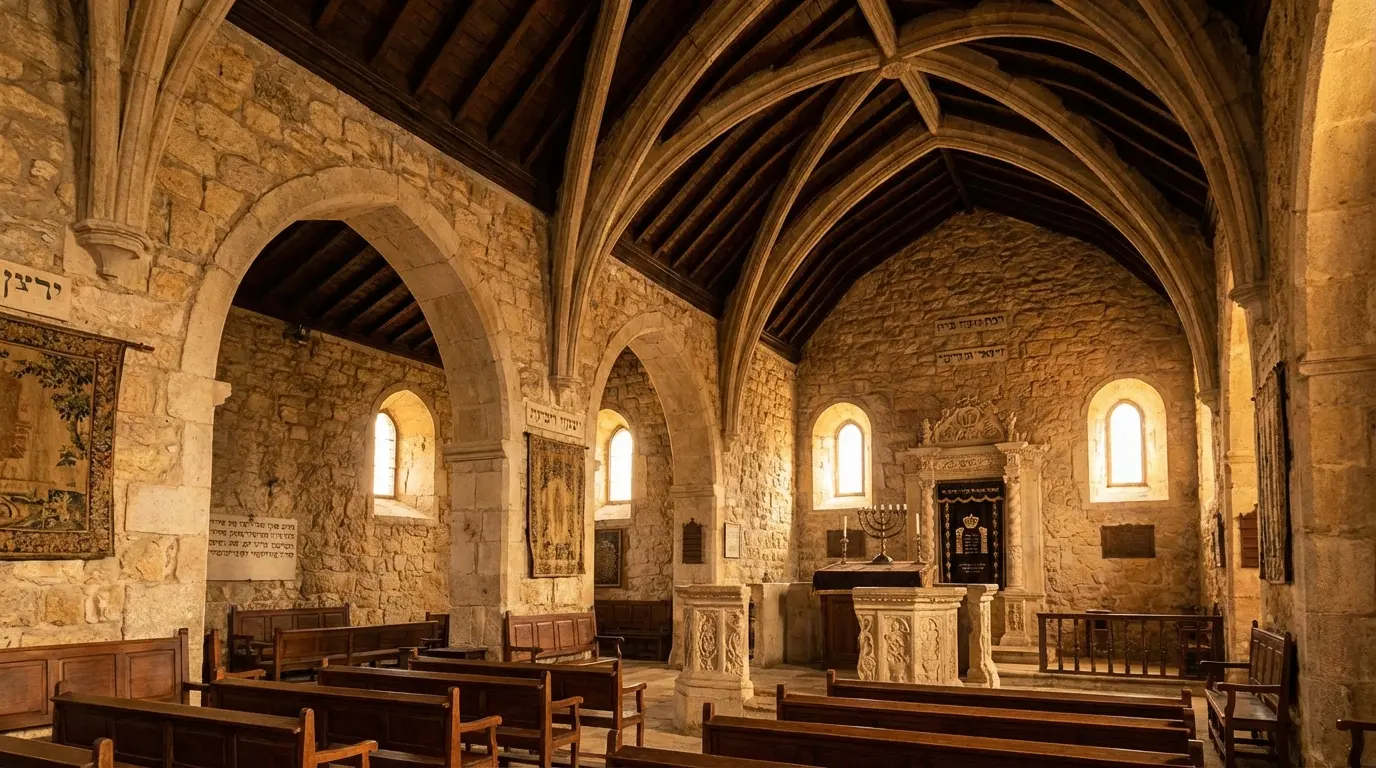
The synagogue in Tomar was built between 1430 and 1460, during the brief window when Jewish life in Portugal was still public. It is a modest building from the outside, sitting on a narrow street in the old town, easy to walk past if you do not know it is there.
Inside, four Gothic columns support the vaulted ceiling. The proportions are intimate, not grand. This was a community synagogue, a place where families gathered, not a monument. After the forced conversions of 1497, the building was seized and used as a prison, then a hay warehouse, then a chapel. Each use left its mark, but none destroyed the structure.
In the 20th century, the building was recognized for what it was. Today it houses the Abraham Zacuto Luso-Hebrew Museum, named after the Jewish astronomer whose navigational tables helped make Portugal’s maritime discoveries possible. The museum holds Hebrew inscriptions, Torah scroll fragments, and gravestones recovered from across Portugal.
Tomar’s synagogue is not just old. It is the only intact pre-expulsion synagogue still standing in Portugal. Every other one was destroyed, converted, or lost. That this one survived is its own kind of miracle.
Lisbon’s Alfama and the Memory of a Lost Community
Lisbon’s Jewish history is older than Portugal itself. Jewish communities were present in what is now Lisbon under Roman, Visigothic, and Moorish rule. By the medieval period, Lisbon’s Judiaria Grande, the great Jewish quarter, was one of the largest in the Iberian Peninsula, centered in what is now the Alfama neighborhood.
The 1497 conversions emptied the quarter. The great earthquake of 1755 destroyed much of what remained. Today, there are no standing synagogue buildings from the medieval period. What survives are traces: street names, building foundations uncovered by archaeologists, the outlines of a community that once numbered in the thousands.
Lisbon now has a modern Jewish community, centered around the Shaare Tikva synagogue, which was built in the 19th century and serves both Sephardic and Ashkenazi congregants. The Jewish Museum of Lisbon, opened in recent years, does thoughtful work connecting the medieval past to the present.
For a heritage group, Lisbon is where the story begins and where the scale of what was lost becomes clear. Walking through the Alfama with a guide who can point out the boundaries of the old Judiaria, where the synagogues stood, where the community lived and traded and worshipped, gives the rest of the trip its context.
Porto and the Sephardic Rescue Network of World War II
Porto’s Jewish story has a chapter that many visitors do not expect. During World War II, as Nazi Germany occupied France and threatened the Iberian Peninsula, Portugal became one of the last escape routes for Jewish refugees fleeing Europe.
At the center of this story is Aristides de Sousa Mendes, the Portuguese consul in Bordeaux, France. In June 1940, as the German army advanced, thousands of refugees crowded outside the consulate desperate for visas. The Portuguese government, under the Salazar dictatorship, had issued explicit orders: do not grant visas to refugees, especially Jews.
Sousa Mendes defied the order. Over three days, he signed thousands of visas, working around the clock, ignoring repeated instructions to stop. By the time the government recalled him, he had saved an estimated 30,000 lives, roughly 10,000 of them Jewish. He was stripped of his career, his pension, and his standing. He died in poverty. Portugal did not formally honor him until decades after his death.
The Kadoorie Mekor Haim Synagogue in Porto, the largest on the Iberian Peninsula, was completed in 1938, just before the war began. Its community today is small but active, and a visit there connects the Sephardic story of expulsion and survival to the broader history of Jewish rescue during the 20th century.
The Sephardic Citizenship Law: What It Means for Heritage Travelers
In 2015, Portugal passed a law that offered citizenship to descendants of Sephardic Jews expelled during the Inquisition. The law was an act of recognition, a formal acknowledgment of a historical wrong.
For heritage travelers, the practical implications are significant. If your family name appears on the lists of known Sephardic families, you may be eligible for Portuguese citizenship. Some travelers begin researching their genealogy before the trip. Others discover their connection while visiting Belmonte or Tomar and hearing family names read from historical records.
But the emotional dimension matters more than the legal one. For some Jewish travelers, this trip is a return. Their ancestors were forced to leave Portugal 500 years ago, and now the country is formally welcoming their descendants back. That is not a detail in a travel guide. That is the reason for the trip.
Whether or not you pursue citizenship, traveling to Portugal with this context changes what you see. The synagogues, the converso doorways, the hidden prayer traditions, all of it takes on a different weight when you know that Portugal has chosen to acknowledge what happened and to offer something back.
What a Jewish Heritage Tour of Portugal Looks Like Today
A thoughtful Jewish heritage itinerary in Portugal usually spans 8 to 10 days and moves from the cities to the interior. You might begin in Lisbon, exploring the Alfama and the site of the old Judiaria. From there, travel north to Tomar for the synagogue and the Convent of Christ. Continue into the interior to Belmonte, where the crypto-Jewish story comes alive. Visit Trancoso and Castelo de Vide for their converso neighborhoods. End in Porto, at the Kadoorie synagogue, with its story of wartime rescue.
What holds the trip together is not geography. It is the arc of a story that begins with a thriving community, moves through expulsion and secret survival, and arrives at recognition and return. That arc is what makes Portugal different from other heritage destinations.
Heritage Tours builds these itineraries with local guides who know the interior towns, who have relationships with the communities, and who understand what these sites mean to Jewish visitors. For groups of 15 or more, the group leader travels free. You can explore our Portugal destination page to see what a journey like this could look like for your community.
Frequently Asked Questions
What is the story of Belmonte’s crypto-Jews in Portugal?
After the forced conversions of 1497, Jewish families in Belmonte continued to practice their faith in secret. They lit Shabbat candles behind shuttered windows, observed Passover as a spring cleaning ritual, and passed prayers from mother to daughter in whispered Portuguese. This secret practice continued for more than 500 years until the community was rediscovered in the early 20th century. Today, Belmonte has an active Jewish community, a synagogue, and a museum dedicated to this history.
What is the Sephardic citizenship law in Portugal?
Portugal’s 2015 law offers citizenship to descendants of Sephardic Jews expelled during the Inquisition. It is a formal recognition of a historical injustice. Descendants of known Sephardic families can apply for Portuguese citizenship. For many Jewish heritage travelers, this law transforms the trip from a cultural visit into a personal return.
What is the Tomar synagogue?
Built between 1430 and 1460, the Tomar synagogue is the only intact pre-expulsion synagogue still standing in Portugal. After the forced conversions, it was repurposed as a prison, warehouse, and chapel. Today it houses the Abraham Zacuto Luso-Hebrew Museum. It is a small building with four Gothic columns and a vaulted ceiling, intimate in scale but enormous in historical significance.
What happened to Portugal’s Jews in 1497?
King Manuel I ordered all Jews in Portugal to convert to Christianity or leave. Unlike Spain’s expulsion five years earlier, Portugal closed its ports and forcibly baptized Jewish children. Most families had no option but to convert outwardly. Many continued to practice Judaism in secret, becoming known as crypto-Jews or conversos. This forced conversion effectively ended public Jewish life in Portugal for centuries.
How is Portugal’s Jewish expulsion different from Spain’s in 1492?
Spain’s 1492 decree gave Jews the choice to convert or leave, and roughly 100,000 chose emigration, many fleeing to Portugal. Portugal’s 1497 order was more coercive: the ports were closed, children were separated from parents and baptized, and the practical option of leaving was largely eliminated. This forced most Jewish families into conversion rather than exile, creating the crypto-Jewish communities that survived in secret for centuries afterward.