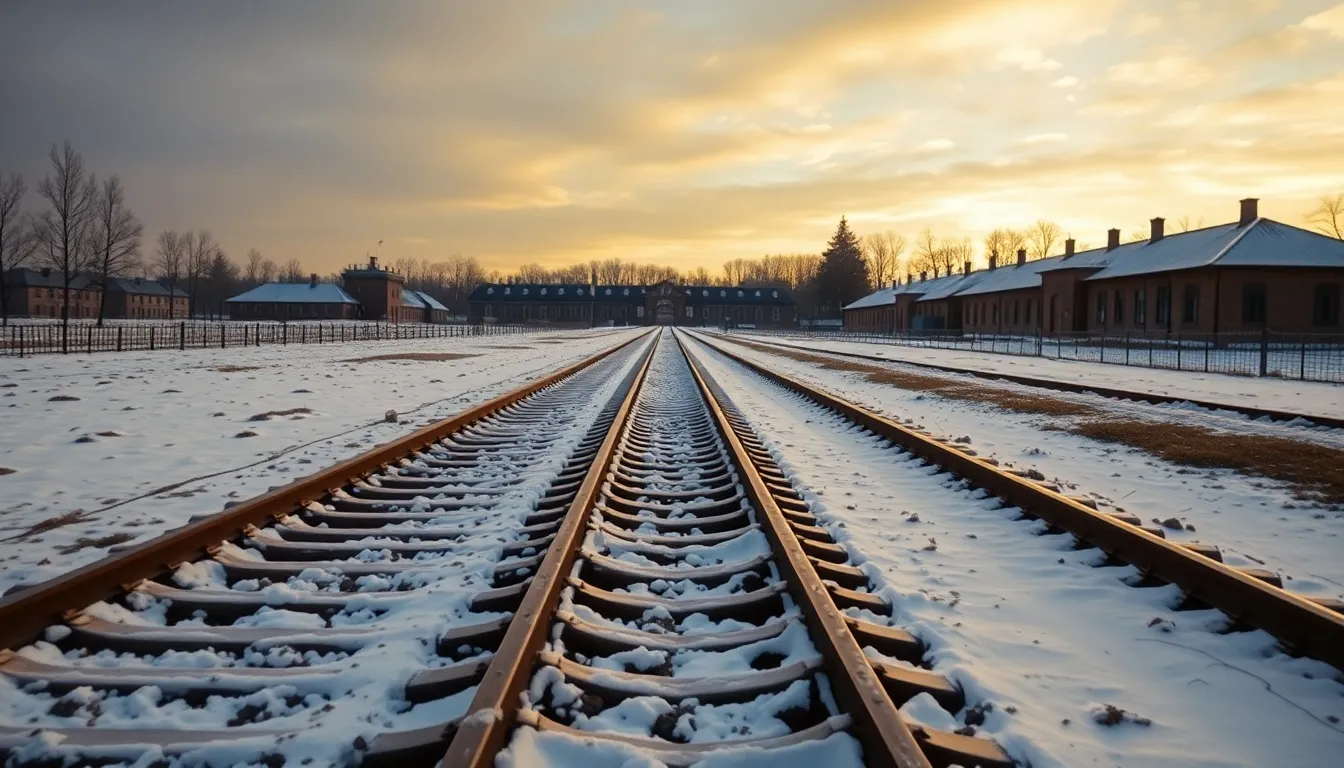
I will tell you about a January morning at Birkenau, because it is the honest way to begin this article. The temperature was several degrees below freezing. Snow lay over the rail tracks and across the open ground where the barracks once stood. The wind came across those fields with nothing to stop it, and within ten minutes every person in our group was cold in a way that no coat could fully solve. A man beside me, a teacher who had studied this history for thirty years, said quietly, “I have read everything. I never understood the cold.” That is what winter does at these sites. It collapses the distance between the visitor and the history.
Winter is the most demanding season for Poland heritage travel, and it is not the right choice for every community. Our season-by-season Poland guide lays out how it compares to spring and fall. This article is for the group leader who is seriously considering winter and needs the honest version: what the camp visits in snow actually ask of your people, what January 27 means, and how to decide whether your community is ready for it.
Who Winter Is For
Let me be clear at the start. Most groups should travel in spring or fall. Those windows are easier on the body, kinder on the schedule, and they let the history reach people without the added strain of the cold. If you have flexibility and no specific reason to choose winter, choose one of the other seasons.
But for certain groups, winter is exactly right. These tend to be communities that want the full emotional weight of the memorial sites with nothing softened. They are often groups that have studied this history deeply, or congregations whose members have asked specifically for the starkest, most unmediated experience. For them, the cold is not an obstacle. It is part of the testimony.
If that describes your community, read on. If it does not, I would gently steer you toward our spring or autumn guides instead.
What a Camp Visit in Winter Is Actually Like
I want to be honest about this, because the difference between Auschwitz in July and Auschwitz in January is not small.
At Auschwitz I, much of the experience is indoors, moving through the brick buildings that now hold the exhibitions. Winter is manageable here. You will be cold between buildings, but the visit is broken up by interior spaces.
Birkenau is the harder part. Birkenau is mostly open ground, and in winter that ground is frozen, often snow-covered, and fully exposed to the wind. There is little shelter and almost no respite from the cold. The walk from the entrance gate down the length of the camp to the ruins of the gas chambers is long, and in a hard winter it is genuinely punishing. The same is true of Treblinka, an open field of stones with nothing to break the weather.
Here is the thing I have watched happen, year after year. Many group members tell me afterward that the cold was the moment the place became real to them. They were cold, exposed, and uncomfortable, standing where people were held with almost nothing to protect them from that same cold. For a brief, imperfect moment, the body understands something the mind has only been reading about. Some people find this unbearable. Others find it is the most important hour of the entire journey. Both reactions are valid, and which one your community will have is something only you can judge.
January 27: International Holocaust Remembrance Day
There is one date that defines the winter calendar.
On January 27, 1945, Auschwitz-Birkenau was liberated. The United Nations later designated that date as International Holocaust Remembrance Day. Each year, the anniversary draws survivors, dignitaries, and community groups from around the world to Auschwitz for the official commemoration.
Some group leaders build their entire journey around this date. To be present at Auschwitz on January 27, among survivors and people who came from across the world for the same purpose, is an experience unlike any other on the calendar. The ceremony carries a gravity that no ordinary visiting day can match, and as the number of living survivors continues to shrink, the chance to stand with them on this date becomes more precious each year.
We can plan a journey around January 27, including access to the commemoration and complementary heritage site visits in the days before and after, when the surrounding sites are at their quietest. If this date matters to your community, it is worth raising early, because the period around it is the one busy stretch in an otherwise quiet season.
The Deep Quiet of the Off-Season
Set aside January 27, and winter offers something the rest of the year does not: near-total solitude at the sites.
From late November through February, Poland’s heritage sites are nearly empty of tourists. Your group may be the only visitors at Treblinka. At POLIN in Warsaw, you can move through the galleries at your own pace, without rushing. In Kazimierz, the streets are quiet, the cafes warm, and the sense of walking through a living historic neighborhood rather than a tourist district is strong. The Galicia Jewish Museum and the synagogues of Krakow’s old Jewish quarter feel different when you are not sharing them with hundreds of others.
For groups that value contemplation over convenience, this quiet is the whole point. It is the deepest the season has to offer, and no other time of year can match it.
What Winter Requires of You
The practical demands are real, and ignoring them turns a meaningful trip into a miserable one.
Dress seriously. This is not the season for fashion over function. Thermal base layers, a heavy insulated coat, a warm hat that covers the ears, gloves, a scarf, and genuinely warm, waterproof footwear are essential for every member. The outdoor sites are the test, and people who underpack will suffer through them rather than absorb them. We send every winter group a detailed packing list, and I ask leaders to take it seriously.
Plan for short days. Winter daylight in Poland is brief, with the sun setting in mid-afternoon. We structure winter itineraries to put the outdoor, exposed sites in the warmest, brightest part of the day and reserve the indoor museums for the dark hours. It means earlier starts, which a winter group should expect.
Build in warmth. Between site visits, we build in time to thaw out, a warm meal, a heated coach, a cafe. After ninety minutes at Birkenau in the cold, your group needs somewhere to recover before the next stop. This is not indulgence. It is what keeps the day sustainable.
Mind the footing. Snow and ice underfoot at the open sites raise the risk of slips, particularly for older members. Stable, gripping footwear matters, and the pace needs to slow accordingly.
For groups with older congregation members, winter raises the stakes, so read our accessibility guide and our travel insurance guide before committing. Our general Poland heritage travel tips round out the practical picture.
FAQ: Poland Heritage Travel in Winter
Is it worth visiting Auschwitz in winter?
For the right group, yes. Winter strips away the crowds and the tourist activity, and the cold and the exposed landscape at Birkenau communicate something other seasons cannot. But it demands warm clothing, shorter touring days, careful footing, and a group prepared for the physical strain of outdoor memorial sites in freezing temperatures. It is not the right choice for every community, and most groups are better served by spring or fall.
What does January 27 mean for a Poland heritage trip?
January 27 is the anniversary of the liberation of Auschwitz-Birkenau in 1945 and the United Nations International Holocaust Remembrance Day. Each year the date draws survivors and community groups from around the world for the official commemoration at Auschwitz. Some groups build their journey around being present for it. We can arrange access and surrounding site visits when a group wants this.
How cold does it actually get?
Winter daytime temperatures in Krakow and Warsaw commonly sit around or below freezing, and the open memorial sites at Birkenau and Treblinka are fully exposed to the wind, which makes them feel far colder than the thermometer suggests. Serious winter clothing for every member is essential, not optional.
Are the sites less crowded in winter?
Dramatically so. From late November through February, outside the period around January 27, Poland’s heritage sites are nearly empty. Your group may be the only visitors at some of them. For communities that value quiet and contemplation, this is the deepest solitude the year offers.
What should our group pack for a winter Poland trip?
Thermal base layers, a heavy insulated coat, a warm hat covering the ears, gloves, a scarf, and warm waterproof footwear with good grip for icy ground. Short daylight hours mean earlier starts, so plan for that too. We send every winter group a detailed packing list and I ask leaders to make sure their people follow it.
If Winter Is Your Season
Winter is not for every group, and I will tell you plainly if I think your community would be better served by another season. But for the groups that choose it, the experience is often the one they talk about for years afterward. The cold becomes part of the testimony, the solitude becomes a gift, and standing at Auschwitz in the snow becomes a memory that never quite leaves them.
If you are considering a winter journey, or thinking about being present for January 27, I would be glad to talk through whether it is right for your community and how we would plan it. Reach out through our contact page whenever you are ready.