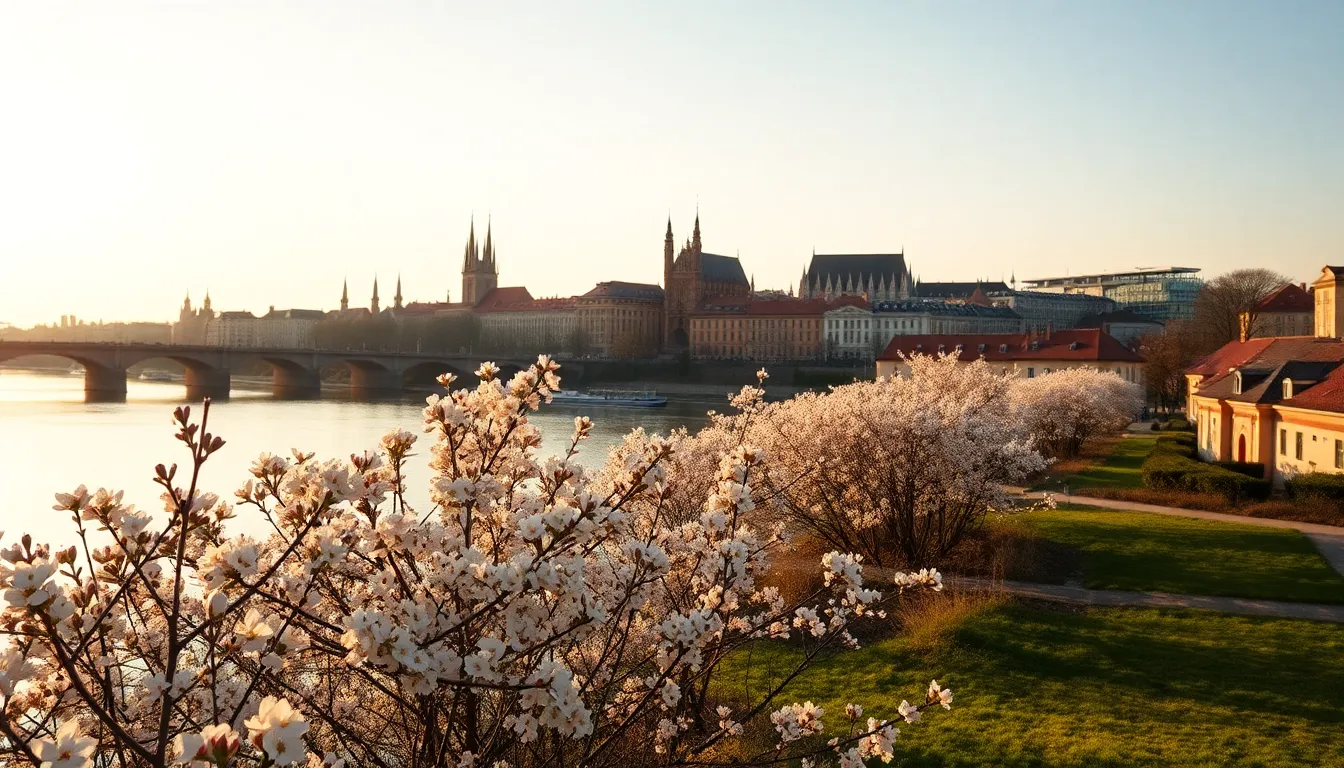
The first group I ever brought to Poland traveled in the third week of April. We arrived in Krakow to find the chestnut trees along the Planty just starting to leaf out, the mornings still sharp enough for a coat, and the afternoons warm enough to sit outside a cafe in Kazimierz. By the time we reached Birkenau a few days later, the open fields were green again. I have brought groups in every season since, and I keep coming back to that spring window for a reason. It does something for a group that the other seasons cannot.
This is not the place to decide whether spring beats fall or winter for your community. Our season-by-season Poland guide handles that comparison in full. What I want to do here is take you inside the spring window itself, week by week, so you understand what late March feels like versus early June, and so you can plan around the one date that defines the season for many groups: Yom HaShoah, and the March of the Living that gathers around it.
Why Spring Is the Window Most Groups Choose
Spring carries two things at once. The weather turns kind, and the calendar fills with meaning. That combination is rare, and it is why late April through early June is the busiest stretch on the Poland heritage calendar.
The practical case is straightforward. By mid-April, daytime temperatures in Krakow and Warsaw climb into the low to mid-teens Celsius, the upper 50s to low 60s Fahrenheit. Days stretch long enough to fill an itinerary without exhausting your group. The frozen ground at Birkenau has thawed. Rain comes and goes, but rarely hard enough to derail a day.
The deeper case is the calendar. Spring holds Yom HaShoah, it holds Passover in most years, and for many Christian communities it overlaps with the season around Easter and Pentecost. Your group does not arrive in Poland in a vacuum. They arrive carrying a season that is already spiritually charged, and that changes what the sites do to them.
The Spring Window, Month by Month
Late March to Mid-April: The Edge of the Season
This is the earliest I recommend going. The weather is a gamble. Some years the second half of March in Krakow is mild and bright. Other years it is gray, raw, and threatening late snow. Birkenau in late March can still be muddy and bitterly cold across those exposed fields.
The upside is that the crowds have not arrived yet. If your group can tolerate cooler, less predictable conditions, you will have many sites nearly to yourselves. I would only push a group into late March if there is a calendar reason, like an early Passover, or if quiet matters more to them than comfort.
Mid-April to Mid-May: The Heart of It
This is the stretch I recommend to most first-time groups. The weather has settled into something reliable. Krakow and Warsaw are mild, the parks are green, and the smaller heritage towns like Tykocin and Lublin look their best. Mornings are still cool, so layers stay essential, but the days are full and the light is good.
This is also the window that holds Yom HaShoah and, around it, the March of the Living. More on that below, because it deserves its own attention.
One scheduling note. This is peak season for a reason, which means Auschwitz-Birkenau requires advance reservation for guided group entry, and the popular time slots go early. If your dates land in this window, lock your booking conversation in well ahead.
Mid-May to Early June: The Quiet Tail
By late May the school groups have not yet flooded in, the weather is genuinely warm, and the days are long. I love this slice of the season. It carries most of the benefits of mid-spring with a softer, greener landscape and slightly thinner crowds than the late-April peak. For a group with no fixed commemorative date to plan around, late May into early June is one of the most comfortable times to travel Poland for heritage.
Once you pass into mid-June, you are crossing into summer, with its crowds and its heat. That is a different conversation.
The March of the Living and Yom HaShoah
I want to handle this part carefully, because it matters and because it is easy to get wrong.
Yom HaShoah, Holocaust Remembrance Day, falls each year according to the Jewish calendar, usually in late April or early May. In 2027 it lands on April 21. In 2028, May 9. Around that date, the March of the Living brings thousands of participants from around the world to walk the route between Auschwitz and Birkenau in a single procession of remembrance.
Being in Poland during this period is a decision, not an accident, and it cuts both ways.
For some groups, this is exactly what they want. To stand at Birkenau on or near Yom HaShoah, among thousands who came for the same reason, carries a weight no ordinary visiting day can match. The ceremonies, the shared silence, the sense of a people gathered in one place to remember, these things stay with people for the rest of their lives. If your community wants this, we can build the itinerary so your group is present for it, with the access and the emotional preparation that the day demands.
But I owe you the honest version too. The March of the Living period is crowded. The sites are full. The intimacy of standing alone in a barrack and letting the place speak to you is harder to find when thousands of others are moving through the same space on the same day. Some group leaders specifically want the scale and the solidarity. Others find it pulls them out of the quiet, reflective experience they were hoping for.
Neither instinct is wrong. They are simply different journeys. What I ask every group leader who is drawn to this window is one question: do you want your community inside the gathering, or do you want them in the quiet just before or just after it? Both are available in spring. Knowing which one you want is the whole planning decision.
Passover Falls in This Window Too
For Jewish groups, spring almost always overlaps with Passover, which typically lands in April. Check your travel dates against the Passover calendar early, because the holiday shapes meal planning, Shabbat observance, and your group’s ability to find kosher-for-Passover food in Poland.
Some groups want to travel during Passover itself, which is meaningful but logistically heavier. Others choose the weeks just before or after, keeping the resonance while simplifying the planning. We can arrange Passover-appropriate accommodations and meals when a group wants them, but it takes lead time, so raise it in the first planning conversation rather than the last.
What to Pack and Prepare for Spring
A few practical notes that come up with every spring group.
Layers are not optional. A spring morning at Birkenau can be ten degrees colder than a Krakow afternoon, and the wind across the open fields at Birkenau and Treblinka has nothing to slow it down. Bring a warm layer even on days the forecast looks mild.
Footwear matters more than people expect. Birkenau involves significant walking on uneven ground that can still be soft and muddy in early spring. Comfortable, broken-in shoes that you do not mind getting dirty are the right call.
Rain happens. A compact rain layer for each member saves a day that would otherwise be spent ducking under eaves. The sites do not close for weather, and neither should your group.
For the broader practical picture across any season, our Poland heritage travel tips cover ground rules that apply year-round, and our accessibility guide is worth reading early if your group includes members with mobility needs.
FAQ: Poland Heritage Travel in Spring
When exactly is the best part of spring to visit Poland?
Mid-April through mid-May is the heart of the season, with settled weather and the Yom HaShoah window. Late May into early June is the quiet tail, warmer and slightly less crowded, ideal for groups with no fixed commemorative date. Late March is possible but the weather is unpredictable.
Should our group plan around Yom HaShoah and the March of the Living?
It depends on what you want. Being present for the March of the Living offers scale, solidarity, and an experience many never forget, but the sites are crowded and the quiet, contemplative version of the trip is harder to find. Some groups want to be inside the gathering. Others prefer the days just before or after. Both are available, and we will help you choose.
Does Passover affect a spring trip to Poland?
Yes, for Jewish groups. Passover usually falls in April and shapes meals, Shabbat, and kosher-for-Passover food access. Check your dates against the Passover calendar early. We can arrange Passover-appropriate accommodations and meals with enough lead time.
Is the weather warm enough in spring for older members of the group?
By mid-April it is generally comfortable, with daytime temperatures in the low to mid-teens Celsius, the upper 50s to low 60s Fahrenheit. Mornings stay cool and the open memorial sites are exposed and windy, so layers are essential. For groups with members who feel the cold, mid-May into early June is the most comfortable slice of the season.
How far ahead do we need to book a spring trip?
Spring is peak season, so six to eight months of lead time is the minimum I recommend, and longer if your dates fall in the Yom HaShoah window or overlap Passover. Auschwitz-Birkenau requires advance reservation for guided group entry, and the best time slots in spring go early.
Let’s Find Your Window
Spring rewards the groups that plan it well. The weather works in your favor, the calendar gives your community a frame, and the sites carry a quiet greenness that softens nothing but holds everything.
If you are weighing a spring journey, I would be glad to walk through the specific weeks with you, look at where Yom HaShoah and Passover fall in your target year, and help you decide whether your group belongs inside the March of the Living or in the stillness around it. Reach out through our contact page whenever you are ready to start that conversation.