Most Poland travel tips are written for someone planning a week in Krakow with a few day trips. They cover plug adapters, tipping, and the best pierogi in the Old Town. That is fine if you are a tourist. But if you are a rabbi or pastor bringing 25 people to Auschwitz-Birkenau, cemetery visits, and heritage sites across the country, you need a different list.
These are the things I have learned from 40 years of organizing heritage group travel to Poland. They are specific, practical, and most of them do not appear in any standard travel guide.
The Tips You Will Not Find in a Standard Poland Travel Guide
Standard guides assume you are an individual tourist with flexible time. Heritage group leaders are responsible for other people’s experiences at sites that demand preparation, respect, and forethought. The tips below are for you.
On Auschwitz-Birkenau Specifically
Book Months in Advance, Not Weeks
Auschwitz-Birkenau operates on a timed-entry system. During peak season (May through September), individual time slots sell out months ahead. Group bookings require even more lead time because group entries are limited.
If you are planning a heritage trip for spring or summer, book your Auschwitz visit at least three to four months in advance. For large groups of 20 or more, start the booking process even earlier. Walk-ins during high season are often turned away, and rescheduling a group visit on the ground in Poland is nearly impossible.
Heritage Tours handles Auschwitz booking for all our groups, and we begin the process as soon as the trip dates are confirmed. This is one of the first things we lock in, because it shapes the rest of the itinerary.
Auschwitz I and Auschwitz II-Birkenau Are Different Sites
Many first-time visitors do not know this. Auschwitz I is the original camp, located in the town of Oswiecim. It consists of brick buildings with interior exhibitions documenting the camp’s history. Auschwitz II-Birkenau is located about two miles away. It is the much larger site, the extermination camp, with the railroad tracks, the ruins of the gas chambers, and the vast open grounds.
A full visit includes both. Most guided tours begin at Auschwitz I in the morning and move to Birkenau in the afternoon. Plan for a minimum of five to six hours for both sites. Rushing this visit is not acceptable, and it is not something Heritage Tours will ever recommend.
What Is Not Allowed Inside
Large bags and backpacks over a certain size are not permitted inside Auschwitz I. There is a bag deposit area, but for groups, it is simpler to leave bags on the bus. Food and drink are not allowed inside the exhibition buildings. Appropriate dress is expected. This is not a dress code in the formal sense, but visitors in beachwear or clothing with offensive slogans have been turned away.
Tell your group these details the evening before, not at the entrance.
Photography: What Is Appropriate and What Is Not
Photography is permitted in most areas of Auschwitz I and Birkenau, with some exceptions. The basement rooms in Block 11 and certain sensitive exhibition areas do not allow photographs.
But the more important question is not what is permitted. It is what is appropriate. Auschwitz is not a photo opportunity. It is a place where over a million people were murdered. Taking a photograph to document what you witnessed is one thing. Posing for a selfie at the gate is another.
This distinction matters at Jewish cemeteries in Poland as well. At the Remuh Cemetery in Krakow, photography is allowed, but the purpose should be documentation or memory, not social media content. As a group leader, set this expectation before the visit. A brief word about it the evening before saves an uncomfortable moment at the site.
The Evening After Auschwitz: Plan for It
This is the tip that matters most, and it is the one no travel guide covers.
After your group returns from Auschwitz-Birkenau, they will need the evening free. Do not schedule a dinner with a guest speaker. Do not plan a cultural activity. People process this visit in different ways. Some will want to talk over dinner. Some will want to walk alone through Krakow. Some will want to sit in their hotel room and call home.
As a leader, you might gather the group briefly, just to check in. Not a formal debrief, but a simple acknowledgment that today was significant and that everyone is allowed to process it however they need to.
In my experience, the most common mistake group leaders make is filling the evening after Auschwitz with programming. The absence of programming is the programming. Give your group space.
On Jewish Heritage Sites in Poland
Synagogue Hours and Access Vary: Confirm Before You Go
Not all historic synagogues in Poland keep regular visiting hours. Some are museums with fixed schedules. Some are active houses of prayer that close to visitors during services. Some are open only by appointment.
Before your trip, confirm the hours for every synagogue on your itinerary. The Remuh Synagogue in Krakow is generally accessible, but smaller synagogues in Lublin, Tykocin, and other towns may require advance coordination.
Heritage Tours handles this for every group, but if you are planning independently, do not assume a synagogue will be open just because it appears in a guidebook.
Jewish Cemetery Visits: Protocols Every Visitor Should Know
Jewish cemeteries in Poland are sacred sites, not tourist attractions. A few protocols apply.
Men should wear a head covering. Kippot are sometimes available at the entrance, but do not count on it. Bring your own or keep a few in your bag for your group.
Do not step on graves. The paths between graves are often narrow and uneven. Walk carefully.
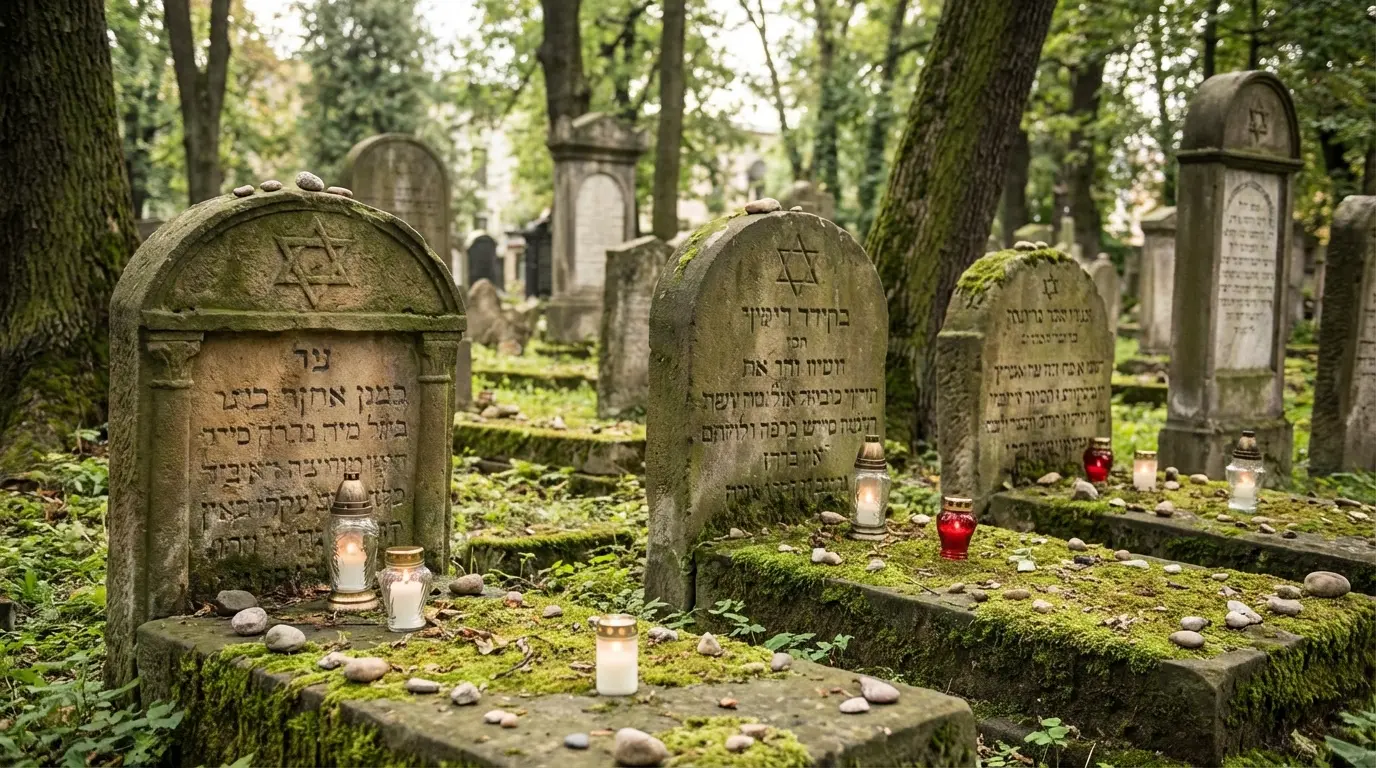
Placing a small stone on a grave is a traditional Jewish sign of respect. If your group includes non-Jewish members, explain this practice beforehand so they understand what they are seeing.
At some cemeteries, particularly smaller ones outside the major cities, the grounds may be overgrown or difficult to navigate. Wear appropriate footwear and brief your group on what to expect.
Bringing a Kippah or Head Covering
If your group includes men who are not Jewish, let them know in advance that a head covering is expected at synagogues and cemeteries. This is not optional at active religious sites like the Remuh Synagogue. Having a few spare kippot in your bag is a practical kindness that avoids awkward moments at the entrance.
For more on Jewish heritage sites across Poland, including sites outside the major cities, see our dedicated guide.
Practical Things That Trip Up Group Leaders
Polish Public Holidays and Site Closures
Poland observes several national and religious holidays that can affect site access. Christmas (December 25-26), Easter, All Saints’ Day (November 1), and Independence Day (November 11) are the most significant. Some museums and heritage sites close on these days or operate on reduced hours.
Auschwitz-Birkenau is closed on January 1, December 25, and Easter Sunday. On other holidays, hours may be shortened.
If your trip falls near a Polish holiday, verify hours for every site on your itinerary well in advance.
Tipping Culture
Tipping in Poland is appreciated but not obligatory. In restaurants, 10% is standard for good service. For your bus driver and local guides, tipping at the end of the trip is customary and appreciated.
For heritage groups, I recommend collecting a group tip for your guides and driver at the end of the trip. This is simpler than individual tipping and allows you to give a meaningful amount that reflects the quality of their work.
Getting Between Warsaw and Krakow: Train vs. Coach
The distance between Warsaw and Krakow is about 300 kilometers. By train, the journey takes two and a half to three hours on the EIP (Express InterCity Premium) service. By coach, it takes four to five hours depending on traffic and stops.
For groups, Heritage Tours arranges private coach transport because it allows for stops along the way, luggage storage, and group flexibility. But if you are traveling independently with a small party, the train is faster, comfortable, and affordable.
If your itinerary includes Lublin, the route typically goes Warsaw to Lublin (about three hours by road) and then Lublin to Krakow (about five hours by road). For a first-timer considering the full route, our 10-day itinerary shows how the travel days are paced.
What Poland Will Ask of Your Group (That No Tip Can Prepare You For)
All the practical preparation in the world will not change the fact that Poland asks your group to be present with difficult history. Your bus driver will be excellent. Your hotels will be comfortable. Your guides will be knowledgeable. And none of that will matter on the afternoon you walk through Birkenau, because what that site asks of you is not logistical. It is human.
As a group leader, the most useful thing you can do is not solve this. Do not try to make it easier. Do not fill every silence with words. Your group came here to feel something, and part of your job is to let them feel it.
If this is your first trip to Poland, that might sound intimidating. It is not. It is simply honest. And in my experience, the leaders who prepare their groups practically and then step back emotionally are the ones whose groups have the most meaningful experience.
One Thing to Leave Behind
Leave your expectations about what you are supposed to feel.
Some people arrive at Auschwitz expecting to weep and feel nothing. Some people expect to feel nothing and are overwhelmed. Some people feel the weight of the trip not at the memorial sites but at a quiet synagogue in a small town, or while watching their group pray together in Kazimierz.
There is no script for how Poland is supposed to affect you. The people who have the hardest time are the ones who arrived with a fixed idea of the “correct” emotional response and then could not produce it.
Tell your group this before you go. Tell them that whatever they feel in Poland is the right thing to feel. And if they feel nothing at a site where they expected to feel everything, that is okay too. The visit does not expire. It works on you in the weeks and months that follow, sometimes when you least expect it.
If you are planning a heritage group trip to Poland and you want someone who has done this hundreds of times to walk you through the details, reach out to us. The practical tips are the easy part. Heritage Tours takes care of all of them so you can focus on being present with your group.
Frequently Asked Questions
How far in advance do you need to book a visit to Auschwitz-Birkenau?
For groups visiting during peak season (May through September), book at least three to four months in advance. Large groups of 20 or more should start the process even earlier. Individual timed-entry slots also sell out during peak months. Heritage Tours begins the Auschwitz booking process as soon as trip dates are confirmed.
What is the difference between Auschwitz I and Auschwitz II-Birkenau?
Auschwitz I is the original camp in Oswiecim, consisting of brick buildings with interior exhibitions. Auschwitz II-Birkenau, about two miles away, is the much larger extermination camp with the railroad tracks, ruins of gas chambers, and vast open grounds. A proper visit includes both sites and takes a minimum of five to six hours.
What photography is appropriate at Auschwitz and Polish Jewish cemeteries?
Photography is permitted in most areas of Auschwitz and at Jewish cemeteries, with specific restricted zones marked at each site. The standard is documentation and witness, not social media content. Selfies at the Auschwitz gate and posed photos at grave sites are inappropriate. Group leaders should set this expectation with their group before the visit, not at the entrance.
What are the visiting protocols for Jewish cemeteries in Poland?
Men should wear a head covering (bring kippot for your group). Do not step on graves. Walk carefully on the narrow, often uneven paths. Placing a small stone on a grave is a traditional Jewish sign of respect. If your group includes non-Jewish members, explain these practices beforehand. Some smaller cemeteries may be overgrown, so wear appropriate footwear.
How do you get from Warsaw to Krakow for a heritage trip?
By train, the EIP service takes two and a half to three hours. By private coach, four to five hours depending on stops. Heritage Tours arranges private coach transport for groups because it allows for flexibility, luggage, and stops along the route. If your itinerary includes Lublin, the road from Warsaw goes through Lublin first before continuing south to Krakow.