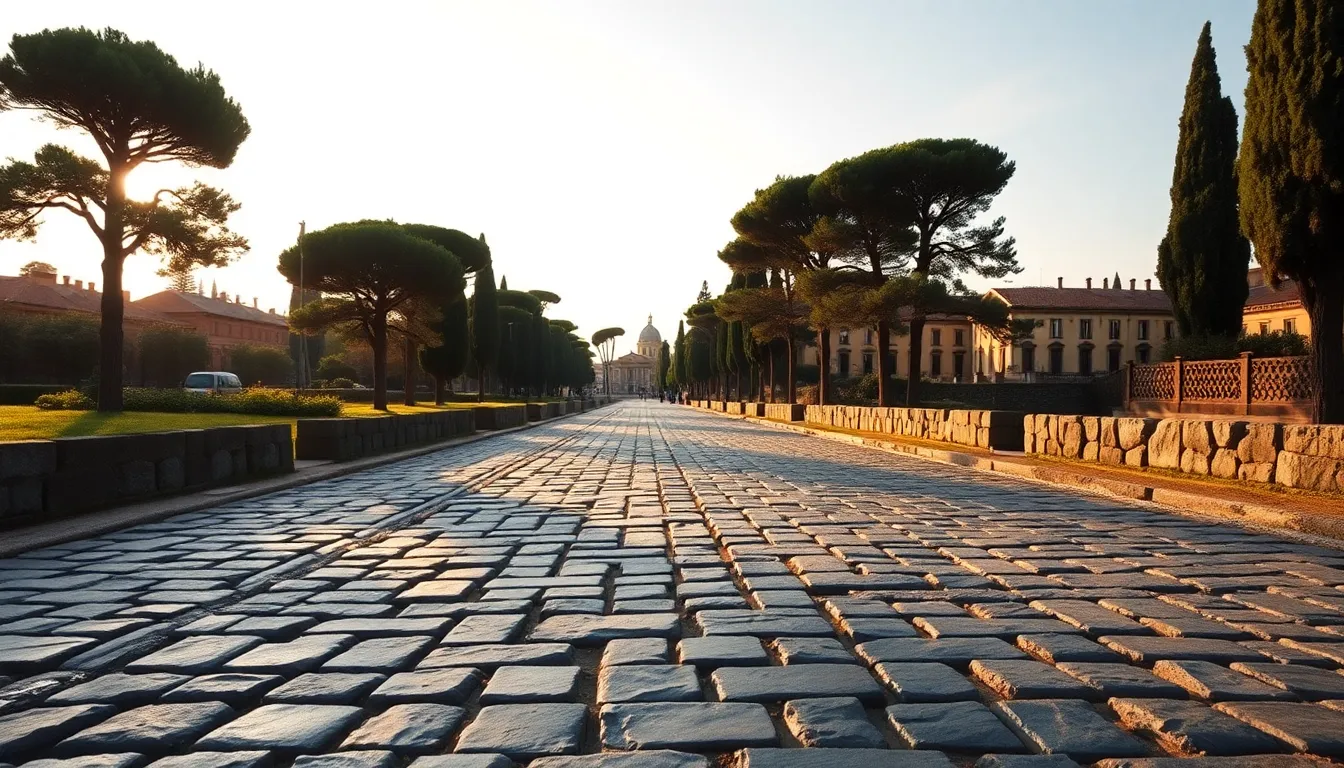
There are not many places where you can set your feet on the exact stones a biblical figure walked, but the Appian Way is one of them. When I bring a group out to the old road on the south edge of Rome, lined with umbrella pines and walled with ancient tombs, I read them the closing lines of Acts. Paul, a prisoner under guard, is being marched up this road toward Rome and an uncertain trial. Believers from the city come out to meet him along the way, and Luke records that “when Paul saw them, he thanked God and took courage.” We are standing on the road where that happened. People feel it in their feet. This is not a museum of the Bible. It is the Bible’s own ground.
Let me walk you through the road, its biblical weight, and how to bring a group along it.
The Queen of Roads
The Romans called the Appian Way the Regina Viarum, the Queen of Roads. It is the oldest and most famous of the great Roman highways, begun in 312 BC by the censor Appius Claudius Caecus, who gave it his name. It ran from Rome southeast across Italy, eventually all the way to Brindisi on the Adriatic coast, the port for ships to Greece and the East. For centuries it was the main artery connecting Rome to the wider Mediterranean world.
That is exactly why it matters for the New Testament. When a traveler, a soldier, a merchant, or a prisoner came up from the southern ports toward Rome, this was the road they took. The stones underfoot, large polished blocks of dark basalt fitted tightly together, are in many stretches the original Roman paving. You are not looking at a reconstruction. You are looking at engineering more than two thousand years old, worn smooth by the traffic of empire. For how the road fits Italy’s wider faith landscape, see our overview of spiritual sites in Italy for faith travelers.
Acts 28: Paul’s Journey Into Rome
Here is the passage I always read on site, because the geography in it is precise and verifiable.
After his shipwreck on Malta and the long voyage described in Acts 27 and 28, Paul lands at Puteoli near Naples, then travels overland toward Rome along this very route. Luke names the stops. Believers come out to meet him at the Forum of Appius, about forty miles from Rome, and at the Three Taverns, about thirty miles out, both of them stations along the Appian Way. These are real places on this road. When the church came out to greet the chained apostle, they walked down these stones to do it.
I tell groups to picture it honestly. Paul is not arriving in triumph. He is a prisoner, worn from a winter shipwreck, facing trial before the emperor. And what lifts him is not deliverance from his chains but the sight of fellow believers who walked miles down a Roman highway to stand with him. The road preaches a sermon about the body of Christ before you have entered a single church. That is why I begin a Rome itinerary here when I can, rather than ending with it.
The Quo Vadis Church
A short way out along the road stands a small church called the Church of Domine Quo Vadis, and it holds one of the most beloved traditions of the early Roman church.
The story, recorded in an early Christian text, runs like this. During Nero’s persecution, Peter is fleeing Rome to save his life, heading out of the city along the Appian Way. On the road he meets the risen Christ walking toward the city. Peter asks him, “Domine, quo vadis?” Lord, where are you going? Christ answers that he is going to Rome to be crucified again. Peter understands the rebuke, turns around, walks back into the city, and accepts his own martyrdom. Inside the church is a stone slab said to bear the footprints of Christ from that encounter, a later devotional marker rather than a relic anyone claims is literal.
Whatever you make of the tradition, it captures something true about Peter and about the cost of discipleship, and it happened, in the story, right here on this road. The church is small and quiet, and a few minutes inside gives groups a moment to sit with the question the legend asks: where are you going, and what are you walking back toward? For the end of Peter’s story, our guide to the tomb of Saint Peter picks up where this road leaves off.
The Catacombs Along the Road
The Appian Way is also lined with the great catacombs, because Roman law required burial outside the city walls, and the roads leading out of Rome became corridors of tombs, pagan and then Christian.
The Catacombs of San Sebastiano sit right on the road, and it was here, in fact, that the word catacomb originated, from the Greek for “near the hollow,” describing the dip in the land at this spot. A little further along lie the great Catacombs of Callixtus, the largest in Rome and the burial place of the early popes. Walking the Appian Way and descending into these catacombs in the same outing gives a group the full early-church experience: the road the living traveled and the ground where they laid their dead. I cover the underground in detail in our guide to the Catacombs of Callixtus, and the road and the graves belong together in one day.
How to Walk the Appian Way With a Group
Some practical guidance from many trips out to the road.
Walk the protected stretch. The first part of the Appian Way nearest the city runs alongside busy modern traffic and is not pleasant on foot. Further out, within the Appian Way Regional Park, there are long quiet stretches of the original paving, closed or calm to cars, lined with tombs and pines. That is where you want your group walking. We arrange transport to the good section.
Pick your footwear. The original basalt paving is uneven, with gaps and worn ridges. It is part of the experience, but it is hard on ankles. Tell your group to wear real walking shoes, not sandals, and pace it for your slowest members.
Sundays are best for walking. A long stretch of the road is closed to most car traffic on Sundays, which makes for a far more peaceful and safe group walk. When the schedule allows, I build the Appian Way into a Sunday.
Combine the road, the church, and a catacomb. The natural rhythm is a stretch of the road on foot, a stop at the Quo Vadis church, and a guided descent into Callixtus or San Sebastiano. That is a full, deeply meaningful half day. Read it alongside our guide to the Catacombs of Priscilla if you want to add the early Christian art on another day.
We design these days, with transport to the quiet stretch and a reserved catacomb guide, as part of a Rome itinerary. Our group heritage tours page explains the group leader experience, and our Italy destination page shows how it fits together.
FAQ: The Appian Way and the Road Paul Walked
Did the apostle Paul really walk on the Appian Way?
Yes. Acts 28 describes Paul traveling overland from Puteoli near Naples toward Rome as a prisoner, and the route ran along the Appian Way. Luke names two stations on the road, the Forum of Appius and the Three Taverns, where Roman believers came out to meet him. The polished basalt paving stones in the protected stretches of the road are in many places the original Roman surface, so a group genuinely walks ground Paul traveled.
What is the Quo Vadis church on the Appian Way?
It is a small church, the Church of Domine Quo Vadis, that marks the spot where, by early Christian tradition, Peter fleeing Rome met the risen Christ walking toward the city. Peter asked, “Lord, where are you going?” and Christ replied that he was going to be crucified again, prompting Peter to turn back and accept his own martyrdom. Inside is a devotional slab said to bear Christ’s footprints. It is a brief, quiet, and moving stop on a walk along the road.
Can a faith group walk the Appian Way on foot?
Yes, and it is one of the most rewarding walks in Rome, but you want the right stretch. The part nearest the city runs beside heavy traffic. Further out, inside the Appian Way Regional Park, long stretches of original paving are calm or closed to cars, especially on Sundays. We arrange transport to that protected section. The ancient stones are uneven, so sturdy walking shoes are essential and the pace should suit the whole group.
How does the Appian Way connect to the catacombs?
Roman law required burial outside the city walls, so the roads out of Rome became lined with tombs, and the great Christian catacombs grew along the Appian Way. The Catacombs of San Sebastiano sit directly on the road, and the Catacombs of Callixtus, the largest in Rome, lie just off it. The word catacomb itself originated at this spot. Walking the road and descending into a catacomb in the same outing gives a group the complete early-church experience.
When is the best time to walk the Appian Way?
Sunday is ideal, because a long stretch of the road is closed to most car traffic, making the walk peaceful and safe for a group. For weather, spring and fall give the most comfortable temperatures for an outdoor day on the stones; midsummer can be hot and exposed in places. We schedule the Appian Way for a Sunday whenever the wider itinerary allows.
The Appian Way gives a faith group something rare: scripture under their own feet, with the body of Christ walking out to meet them on the same stones it walked out to meet Paul. Begin a Rome journey here and everything that follows reads differently. If you want help building a day that joins the road, the Quo Vadis church, and the catacombs, I would love to design it with you.
Contact us to start planning your group’s journey to Rome.