How This Itinerary Was Built (and What We Left Out Intentionally)
After more than forty years of bringing faith groups to Italy, I can tell you the biggest mistake most leaders make: trying to see everything. Italy rewards the group that slows down. This itinerary was built on that principle.
We focused on four cities, each chosen for a specific reason. Rome holds the deepest layers of both Jewish and Christian history in Europe. Assisi offers something no other Italian city can, a sense of spiritual stillness that changes the pace of your trip at exactly the right moment. Florence balances art, faith, and a living Jewish community. And Venice anchors the journey with the story of the original Ghetto, the place where the word itself was born.
What did we leave out? Naples, the Amalfi Coast, Sicily. Not because they lack heritage, but because ten days with depth is worth more than ten days of rushing. If your group has a specific connection to southern Italy, we can adapt. But this route, as it stands, gives your group time to reflect at each stop rather than just pass through.
Days 1 to 3: Rome, the Ghetto, the Vatican, the Catacombs
Three days in Rome is not too much. I say this because every group leader I work with initially wants to cut it to two. Then they arrive and realize how much is here.
Day 1 begins in the Jewish Ghetto, the oldest continuously inhabited Jewish quarter in the Western world. Your group will walk streets where Jewish families have lived since the second century BCE. The Great Synagogue of Rome still stands on the banks of the Tiber, and the small museum inside tells a story that stretches from ancient Rome through the deportations of 1943. For groups that include both Jewish and Christian travelers, starting here sets the right tone. This is a place where history is not behind glass. It is still lived.
Day 2 is the Vatican. I recommend arriving early, before the crowds build. Most groups spend the morning in the Vatican Museums and Sistine Chapel, then move to St. Peter’s Basilica in the afternoon. Here is what I tell every leader: do not try to see every gallery. Choose the Raphael Rooms and the Sistine Chapel, and give your group time to sit with what they see. The ceiling alone needs twenty minutes of quiet looking. Rush through it and you lose the entire experience.
Day 3 takes you underground to the Catacombs of San Callisto or San Sebastiano. This is where early Christians gathered to worship when doing so could cost them their lives. The narrow corridors and carved inscriptions are not dramatic in the way the Vatican is dramatic. They are quiet, close, and deeply real. For a faith group, this is often the most powerful day in Rome. Pair the morning underground with an afternoon walk through Trastevere, one of Rome’s oldest neighborhoods, where you can gather for a group dinner that lets everyone process what they have seen.
Days 4 to 5: Assisi and the Umbrian Hill Towns
The drive from Rome to Assisi takes about two hours, and the landscape shift is immediate. You leave the density of the city and climb into green hills where the light changes and the noise drops away.
Day 4 in Assisi centers on the Basilica of St. Francis. The lower church holds Giotto’s frescoes depicting Francis’s life, and the crypt below contains his tomb. But the real power of Assisi is not any single building. It is the town itself. Francis grew up wealthy here, and one day stood in the town square, stripped off his fine clothes in front of his father, and chose poverty. That moment reshaped Christianity’s relationship with material wealth. Walking the streets where it happened gives that story a weight that reading about it never can.
Day 5 can include Orvieto or Spoleto, depending on your group’s interest. Orvieto’s cathedral holds one of the most significant Eucharistic miracle sites in Catholic tradition. Spoleto offers Roman ruins and medieval churches in a quieter setting. Both make excellent half-day stops before returning to Assisi for the evening, or you can use the full day in Assisi itself. Some groups prefer to return to the Basilica a second time, in the late afternoon when the tour buses have left and the light through the windows changes.
Days 6 to 7: Florence, the Synagogue, the Duomo, San Miniato al Monte
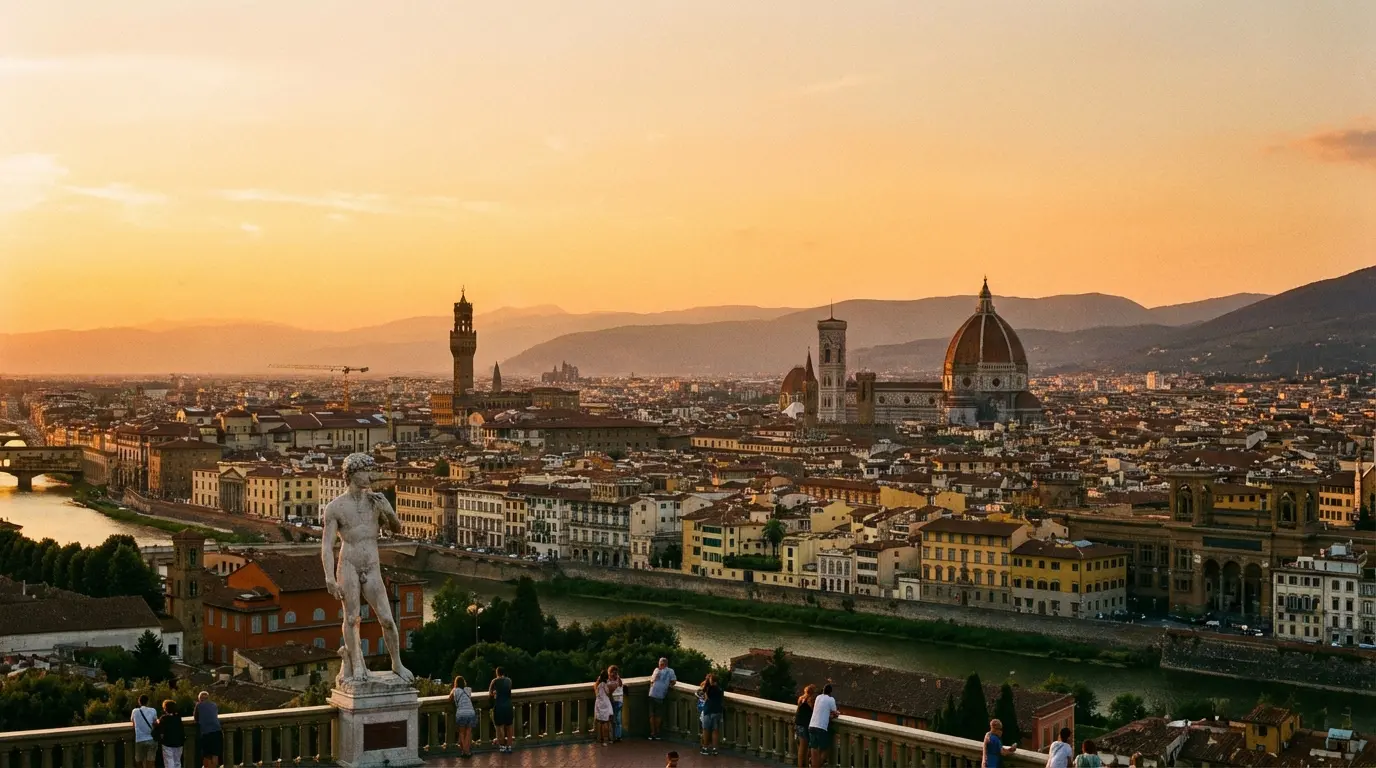
Florence is where faith and art become impossible to separate. The entire city was built by people who believed that beauty was a form of worship.
Day 6 should start at the Great Synagogue of Florence, one of the most architecturally striking synagogues in Europe. Its green copper dome is visible across the city skyline. The interior, with its Moorish-influenced design, tells the story of Florence’s Jewish community and the period of emancipation that allowed the building to exist at all. From there, your group moves to the Duomo. Brunelleschi’s dome is a feat of engineering, but for a faith traveler, the real story is what it represents: a community that spent 140 years building a cathedral because they believed it mattered that much.
Day 7 begins at San Miniato al Monte, a Romanesque church on the hill above Florence that most tourist itineraries skip entirely. The Benedictine monks who live there still sing Gregorian chant at vespers. If your group can attend, it is one of the most grounding experiences available in Italy. The afternoon is open for the Uffizi, the Baptistery, or simply walking the streets of the Oltrarno neighborhood. Give your group time to wander. Florence rewards it.
Days 8 to 9: Venice, the Original Ghetto, St. Mark’s, Murano
Venice is not primarily about canals and gondolas. For a heritage traveler, Venice is about the Ghetto.
Day 8 begins in the Ghetto Nuovo, established in 1516. This is the place that gave the world the word “ghetto,” from the Venetian word for the foundry that previously occupied the island. The buildings here are taller than anywhere else in Venice because the Jewish community, confined to this small area, could only build upward. Five synagogues still stand, layered into the upper floors where they were hidden from street view. The Jewish Museum of Venice provides context, but walking the campo itself, seeing the Holocaust memorial plaques set into the walls, is what stays with people.
Day 9 moves to St. Mark’s Basilica, where Byzantine mosaics cover nearly every surface of the interior. The gold background of these mosaics was not decorative excess. It represented divine light. For groups interested in the connection between Eastern and Western Christianity, St. Mark’s is one of the most important buildings in Europe. In the afternoon, a boat to Murano offers a gentler pace. The glass-blowing tradition there stretches back to the thirteenth century, and visiting a working furnace gives your group a shared experience that balances the weight of the heritage sites.
Day 10: Departure and Reflection
The last morning is not filler. I always suggest group leaders use it intentionally. A short gathering at the hotel, a walk to a quiet campo for coffee, or a final visit to a site that resonated most during the trip. Some leaders hold a brief reflection session where each traveler shares one moment from the journey. This takes thirty minutes and transforms the trip from a series of visits into a shared story.
Departure transfers from Venice are included. Your group will not need to navigate water taxis or train schedules on the last day.
Adapting This Itinerary for Your Group
This itinerary is a starting point. Every group we work with shapes it differently.
If your congregation is primarily Jewish, we can expand the Ghetto visits in Rome and Venice and add the Jewish cemetery on the Lido, one of the oldest in Europe. If your group has a strong connection to Catholic tradition, we can add a stop in Padua at the Shrine of St. Anthony or extend the Assisi portion to include the Eremo delle Carceri, the mountain hermitage where Francis retreated to pray.
If you have members with mobility concerns, we adjust the walking distances and choose accessible alternatives. Venice in particular requires planning, as many bridges have steps. We know which routes work and which do not.
The group leader’s role in shaping this is important. You know your community. We know Italy. When those two things come together, the itinerary takes care of itself.
With fifteen or more participants, the group leader travels at no cost. That is not a promotional offer. It is how we have always worked, because the leader’s presence is what makes a heritage tour different from a sightseeing trip.
If this route interests you, or if you want to talk through how to adjust it for your community, we would welcome that conversation. You can reach us through our Italy destination page or call directly.
FAQ
What cities should I include in a 10-day heritage tour of Italy?
Rome, Assisi, Florence, and Venice form the strongest heritage route for a ten-day trip. Rome gives you three days of layered Jewish and Christian history. Assisi provides spiritual depth. Florence connects faith with Renaissance art. Venice anchors the trip with the story of the original Ghetto. If your group has a specific connection to southern Italy or wants to add Padua or Ravenna, the itinerary can be adjusted.
Can a 10-day Italy itinerary cover both Jewish and Christian sites?
Yes, and this itinerary is specifically designed for that. Rome’s Jewish Ghetto and the Vatican are less than two miles apart. Florence’s Great Synagogue and the Duomo sit in the same city center. Venice’s Ghetto and St. Mark’s Basilica are a short walk from each other. The heritage of both traditions is woven into the same cities, which makes a combined itinerary feel natural rather than forced.
How many hours should I plan for the Vatican with a group?
Plan for a full day. The Vatican Museums alone take three to four hours if you focus on the key galleries, and St. Peter’s Basilica needs at least another two hours. Groups that try to fit the Vatican into a half day consistently feel rushed. An early morning entry helps avoid the heaviest crowds, and breaking for lunch between the Museums and the Basilica keeps energy levels manageable for the full group.
Is 10 days enough to see Italy’s major heritage sites?
Ten days is enough to see the most significant heritage sites in central and northern Italy with genuine depth. You will not cover all of Italy in ten days, and you should not try. What ten days gives you is time to stand in front of Giotto’s frescoes in Assisi without checking your watch, to walk the Roman Ghetto with a guide who can explain every plaque on the walls, and to sit in St. Mark’s long enough to notice how the mosaics change in different light. Depth over distance is the right approach.
What should I cut if I only have 7 days in Italy?
With seven days, keep Rome at three days (it is non-negotiable for heritage content), reduce Florence to one full day, and choose between Assisi and Venice based on your group’s priorities. If your group is primarily Christian, Assisi may be the stronger choice. If your group includes Jewish travelers or has a particular interest in the Ghetto’s history, Venice is essential. We can help you make this decision based on who is actually in your group.