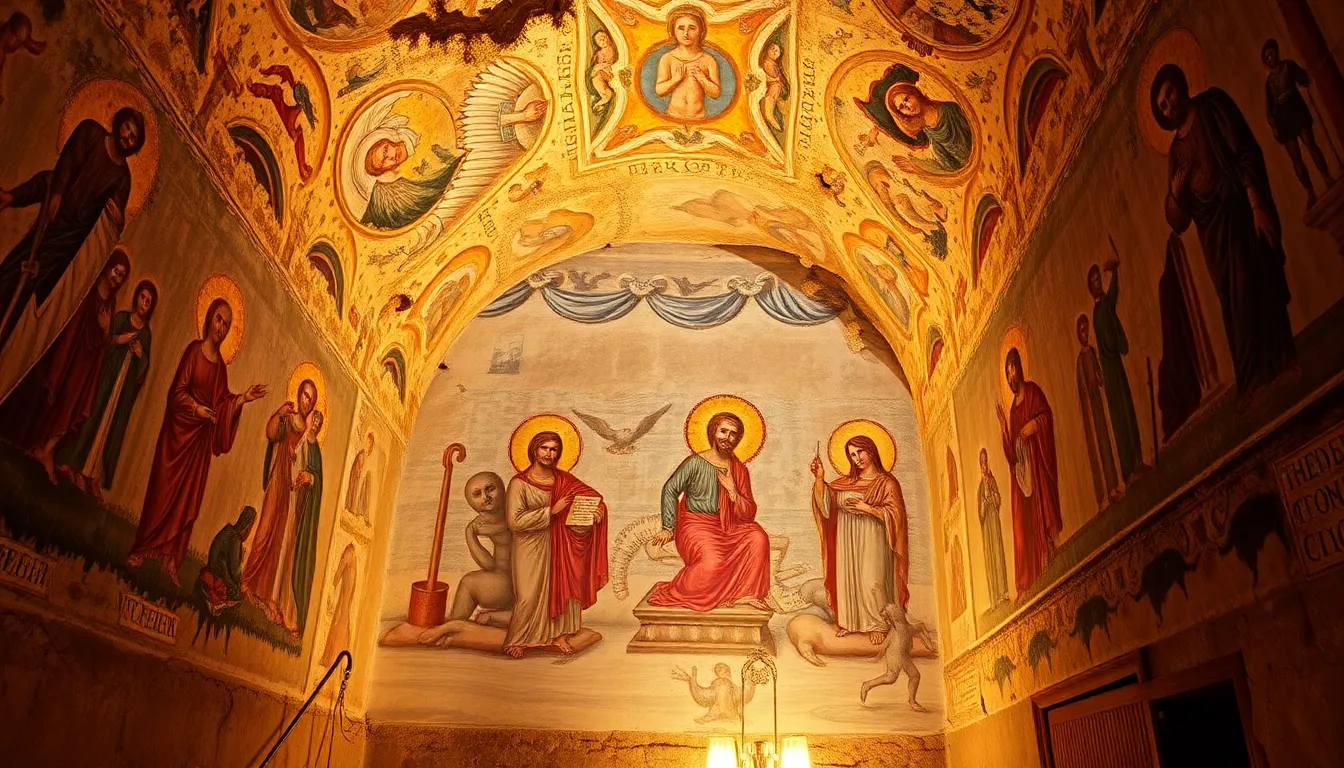
I have a soft spot for the Catacombs of Priscilla, and I tell my groups so. They sit on the north side of Rome, on the Via Salaria, away from the famous catacombs of the Appian Way, and they get a fraction of the crowds. But on a wall in one of these galleries is painted what many scholars consider the oldest known image of the Virgin Mary, made sometime in the early third century, possibly around 230 to 240 AD. To stand in front of the first time Christians tried to picture Mary holding her child, eighteen centuries ago, is the kind of moment that justifies the whole trip. This is where Christian art begins.
Let me tell you what is down there and how to bring a group through it with the attention it deserves.
The Queen of the Catacombs
The Catacombs of Priscilla earned the old nickname “Regina Catacumbarum,” the Queen of the Catacombs, because of the number of martyrs and early popes buried here and the quality of their painted decoration. They take their name from Priscilla, a Roman noblewoman of the senatorial Acilii family, who donated the land for Christian burial in the second century. That she could give land at all, and that her family appears connected to the early Roman church, tells you something important: the faith was already reaching into the Roman upper class long before it was legal.
The galleries run for miles on multiple levels, carved like all the Roman catacombs into the soft volcanic tufa. Several early popes were buried here, and the catacomb stayed in use and venerated for centuries. But people do not come to Priscilla for the size. They come for the paintings. For where this sits among Italy’s faith sites, our overview of spiritual sites in Italy for faith travelers gives the wider map.
The Oldest Image of Mary
In a section of the catacomb, on the curved wall of a niche, is a faded fresco of a seated woman holding an infant. Beside her stands a figure pointing upward at a star. Most scholars read this as the Virgin and Child, with the prophet Balaam or Isaiah pointing to the star prophesied to rise out of Jacob. If that reading holds, and it is widely accepted, this is the earliest depiction of Mary known to exist, painted while people who could have known the apostles’ own students were still alive.
What moves me, and what I want groups to notice, is how ordinary and tender it is. There is no gold, no halo, no throne. It is a mother and a baby, painted simply on a tomb wall by a community that wanted to express its hope in the most human image it had. The grand Madonnas of the Renaissance, the ones your group will see in the great galleries, all trace back to this small, faded painting in a quiet catacomb. Christian art did not start in cathedrals. It started here, in the dark, on the wall of a grave.
The Greek Chapel
The most decorated room in Priscilla is the Cappella Greca, the Greek Chapel, named for two Greek inscriptions painted on its walls. It is a small chamber with an arched recess, covered in third-century frescoes, and it functions almost like a textbook of early Christian symbolism.
I walk groups through the scenes one by one, because each one is a sermon. There is Daniel in the lions’ den, arms raised in prayer, a sign of deliverance. There are the three young men in the fiery furnace, untouched by the flames. There is Moses striking the rock to bring out water. There is the sacrifice of Isaac, and Noah in the ark, and the raising of Lazarus. And on one wall is an image of a meal, often read as a depiction of the Eucharist, an early Christian banquet of bread and wine.
Notice the pattern. Almost every scene is about rescue, deliverance, and resurrection. People burying their loved ones under threat of death chose to surround them with images of God saving his people from the lions, from the fire, from the grave. The walls preach the resurrection to the dead and to the living who gathered there. There is no clearer window into what the early church actually believed and hoped.
The Velata Fresco
On another wall is one of the most striking single figures in early Christian art: a young woman in a red robe, her arms raised in the ancient posture of prayer called the orans position, with a veil over her head. She is flanked by smaller scenes, and scholars debate exactly what the full image represents, with readings ranging from a deceased woman to stages of a consecrated life. Whatever the precise meaning, the central figure, praying with open hands, is one of the enduring images of the praying church, and it is painted with real artistic sensitivity. Groups often find her quietly powerful.
How a Group Experiences Priscilla
Some practical guidance for bringing people through.
It is run by nuns, and it is calm. The Catacombs of Priscilla are administered by the Benedictine Sisters of Priscilla, and there is a gentleness to a visit here that the larger sites do not always have. The guided tours are unhurried. For a group that wants to reflect and pray rather than file through quickly, this matters.
You still go with a guide. As with all the Roman catacombs, you visit only on an official guided tour. Request English when you book. The tour walks your group through the galleries to the key frescoes, explaining the symbolism as you go.
Dress for cool, even air. Like all the catacombs, Priscilla holds steady around 15 degrees Celsius, about 59 Fahrenheit, year-round, with humidity. A light layer is essential even in a Roman summer.
Watch the footing. Uneven floors and stairs between levels mean you should flag mobility concerns in your group ahead of time.
Pair it thoughtfully. Priscilla is on the opposite side of the city from the Appian Way catacombs, so you usually do not combine it with Callixtus in the same outing. Instead, I pair Priscilla with central Rome sites. It contrasts beautifully with the larger Catacombs of Callixtus, which you might do on a separate day, and the early imagery here connects naturally to the apostolic story you trace at the Mamertine Prison near the Forum.
We arrange these visits, with an English-speaking guide and a reserved group slot, as part of a wider Rome itinerary. Our group heritage tours page explains how that works, and our Italy destination page shows how the days fit together.
FAQ: The Catacombs of Priscilla
What is the oldest image of Mary, and is it really in the Catacombs of Priscilla?
Yes. A fresco in the Catacombs of Priscilla, dated to the early third century, around 230 to 240 AD, is widely considered the oldest known depiction of the Virgin Mary. It shows a seated woman holding an infant, with a figure beside them pointing to a star, usually read as a prophet pointing to the star foretold in scripture. It is simple and tender, with no gold or halo, and it is the root from which all later images of the Madonna grew.
How are the Catacombs of Priscilla different from the Catacombs of Callixtus?
Callixtus, on the Appian Way, is the largest catacomb and holds the Crypt of the Popes. Priscilla, on the Via Salaria on the north side of the city, is smaller, quieter, and famous for its art, especially the oldest image of Mary and the richly painted Greek Chapel. Callixtus is about the burial of the early church’s leaders. Priscilla is about the birth of Christian imagery. Many groups visit both, on separate days, since they sit on opposite sides of Rome.
Can our group pray or hold a reflection inside the catacombs?
The Catacombs of Priscilla, run by Benedictine sisters, have an unhurried and prayerful atmosphere that lends itself to reflection. Visits are by guided tour, so you move with the group and the guide, but the tone is calm and there is room for a quiet moment, especially in the Greek Chapel. If your pastor wants to offer a short reflection, let us coordinate it with the site when we book, so it fits respectfully within the tour.
What scenes are painted in the Greek Chapel?
The Greek Chapel is covered in third-century frescoes that read like a catalog of God’s deliverance: Daniel in the lions’ den, the three young men in the fiery furnace, Moses striking the rock, the sacrifice of Isaac, Noah in the ark, and the raising of Lazarus, along with a banquet scene often read as the Eucharist. Almost every image is about rescue and resurrection, which is exactly what a community burying its dead under persecution wanted painted on the walls.
Is the visit suitable for older travelers?
The frescoes and the calm pace suit reflective and older travelers well, but the catacombs themselves involve uneven floors, cool damp air, and stairs between levels. Flag any mobility concerns when you book so we can advise and pace the visit accordingly. Everyone should bring a light layer for the steady 15-degree-Celsius air. For travelers who can manage the stairs, Priscilla is one of the most rewarding and least crowded stops in Rome.
Priscilla is where I send groups who want to feel the very first heartbeat of Christian faith and art, away from the crowds, in the company of a mother and child painted eighteen centuries ago. If you want a Rome itinerary that honors both the grandeur above ground and the tender beginnings below it, I would be glad to build it with you.
Contact us to begin planning your group’s journey to Rome.