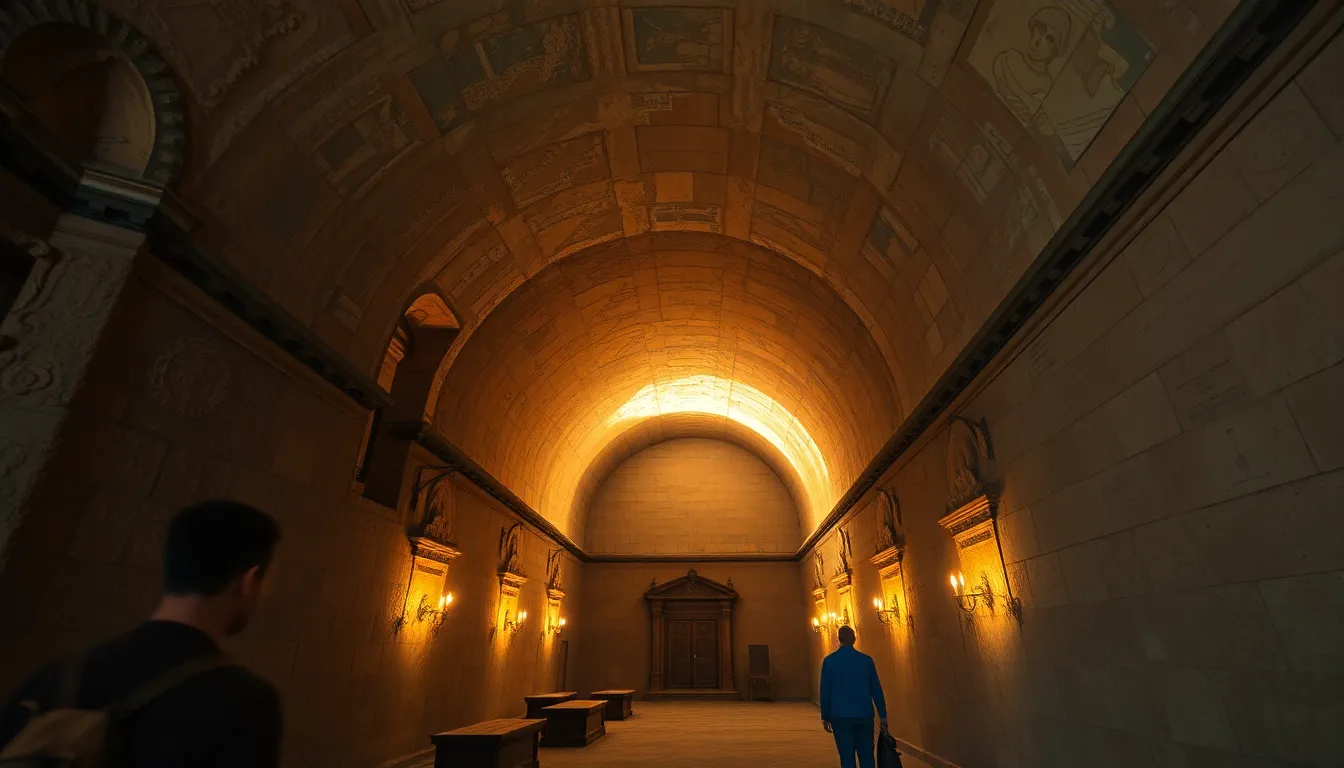
There is a place under Saint Peter’s Basilica that most travelers to Rome never see, and it is the closest you can stand to the foundation of the early church. Forty feet below the marble floor, beneath the high altar, runs a buried Roman street of pagan and early Christian tombs. At the end of it is a simple grave the church identifies as the burial place of the apostle Peter. I have taken groups down into it, and I have watched seasoned pastors go quiet in a way nothing above ground produces. This is the scavi, and if you can get your group in, it may be the most important hour of your time in Rome.
I want to be honest up front. Getting in is not easy, and it is not for every group. But I want you to understand what is down there, why it matters, and how to plan for it, so you can decide whether to pursue it.
What the Scavi Actually Is
Scavi is simply the Italian word for excavations. In the 1940s, under Pope Pius XII, archaeologists dug beneath the Basilica floor and uncovered something extraordinary: an entire Roman necropolis, a city of the dead, that had been buried and built over for nearly two thousand years.
When Constantine built the first basilica here in the fourth century, he did not build on open ground. He built over this hillside cemetery. To make a level platform for his church, his engineers filled the tombs with earth and sealed them. That act of burial, frustrating for the families of the time, preserved the necropolis almost perfectly. What the archaeologists found in the 1940s was a street of mausoleums with painted walls, mosaics, inscriptions, and the everyday names of Romans who lived in the first three centuries after Christ.
Walking through it, you pass tombs decorated with pagan imagery, and then, mixed among them, tombs with early Christian symbols: the fish, the anchor, Christ shown as the sun. You are watching one faith give way to another in the archaeological record itself, on a single buried street. For context on how that early-church world looked outside the Vatican, our overview of spiritual sites in Italy for faith travelers sets the scene.
Why the Church Believed Peter Was Here
The reason Constantine built on this awkward, sloping cemetery instead of flat ground nearby comes down to one grave.
Roman tradition held that Peter was crucified in Nero’s circus on the Vatican hill around 64 to 67 AD, during the persecution that followed the great fire of Rome, and that Christians buried him in the adjacent cemetery. By the second century, a small monument marked the spot. Archaeologists found it during the scavi excavation: a modest shrine known as the Trophy of Gaius, built around 160 AD against a red plastered wall. It matches a description written by a Christian named Gaius around 200 AD, who referred to the “trophies” of the apostles at the Vatican and on the Appian Way.
So the line of evidence is this. A second-century shrine, described in a third-century text, sits directly beneath the high altar of the church Constantine built in the fourth century, which sits beneath the altar of the church Bernini decorated in the seventeenth century. Every altar, across every rebuilding, was placed over the same point. The builders did not move the spot. They could not. The grave was the reason for the building.
The Bones
In 1968, Pope Paul VI announced that bones found near the shrine had been identified, in his words, “in a manner we believe convincing,” as the relics of Saint Peter.
The story behind that announcement is genuinely fascinating, and I share it with groups because it is honest about the uncertainty. Bones found in the original 1940s dig had been set aside. Years later, an epigraphy expert named Margherita Guarducci traced a set of bones that had been removed from a niche in the wall near the shrine, marked with a Greek inscription that reads, in part, “Peter is here.” The bones were those of a robust man in his sixties, which fits the tradition, and they were wrapped in cloth dyed with royal purple and gold thread, a sign of reverence. Notably, the feet were missing, consistent with the tradition that Peter was crucified upside down and a body cut down from such a cross.
I always tell groups plainly: faith does not hang on the forensics. The church offers this as a reasoned conclusion, not a proof, and reasonable people weigh it differently. But standing a few feet from that wall, reading “Peter is here” scratched into the plaster by an ancient hand, is a powerful thing whether you arrive certain or curious.
How a Group Actually Visits the Scavi
This is where I have to manage expectations carefully, because the scavi is the hardest Vatican experience to book.
The Booking Reality
Access is controlled by the Fabbrica di San Pietro, the office that maintains the Basilica, not by the regular Vatican Museums ticket system. You cannot buy a scavi ticket online like a museum pass. You request it, in advance, by email or fax, stating your preferred dates, group size, and language. They reply if and when space is available.
A few hard limits to plan around:
- Only about 250 people are allowed into the scavi per day, total, across all visitors.
- Tour groups are small, usually capped around twelve people per guided visit.
- No one under age fifteen is permitted. This is firm, and it affects family-oriented congregations.
- You must book months in advance. For a specific date with a group, I tell leaders to start the request as early as you possibly can, sometimes the better part of a year out.
For a group larger than twelve, you may need to split across two time slots, or accept that only part of your group can go down while the rest visit the Basilica and Vatican Grottoes above. That coordination is exactly the kind of thing a group operator handles for you, and our group heritage tours page explains how we manage these limited-access logistics.
What the Visit Is Like
The tour lasts roughly ninety minutes. A Vatican guide leads your small group down below the Basilica floor and along the ancient street, tomb by tomb, building toward the shrine and the grave. The passages are narrow and the air is warm and humid, kept that way to protect the fragile painted walls. Photography is not allowed. Your phone stays in your pocket, which I actually think helps. People are present in a way they rarely are.
The visit ends at the level of the Confessio, looking back up toward the altar of the Basilica, having approached Peter’s grave from below rather than from the church floor above. Groups that have stood at the Confessio rail earlier in their trip, described in our guide to Saint Peter’s Basilica, suddenly understand what they were looking down toward.
The Vatican Grottoes: The Accessible Alternative
If the scavi will not work for your group, because of the age limit, the small cap, or booking timing, there is a meaningful alternative that requires no special reservation: the Vatican Grottoes.
The Grottoes sit at the level of Constantine’s original basilica floor, between the scavi necropolis below and the current Basilica above. They are free, generally open to all, and they hold the tombs of over ninety popes, including John Paul II, whose grave draws steady streams of pilgrims. You do not reach Peter’s actual grave in the Grottoes, but you stand much closer to it than the church floor, and you walk among the burials of his successors. For a group that cannot get scavi access, an unhurried visit to the Grottoes carries real spiritual weight and asks nothing more than showing up.
You can see how we sequence the Basilica, the Grottoes, and the scavi into a coherent Rome day on our Italy destination page.
FAQ: The Tomb of Saint Peter and the Scavi
How do I book the scavi tour for my group?
You request it through the Fabbrica di San Pietro, the office that runs the Basilica, by email, well in advance. It is not sold through the regular Vatican Museums website. You send your preferred dates, group size, and language, and they confirm if space exists. With only about 250 visitors allowed per day and groups capped near twelve, a specific date for a group needs to be requested many months ahead. A group operator can handle this request and the coordination for you.
Is there an age limit for the scavi?
Yes, and it is strict. No one under fifteen is admitted to the scavi tour. This is a real consideration for congregations traveling with families or youth groups. If younger travelers are part of your group, plan for them to visit the Vatican Grottoes and the Basilica with a chaperone while the eligible members take the scavi tour.
Are the bones found beneath the Basilica really Saint Peter’s?
The church considers it a reasoned conclusion, not a proven fact. Pope Paul VI announced in 1968 that bones found near the ancient shrine had been identified in a manner the Vatican found convincing. The bones belonged to a robust older man, were wrapped in costly cloth, and were missing the feet, all consistent with the tradition of Peter’s upside-down crucifixion. A nearby inscription reads “Peter is here.” Faith does not depend on the forensics, but the convergence of evidence is genuinely striking.
What is the difference between the scavi and the Vatican Grottoes?
The scavi is the deepest level: the ancient Roman necropolis and Peter’s grave itself, reachable only by an advance-booked guided tour. The Grottoes sit above the scavi, at the floor level of Constantine’s original church, and hold the tombs of more than ninety popes. The Grottoes are free, generally open without special reservation, and a strong alternative if you cannot secure scavi access. Many groups visit both, approaching Peter’s resting place from two levels.
How long does the scavi tour take, and can we take photos?
The tour runs about ninety minutes, led by a Vatican guide through narrow, warm passages along the ancient street of tombs to the shrine. Photography is not permitted anywhere in the scavi, to protect the fragile painted walls and out of respect for the site. Many travelers find that being unable to reach for a camera keeps them more present for what is, for a faith group, one of the most moving experiences in Rome.
The scavi is the rare site where the effort to get in is part of what makes it meaningful. If your group can manage the booking and the age limit, I would push you to pursue it. If it cannot, the Grottoes and the Confessio still put you closer to Peter than almost anywhere on earth. Either way, I am glad to help you plan the visit and handle the hard parts of the booking.
Contact us to start building your group’s Rome itinerary.