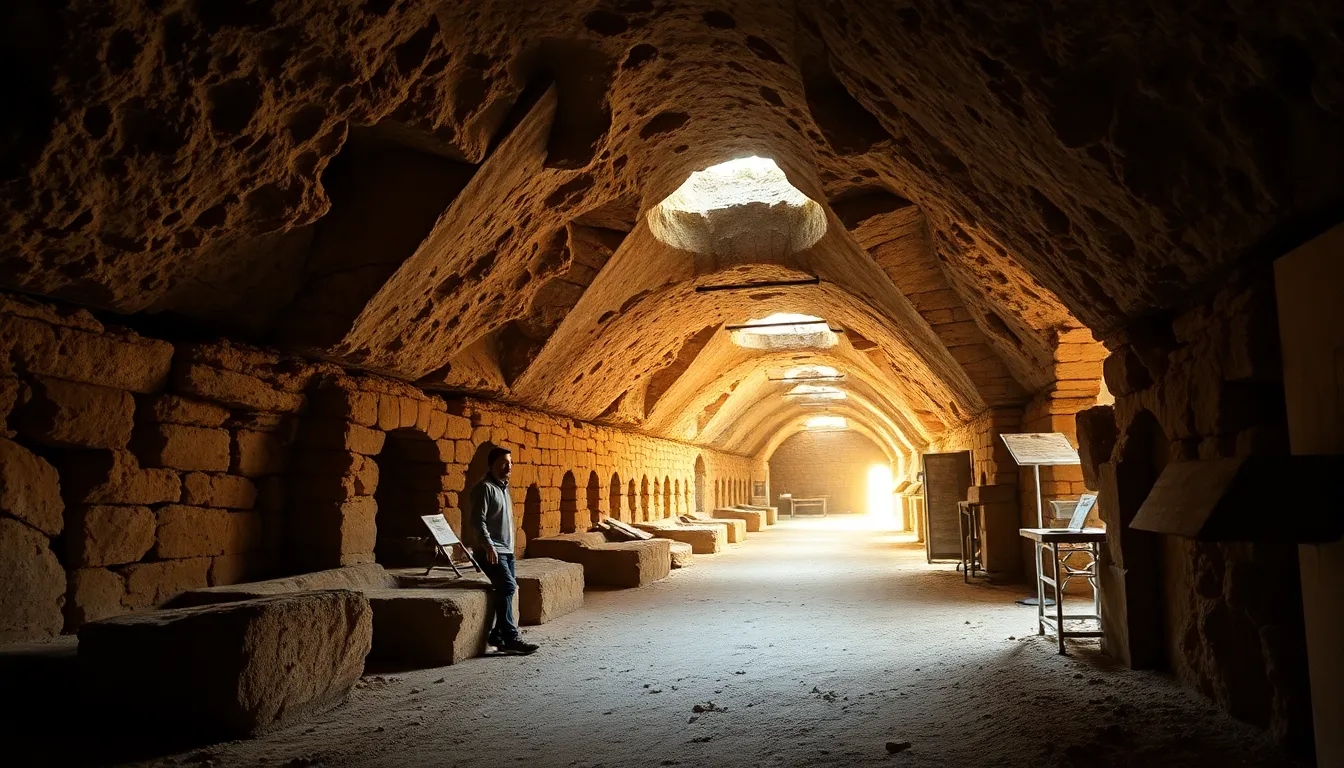
The first time I led a group down into the Catacombs of Callixtus, a pastor stopped halfway along a gallery, put his hand on the rough tufa wall, and said quietly that he had been preaching about the early church for thirty years and had never once stood in it. That is what this place does. Above ground, Rome shows you the church in triumph: gold, marble, domes. Down here, on the Appian Way, you meet the church as it actually began, in darkness, under threat, burying its dead with hope scratched into soft stone. For a faith group, the Catacombs of Callixtus may be the most grounding hour in all of Italy.
I want to walk you through what is down there, who is buried in it, and how to bring a group through it well.
The Largest Catacombs in Rome
The Catacombs of Callixtus stretch across an estimated twelve miles of galleries on four or more levels, descending in places more than sixty feet below the surface. They hold something on the order of half a million graves. The numbers are hard to grasp until you are inside and the corridors keep branching, level under level, going deeper than you expected.
They take their name from Callixtus, a deacon in the early third century who was put in charge of the cemetery by Pope Zephyrinus around 199 AD, and who later became pope himself. Under his administration the catacomb became the official burial ground of the church of Rome. That is the key thing to understand. This was not a hiding place dug in panic. It was an organized, administered Christian cemetery, expanded deliberately over generations.
I correct one common misunderstanding with every group. The catacombs were not secret hideouts where Christians lived to escape Roman soldiers. The Romans knew exactly where they were. Roman law actually protected burial sites. Christians dug downward because land in Rome was expensive and their numbers were growing, and because they wanted their own ground to bury believers in the hope of resurrection rather than cremate them as pagans did. People did sometimes gather here for worship at the tombs of martyrs, especially during persecution, but the catacombs were first and foremost a place to bury the dead. For how this fits the broader picture, see our overview of spiritual sites in Italy for faith travelers.
Why They Dug Down: Tufa and Hope
The engineering and the theology fit together here, and groups appreciate hearing both.
Rome sits on tufa, a soft volcanic rock that cuts easily when first exposed and then hardens as it dries in the air. Specialized diggers called fossors carved the galleries by hand, lining the walls with rectangular niches called loculi, stacked floor to ceiling like shelves. A body wrapped in cloth was laid in a niche and the opening sealed with a slab of marble or tile, often with the deceased’s name and a symbol carved into it. When a level filled, they simply dug down and started another. That is how you get twelve miles of tunnels.
The theology is in the symbols. Christians chose burial, not cremation, precisely because they believed in the resurrection of the body. The graves are not morbid. They are statements of confidence. The art and inscriptions carry the same message: the anchor for hope, the dove for the soul at peace, the fish, whose Greek letters spell an acrostic for “Jesus Christ, Son of God, Savior,” and the Good Shepherd carrying a lamb on his shoulders, the most common image in the early Christian catacombs. People who lived under the threat of execution decorated their tombs not with grief but with hope.
The Crypt of the Popes
The heart of the Catacombs of Callixtus is a chamber called the Crypt of the Popes, and it is the reason I will not let a group skip this catacomb for a smaller one.
In this single underground room, nine bishops of Rome from the third century were buried, along with several other church leaders. The archaeologist Giovanni Battista de Rossi, who rediscovered and excavated the crypt in the nineteenth century, called it “the little Vatican,” the central monument of the cemetery. The original Greek inscriptions naming the popes are still set into the walls. You are standing in the burial chamber of the leaders of the church during the very decades it was being hunted.
One of them is Pope Sixtus II, martyred in 258 AD. He was seized by Roman soldiers while leading worship in a cemetery during the persecution under the emperor Valerian and executed on the spot. His deacon Lawrence, one of the most beloved martyrs of Rome, died days later. When you tell a group that the man buried in this niche was killed for doing the very thing they are doing, gathering with believers underground, the room goes still.
The Crypt of Saint Cecilia
A few steps from the popes lies the crypt of Saint Cecilia, a young Roman noblewoman martyred in the third century and one of the most venerated of the early martyrs, later named patron of music. Her body was originally buried here before being moved to the church that bears her name in Trastevere. A copy of Stefano Maderno’s famous statue lies in the crypt, depicting her body as it was reportedly found when her tomb was opened in 1599: lying on her side, with marks at the neck. The original faded frescoes of her story still color the walls. It is a quieter, more intimate space than the Crypt of the Popes, and groups often linger here.
How to Bring a Group Through
A few practical things I have learned over many descents.
You go with an official guide, always. The catacombs can only be visited on a guided tour led by the staff who manage the site. You cannot wander on your own, and you should not want to. The galleries branch endlessly, and a guide keeps your group together and tells the story tomb by tomb. Tours run in multiple languages, so request English when you book.
Dress for the temperature. The catacombs hold steady around 15 degrees Celsius, roughly 59 Fahrenheit, all year. In the August heat above ground, that feels wonderful for about two minutes and then chilly. Tell your group to bring a light layer even in summer.
Mind the footing and the stairs. The floors are uneven and there are staircases down into the levels. For groups with members who have mobility limits, flag this in advance. It is not a flat, easy walk.
Book ahead for a group. Walk-in access for fifteen or more people is unreliable, especially in peak season. We reserve a dedicated group slot and an English-speaking guide ahead of time. Our group heritage tours page explains how that coordination works.
Pair it with the road and the other catacombs. Callixtus sits on the Appian Way, the ancient road Paul traveled into Rome, and the nearby Catacombs of San Sebastiano lie along the same route. Reading our guide to the Appian Way before you go ties the road and the graves together. For the dawn of Christian art specifically, the Catacombs of Priscilla on the other side of the city complement Callixtus beautifully.
You can see how we arrange a full early-church day in Rome on our Italy destination page.
FAQ: The Catacombs of Callixtus
What makes the Catacombs of Callixtus different from the other Roman catacombs?
Callixtus is the largest and was the official burial ground of the early Roman church. Its centerpiece is the Crypt of the Popes, where nine third-century bishops of Rome are buried with their original Greek inscriptions still in place. No other catacomb gathers that many early church leaders in one chamber. If your group sees only one catacomb, I steer them here for that reason, with the Catacombs of Priscilla as the second choice for its early Christian art.
Were the catacombs secret hiding places during persecution?
This is the most common myth, and the answer is no. The Roman authorities knew where the catacombs were, and Roman law protected burial grounds. Christians dug underground because land was scarce and expensive, and because they wanted to bury rather than cremate their dead in hope of the resurrection. Believers did sometimes gather at martyrs’ tombs to worship, especially during persecution, but the catacombs were primarily cemeteries, not hideouts.
Can children visit the Catacombs of Callixtus with a faith group?
Yes. Unlike the scavi beneath Saint Peter’s, the catacombs have no minimum age, and children can join the guided tour. The experience is humbling rather than frightening: cool stone galleries, carved symbols, and the story of the early church told tomb by tomb. Bring a layer for the cool air and be mindful of uneven floors and stairs with younger or older travelers.
How cold is it inside the catacombs?
The catacombs hold a steady temperature near 15 degrees Celsius, about 59 Fahrenheit, year-round. After the heat of a Roman summer day, that feels refreshing at first and then cool, so I tell every group to bring a light jacket or wrap regardless of the season above ground. The air is also humid, which is part of how the fragile painted walls have survived.
Do we need a guide, and can we book a private group tour?
A guide is required. The catacombs can only be visited on an official guided tour, both to keep visitors from getting lost in the branching galleries and to protect the site. Tours run in several languages, so you request English when you reserve. For a group of fifteen or more, booking a dedicated slot with an English-speaking guide well ahead of time is essential, especially in the busy spring and fall seasons. A group operator arranges this for you.
The Catacombs of Callixtus give a faith group something no basilica can: the church before the glory, when belief carried a real and present cost. Standing among those who paid it changes how people read the rest of Rome. If you want help building a Rome day that moves from these graves up into the great churches above, I would love to design it with you.
Contact us to start planning your group’s journey.