The Vatican: What Most Groups Miss Inside St. Peter’s
Everyone goes to St. Peter’s. And almost everyone walks the same route: entrance, nave, Michelangelo’s Pieta, dome, exit. What gets lost in that flow is the building itself.
Most groups spend their emotional energy in the Sistine Chapel earlier in the day. By the time they reach the Basilica, they are tired and the crowds are thick. Here is what I suggest instead. Give St. Peter’s its own morning. Arrive when the doors open, before the tour groups assemble. Walk past the Pieta, which you can return to later, and go straight to the Confessio, the sunken area directly below the altar. This is the site believed to hold St. Peter’s burial place. A faith group standing here, before the noise builds, will experience something the afternoon visitor never does.
The other thing most groups miss is the Vatican Grottoes beneath the Basilica. These are free to enter, rarely crowded, and contain the tombs of over ninety popes. For a Christian group, standing at the tomb of John Paul II in this quiet underground space carries more spiritual weight than most of the galleries above.
The Catacombs of Rome: Faith Under Persecution
The Catacombs are not a tourist attraction. They are the place where early Christians buried their dead and gathered to worship when doing so meant risking execution.
San Callisto is the largest and most historically significant, with over half a million burial niches across twelve miles of tunnels. The Crypt of the Popes contains the remains of nine bishops of Rome from the second and third centuries. San Sebastiano, slightly smaller, offers a more intimate experience and includes early Christian art scratched into the walls by people who had no idea their faith would one day fill the basilicas above.
What makes the Catacombs essential for a faith group is the scale of the commitment they represent. These were not symbolic gestures. The people buried here chose their faith knowing the cost. Walking through the tunnels with your congregation, seeing the fish symbols and anchor crosses carved by hand in dim light, creates a shared experience that connects your group’s faith to its earliest roots.
A practical note: the Catacombs maintain a cool temperature year-round. Bring a layer, even in summer. And book your group’s entry in advance. Walk-in access for large groups is not reliable.
Assisi: The Most Spiritually Complete City in Italy
If I could send every faith group to only one place in Italy outside of Rome, it would be Assisi.
The story of St. Francis is known in broad strokes. He was the son of a wealthy cloth merchant. He renounced his inheritance. He founded an order devoted to poverty and service. But being in Assisi changes how you understand that story. You walk the streets where Francis walked as a young man of privilege. You stand in the piazza where he stripped off his fine clothes in front of his father and the bishop, choosing poverty in the most public and irreversible way possible. That moment, which happened in this specific place, reshaped how Christianity understood the relationship between faith and wealth.
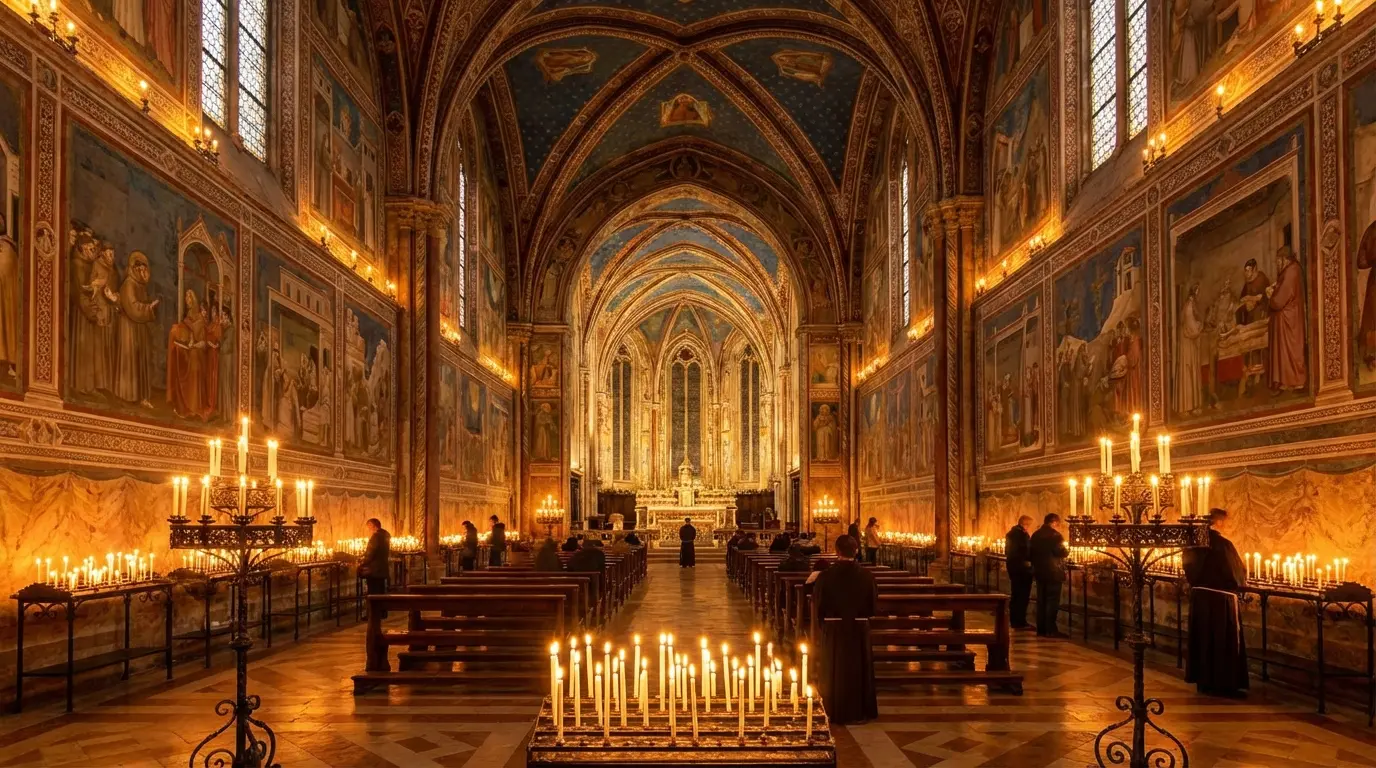
The Basilica of St. Francis is built into the hillside in two levels. The upper church holds Giotto’s fresco cycle depicting Francis’s life. The lower church, darker and older, leads to the crypt where Francis is buried. The contrast between the two levels is itself meaningful. The upper church is grand and visible. The lower church and the tomb are hidden, humble, underground. Francis would have preferred the lower one.
Beyond the Basilica, Assisi offers the Eremo delle Carceri, a mountain hermitage where Francis retreated to pray in the forest above the town. It is a thirty-minute drive up the slope of Mount Subasio, and the silence there is genuine. For groups with the time, an hour at the Eremo does more than a full day of scheduled site visits.
Ravenna: Byzantine Mosaics and the Eastern Church Legacy
Ravenna is not on most Italy itineraries, which is precisely why it matters for a faith traveler.
In the fifth and sixth centuries, Ravenna was the capital of the Western Roman Empire and later the seat of Byzantine rule in Italy. The mosaics created during that period are among the most important works of Christian art in existence. The Basilica of San Vitale holds mosaic panels of Emperor Justinian and Empress Theodora that are reproduced in every art history textbook, but seeing them in person is a different experience entirely. The gold tesserae catch light from the windows and shift as you move through the space. They were designed to do that. The builders understood that divine light should not be static.
The Mausoleum of Galla Placidia, small enough to hold perhaps fifteen people, contains a ceiling mosaic of a deep blue sky filled with gold stars. It is fifteen hundred years old and still produces an involuntary silence in nearly everyone who enters.
For groups interested in how Christianity moved between East and West, how Byzantine theology expressed itself in art, and how a small city in northern Italy became the meeting point of two civilizations, Ravenna is essential. It adds a half day to your itinerary and changes the entire conversation.
Padua and the Shrine of St. Anthony
Padua sits thirty minutes west of Venice by train, and most groups pass through without stopping. For Catholic travelers, that is a significant missed opportunity.
The Basilica of St. Anthony is one of the most visited pilgrimage sites in the world. Anthony of Padua, a Portuguese Franciscan friar who became one of the most beloved saints in Catholic tradition, is buried here. The chapel containing his tomb draws millions of visitors each year, and the devotion there is not historical or academic. It is active and present. You will see people praying, leaving written petitions, touching the walls of the chapel. For a faith group, witnessing that kind of living devotion connects the heritage sites you have visited to a faith that is still practiced with intensity.
The Scrovegni Chapel, also in Padua, holds Giotto’s greatest fresco cycle. These paintings, completed in 1305, changed the course of Western art. Entry is limited to small groups on timed reservations, so booking well in advance is necessary. But for a group that has seen Giotto’s work in Assisi, seeing his masterpiece in Padua completes the story.
Loreto: A Pilgrimage Site Most Americans Have Never Heard Of
The Basilica della Santa Casa in Loreto houses what tradition holds to be the walls of the house where Mary received the Annunciation. Whether you approach this with literal belief or historical curiosity, the site itself is remarkable. The small stone structure sits inside the larger basilica, enclosed by a marble screen designed by Bramante. Pilgrims have traveled here continuously since the thirteenth century.
Loreto sits on the Adriatic coast, about three hours from Rome by car. It is not convenient to reach, which is part of what makes visiting it meaningful. The effort to get there mirrors the pilgrim tradition. For groups traveling between Rome and the north, a stop in Loreto adds genuine pilgrimage character to what might otherwise feel like a transfer day.
The town itself is small and centered entirely on the basilica. An hour and a half is enough time to visit the Holy House, see the basilica’s interior, and walk the surrounding square. It is a stop that takes little time but adds significant spiritual depth, particularly for groups with a strong Marian devotion.
For Jewish Travelers: The Spiritual Weight of the Roman Ghetto
The Jewish Ghetto of Rome is not a museum. It is a neighborhood where Jewish families have lived for over two thousand years, making it the oldest Jewish community in Europe.
The Ghetto was formally established by papal decree in 1555, confining Rome’s Jews to a few blocks along the Tiber. The walls came down in 1870, but the community remained. The Great Synagogue, built in 1904 after emancipation, stands as a statement of presence and continuity. The museum inside tells the full arc of Roman Jewish history, from the ancient community that predates Christianity to the deportation of over a thousand Roman Jews to Auschwitz on October 16, 1943.
For Jewish travelers, the spiritual weight of this place is not just historical. It is personal. Walking past the stumbling stones, the small brass plaques set into the sidewalks marking the last known addresses of deportees, connects the ancient history to living memory. Standing inside the synagogue, which still holds regular services, connects that memory to the present.
I grew up in Jerusalem, the granddaughter of a Chief Rabbi, and I can tell you that the Roman Ghetto holds a particular place in Jewish heritage. The community here maintained its identity through centuries of restriction, persecution, and loss. Visiting it is not sightseeing. It is witness.
If your group includes both Jewish and Christian travelers, the Ghetto is a place where both communities can stand together in recognition of what happened here. That shared experience often becomes the most meaningful moment of the entire trip.
For more on planning your group’s journey through these sites and others, visit our Italy destination page.
FAQ
What are the most important Christian pilgrimage sites in Italy besides the Vatican?
Assisi is the most spiritually significant Christian site in Italy after Rome. The Basilica of St. Francis, with Giotto’s frescoes and Francis’s tomb, draws pilgrims from around the world. Beyond Assisi, the Catacombs of Rome offer a direct encounter with early Christian faith. Ravenna’s Byzantine mosaics represent some of the most important Christian art ever created. Loreto’s Santa Casa and the Shrine of St. Anthony in Padua are both active pilgrimage destinations with centuries of continuous devotion.
What is special about Assisi for Christian pilgrims?
Assisi is where St. Francis lived, renounced his wealth, and founded the Franciscan order. The city itself has been preserved in a way that allows visitors to walk the same streets Francis walked. The Basilica built in his honor contains Giotto’s fresco cycle of his life and his burial crypt. But beyond the Basilica, the mountain hermitage of Eremo delle Carceri and the quiet streets of the town itself create an atmosphere of spiritual stillness that most Italian cities simply do not offer.
Are the Catacombs of Rome appropriate for a faith group tour?
Absolutely. The Catacombs are one of the most meaningful stops for any Christian faith group. They are the burial places and secret worship sites of early Christians who practiced their faith under threat of death. The experience is not frightening or morbid. It is humbling. The narrow tunnels, the carved symbols, and the burial niches tell a story of courage that connects directly to the foundations of Christian practice. Children over age six are welcome, and guided tours are available.
What Jewish spiritual sites are worth visiting in Rome?
The Jewish Ghetto is the essential site, centered on the Great Synagogue and the Jewish Museum of Rome. The Ghetto’s streets, the memorial plaques for Holocaust deportees, and the active synagogue together tell a story that spans over two thousand years. Beyond the Ghetto, the Jewish catacombs of Vigna Randanini, less visited than the Christian catacombs, contain ancient Jewish art and inscriptions. The Arch of Titus in the Roman Forum, depicting the looting of the Jerusalem Temple in 70 CE, is also significant for Jewish heritage travelers.
Is Loreto a major pilgrimage site?
Loreto has been one of the most important Catholic pilgrimage sites in Europe since the thirteenth century, though it is less well known among American travelers. The Basilica della Santa Casa draws millions of visitors each year. For groups with a connection to Marian devotion, it holds deep significance. Even for groups without that specific tradition, the site’s continuous pilgrim history and its location on the Adriatic coast make it a worthwhile addition to an Italy heritage itinerary.