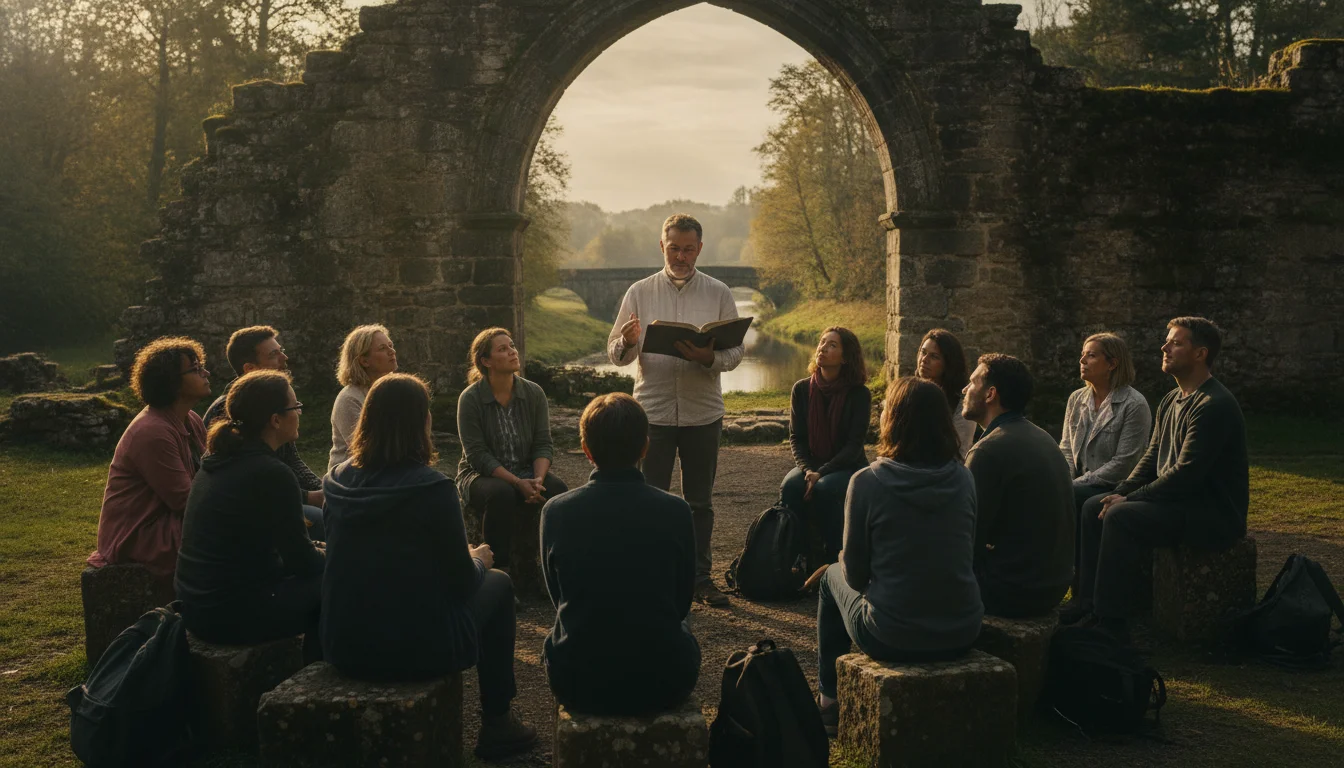
The question I hear most from first-time leaders is not about cost or dates. It is quieter than that, and they usually ask it near the end of the call, almost embarrassed: “What am I actually supposed to do over there?” A pastor or a rabbi will happily preach to three hundred people on a Sunday or a Shabbat, then worry that leading fifteen of them through Israel or Greece requires some travel skill they do not have. It does not. Your job on a heritage tour is the job you already do at home, moved into the places where the text was written.
I have built heritage journeys for more than forty years, and I want to tell you plainly what the leader’s role is, hour by hour, so you can picture yourself doing it. This is not a mystery, and it is not logistics work. Once you see how the day is actually divided, the whole trip stops feeling like something you have to run and starts feeling like something you get to lead.
The Short Answer: You Are the Shepherd, Not the Operator
Here is the distinction that settles most nerves. On a well-built trip there are two roles that never overlap. There is the operator, meaning the guide, the driver, the ground team, and me behind them, who handle every logistic. And there is you, the leader, who handles the people and the meaning. Those are different jobs, and you were only ever meant to do one of them.
You are not booking hotels, counting luggage, negotiating site entries, or reading a map on the coach. That is our work, and we do it so it stays invisible to you. What you do is pastoral and teaching work: you set the spiritual tone, you connect each place to Scripture and to your community’s own life, and you are present for your people in the moments that move them. When a congregant stands at the Western Wall for the first time, or reads Acts aloud at the site where Paul stood, they are not going to turn to the guide. They are going to look for you.
If you want the full picture of how a trip comes together from the first idea to departure, our complete guide to planning a group pilgrimage lays out the whole arc. This article stays zoomed in on one thing: what you personally do once the group is on the ground.
How the Leader and Guide Divide the Day
This is the part I most want you to see clearly, because it is where new leaders imagine the burden falling on them, and it does not.
A typical touring day has a rhythm, and the two roles hand off inside it. A guide is a licensed professional who knows the history, the archaeology, the routes, and the practical flow of a site. The guide carries the facts, the logistics, and the timing. You carry the heart.
Picture a morning at a single site. The guide gathers the group, explains what they are looking at, walks them through the history and the layout, and answers the “when” and “how” and “who built this” questions. That runs fifteen or twenty minutes. Then the guide does something deliberate: the guide steps back and hands the moment to you. Now you read the passage that belongs to that place. You offer a short reflection, a prayer, or in a synagogue group a teaching or a psalm. You tie the stones in front of everyone to the words they already know. Five minutes, sometimes ten. Then the group moves on, and the guide picks the logistics back up.
That handoff repeats all day. History from the guide, meaning from you. Neither of you is improvising, because a good guide has led faith groups before and knows exactly when to pass the moment over. Before the trip, you and I will talk through which sites you want to lead a devotion at, so nothing catches you off guard. You will get a day-by-day itinerary, and you can mark the stops where you want to teach and the ones where you would rather simply take it in with your people.
The evenings are yours too, but lightly. Many leaders gather the group after dinner for fifteen minutes to reflect on the day, share what struck them, and preview tomorrow. Some leaders do this every night, some only a few times across the trip. There is no rule. It is your group and your rhythm.
How a First-Time Leader Should Prepare
Preparation for a heritage tour is not travel logistics. It is spiritual and pastoral preparation, and it is lighter than you expect. Here is what actually helps.
First, know your itinerary spiritually, not operationally. You do not need to memorize hotel names or drive times. You do need to sit with the itinerary and ask, at each major site, “What passage lives here, and what do I want my people to feel?” A day at Capernaum, the Sea of Galilee, or the Areopagus in Athens becomes far richer when you have thought ahead about the two or three verses you will read there. An afternoon at a Holocaust memorial or an ancient synagogue asks for a different kind of preparation, quieter and more reflective. Walk the itinerary in your study before you walk it with your group.
Second, prepare your people, not just yourself. The best trips start months before departure. A short pre-trip gathering, a group study tied to the route, or even a single evening walking through where you will go and why does more for the experience than anything that happens at the airport. When your travelers arrive already primed, already reading Acts or the relevant history, the sites land differently. This is also where recruiting and preparation overlap, and if you are still building your group, our guide on how to recruit for a church trip covers the practical side.
Third, let the operator carry what the operator should carry. First-time leaders often try to become experts in flights, insurance, rooming lists, and payment schedules. You do not need to. That is exactly what a good faith tour operator absorbs. Choosing the right one is the single decision that determines how much falls on you, and our guide on how to choose a faith tour operator walks through what to look for. Get that choice right and your preparation shrinks to the pastoral work only you can do.
Fourth, pack light on responsibility, not just luggage. Give yourself permission not to know everything. You are allowed to say “I do not know, let us ask our guide.” Your people are not there for your archaeology. They are there for your shepherding.
How to Lead a Group With No Travel Experience
I have led pastors who had never left their own country. It made no difference to how well they led, and I will tell you why. Leading a group abroad is not a travel skill. It is a people skill, and you already have it.
The travel itself is handled. You are not navigating airports alone, renting vehicles, or deciphering foreign transit. You move with the group, and the ground team moves with you. A licensed guide meets you, a driver takes you, and I am reachable the entire time. The parts of international travel that intimidate people who have never done them are precisely the parts we remove from your plate.
What remains is what you do every week: caring for a group of people, reading the room, holding space for emotion, and pointing everyone back to the text. A congregant who feels anxious at the airport does not need a seasoned traveler. They need their pastor to say “we are together, and everything is arranged.” That reassurance is worth more than any travel experience, and no amount of frequent-flyer miles can substitute for it.
The one honest caution is this: do not try to be the expert on things you are not. New leaders sometimes overcompensate by fielding logistics questions themselves and getting them wrong. Route every “what time,” “where next,” and “is this water safe” question to the guide. Keep yourself in the role that only you can fill. Leaders who try to do both jobs get tired and distracted. Leaders who stay in their lane come home saying it was the most meaningful trip of their ministry.
If part of your hesitation is financial rather than logistical, know that on most group trips the leader travels free at fifteen or more paying travelers, which takes your own cost off the table entirely. We explain the mechanics in how pastors afford to lead a trip, and the specifics of the free seat in does the pastor travel free.
How to Co-Lead a Trip With Another Pastor
Co-leading is common and, done well, it is a gift to the whole group. Two leaders can carry more people, share the teaching, and cover for each other when someone needs personal attention. But it only works when the two roles are defined before departure, not improvised on the coach.
Here is how I coach co-leaders to divide it. Decide in advance who leads the devotion at each site, so you are not glancing at each other wondering whose turn it is. Many co-leaders simply alternate: one takes the morning site, the other takes the afternoon. Decide who is the pastoral first responder if a traveler gets sick, homesick, or overwhelmed, and let the other stay with the group. And agree on one point of contact for the operator, meaning one of you is my primary liaison, so instructions never get crossed.
Co-leading also opens a practical door on cost. On larger groups, the economics that make one leader free can sometimes extend to a reduced or complimentary second seat for a co-leader or a spouse. It is not automatic at the minimum group size, but it is worth raising early. Our guide on how many people you need for the leader to travel free explains where those thresholds sit, and it is a conversation best had while you are still building the group, not after.
One more thing about co-leading two congregations together, say a pastor and a colleague from a partner church, or a rabbi and a cantor. Agree ahead of time on the spiritual tone. Two leaders with slightly different styles is a strength when both have talked it through, and a source of quiet friction when they have not. Fifteen minutes on the phone before the trip settles it.
The Free Seat Exists So You Can Actually Lead
There is a reason the leader’s role and the free-leader model fit together. When your own cost comes off the table, so does your role as the trip’s accountant. You stop being the person worrying about the budget and become the person shepherding the group. That is the entire point of how these trips are structured. The operator carries the money and the logistics so your attention stays where only your attention can go.
You can see how the group experience is built on our group heritage tours page. But the short version is the one I opened with: your job over there is your job here, set inside the places that made the text real.
FAQ: The Pastor’s Role on a Heritage Tour
Do I need to know the history and archaeology to lead a group?
No. That is the guide’s job. A licensed guide carries the history, the routes, and the facts at every site. Your role is to connect each place to Scripture and to your community, to lead the devotions, and to shepherd your people. When a factual question comes up, pass it to the guide.
How much of the day am I actually leading?
Less than most leaders expect. At each major site the guide handles the teaching and logistics, then hands you a five to ten minute window for a reading, a prayer, or a reflection. Many leaders also gather the group briefly in the evenings. The rest of the day you travel with your people, present but not performing.
I have never traveled internationally. Can I still lead?
Yes, and it changes nothing about how well you will lead. The travel is handled by the ground team, the guide, and the operator. What the trip asks of you is pastoral care and teaching, which you already do every week. The intimidating parts of international travel are exactly the parts we remove from your plate.
How do two pastors share the leadership on a co-led trip?
Define the roles before departure. Decide who leads the devotion at each site, often by alternating morning and afternoon. Name one pastoral first responder for anyone who gets sick or overwhelmed, and one primary liaison with the operator. On larger groups, co-leading can also open a reduced or complimentary second seat, so raise it early.
What is the single most important thing I can do to prepare?
Prepare spiritually, not operationally. Sit with the itinerary and decide, at each major site, which passage you will read and what you want your people to feel. Then prepare your travelers with a pre-trip gathering or study. Let the operator carry the logistics so your preparation stays on the pastoral work only you can do.
If you are weighing whether you could lead a trip like this, the honest answer is that you almost certainly can, because the role is the one you already fill. Contact us and we will walk you through your itinerary, mark the stops where you will teach, and take everything else off your plate.