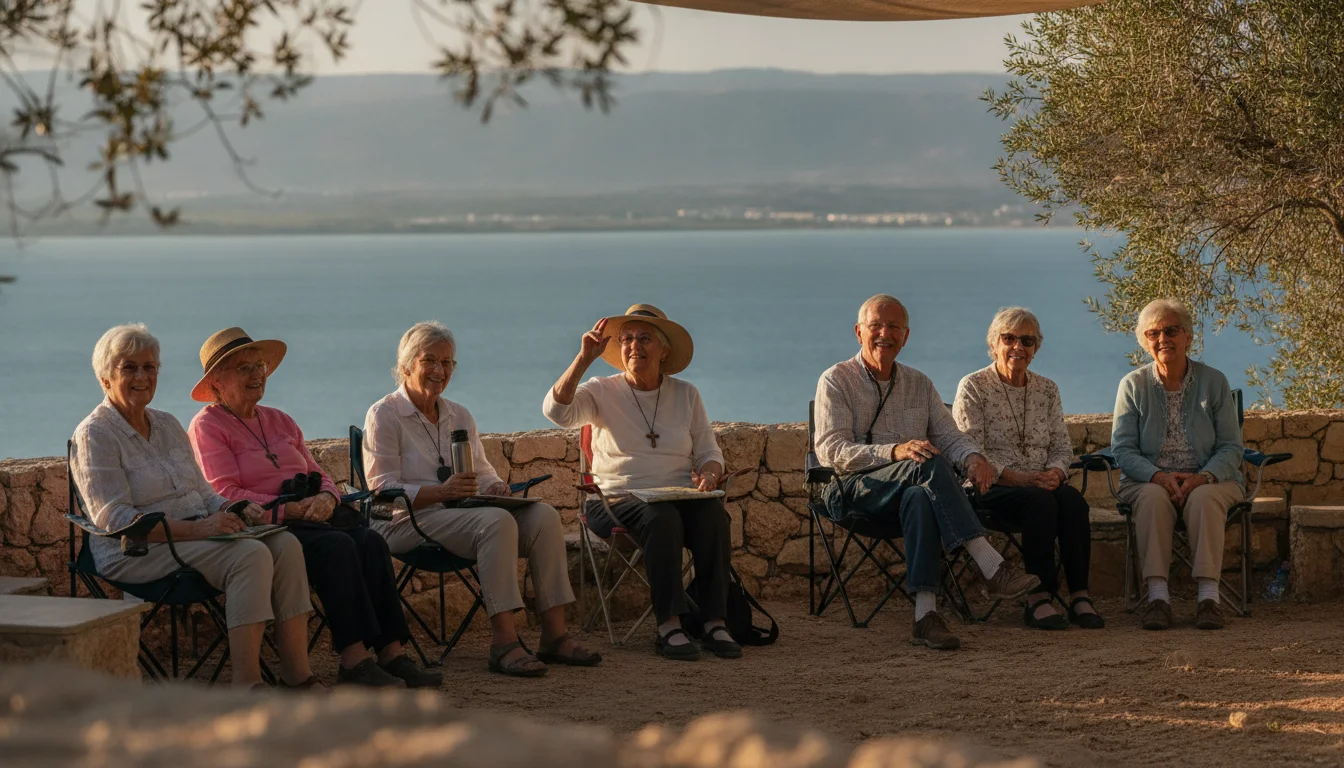
Most of the pastors and rabbis who call me about a senior trip to Israel are not worried about whether their people want to go. They know they do. The Holy Land sits at the top of the list for the older adults in almost every congregation I have worked with. What they are actually worried about is the part nobody talks about from the pulpit: the walking, the heat, the medications, the person with a bad knee, and how to lead a group of retirees through a country of stone steps and steep sites without wearing anyone out. That is the real question. And it is a good one, because a senior adult ministry trip to Israel is a very different animal from a college mission trip or a young couples’ getaway.
I have built heritage journeys for more than forty years, and I have led more senior groups through Israel than any other kind. I want to walk you through how to plan one well, from the organizer’s chair. Not how to be a tourist. How to lead. We will cover pacing, group size, cost, recruiting, the free leader seat, and the small logistics decisions that decide whether your people come home tired-and-glad or just tired.
Why Senior Groups Are the Best Groups to Lead in Israel
Let me start with the encouragement, because leaders often approach this trip bracing for problems. Senior adults are the ideal Israel travelers, and I mean that as a planning fact, not a compliment.
They have time. They can travel in the shoulder seasons when the weather is kinder and the sites are calmer. They have waited years, sometimes decades, for this trip, so they arrive present and grateful. They read Scripture on the bus without being asked. They do not need nightlife. And they will tell every friend in the congregation about it when they get home, which is how your next group fills itself.
The trade is simple. You design the trip around them instead of around a packed itinerary. Do that, and a senior group becomes the most rewarding trip you will ever lead.
Pace Is the Whole Game
If you take one thing from this guide, take this: with a senior group, pace is not a detail. It is the design.
A younger group can absorb a seven-site day and a late dinner. A senior group cannot, and forcing it does not build a stronger trip. It builds a bus full of exhausted people who miss the meaning of the places because their feet hurt. Here is how I pace a senior itinerary.
Fewer sites per day, held longer. Three meaningful stops beat six rushed ones. At the Sea of Galilee I would rather your group sit at the water and hear the Gospel read aloud than sprint between four Galilee sites checking boxes. The depth is the point.
A real rest built into the middle of the trip. On a ten or eleven day itinerary I put a lighter day around the midpoint. A morning at leisure, an afternoon at a site with shade and seating. People recover, and the second half of the trip lands better for it.
Mornings for the hard walking. Old City Jerusalem, Masada, the climbs and the uneven ground all go in the cool of the morning. Afternoons trend toward sites with more shade, more seating, and less elevation. The heat in Israel is not a rumor, and for older travelers it is the single biggest physical factor after walking.
Hotels chosen for location and elevators, not just star rating. A hotel five minutes from where you start the day saves your group forty minutes of morning walking they do not have to spend. That is a planning decision, and it matters more for seniors than any lobby.
Mobility and Medical: Ask Before You Book, Not at the Airport
This is the conversation leaders avoid, and avoiding it is the mistake. You do not need to be a nurse. You need to know your group before you build the trip.
Send every registrant a simple mobility and health form early, well before final payment. You are asking plainly: Can you walk a mile on uneven ground? Can you manage stairs without a rail? Do you use a cane, a walker, oxygen, or a scooter? What medications need refrigeration? Is there a dietary restriction we must plan meals around? None of these answers disqualify anyone. They shape the trip.
Once you know your group, you can build the right version of it. A group that is mostly mobile with two or three slower walkers can be handled with a good guide, a nearby drop-off, and a plan to seat those travelers at the harder sites. A group with several members who cannot manage long walks may want a wheelchair-accessible coach and an itinerary that favors sites with vehicle access. Israel handles accessibility better than most people expect, but only if you plan for it in advance rather than discovering the stairs on the day.
A few practical calls I make for every senior group. I keep a light day after the arrival flight, because a long flight hits older travelers harder and nobody should climb the Old City jet-lagged. I confirm the coach has a working restroom and I plan more stops than I would for a younger group. And I make sure travel insurance is not optional. For a senior group, medical coverage that includes evacuation is not a nice extra, it is a baseline, and I say so plainly to every family. Our guide on travel insurance for a church group walks through what to look for.
How to Plan a Senior Group Heritage Tour: The Organizer’s Sequence
When a leader asks me how to plan a senior group heritage tour from scratch, I give them the same order of operations every time. The order matters. Most trips that struggle got the sequence wrong, usually by picking dates last instead of first.
-
Set the dates before you announce anything. Vague interest never fills a group. A specific departure does. For seniors I favor spring or fall, when the weather is mild and the walking is bearable.
-
Choose the length honestly. Seven or eight days is a strong first Israel trip for an older group. Ten to eleven days covers Galilee, Jerusalem, and the south with room to breathe. Longer than that starts to tire the very travelers you are protecting.
-
Pick your operator before you recruit, not after. Your operator sets the pace, the hotels, the guide, and the accessibility plan. Choose one who builds for senior groups specifically. Our checklist on questions to ask a tour operator is built for exactly this call.
-
Lock the price per person and the payment plan. Seniors on fixed incomes commit faster when the number is firm and the deposits are spread out. A clear group trip payment plan removes the hesitation.
-
Then recruit. With dates, a length, a price, and an itinerary in hand, you are giving people a real decision instead of an idea.
For the full framework across any destination, our pillar guide on how to plan a group pilgrimage is the place to start, and the church group planning checklist keeps the moving parts in one place.
Recruiting a Senior Group Without Chasing People
Recruiting older travelers is different from recruiting a general church trip, and easier once you see the pattern.
Start with the people already leaning in. In most congregations there is a core of five to eight seniors who have wanted to see Israel their whole lives. Talk to them first. They are your foundation, and they bring others: a spouse, a widowed friend, the couple from their Sunday school class. A senior group grows through existing relationships, not flyers.
Give a single information session with real detail. Older travelers want to see the itinerary, the hotels, and the price in one sitting, from a person they trust. One well-run session with the dates and the map on the screen does more than months of bulletin announcements. Bring the physical realities into that room honestly: the amount of walking, the pace you have planned, the accessibility options. Seniors respect a leader who tells them the truth about their knees.
Tie the trip to something they are already living. A congregation walking through the Gospels, a class studying the life of Paul, a synagogue preparing for a milestone: the trip becomes the capstone of something already meaningful, and interest sharpens. For more on filling the group, see our guide on how to recruit for a church trip.
The Cost, and the Seat That Is Free
Now the part every organizer needs plainly. On our group model, when you gather fifteen or more paying travelers, the group leader travels free. That covers the leader’s full trip on the same terms as a participant: international flights, hotel accommodation, ground transportation, included site entries, and the group meals built into the itinerary.
For a senior ministry trip this changes the whole conversation. You are no longer asking your congregation to fund the pastor’s or rabbi’s expensive trip on top of everyone else’s. You are organizing a journey your people pay into, and the leader’s seat is part of how the economics are built. If you reach twenty-five or thirty travelers, which senior groups often do because couples travel together, there is sometimes room for a reduced or complimentary second seat for a co-leader or a spouse. Raise that early if it matters to you.
I go deeper on the numbers in two places. Our breakdown of the cost of a church trip to Israel shows what a real per-person price includes, and the piece on how pastors afford to lead a trip covers the free-leader math in full. The short version: the free seat is not a discount or a gimmick. Fifteen paying travelers generate enough within the trip’s costing to carry the person who made the trip happen, which is you.
The Leader’s Real Job Once the Logistics Are Handled
Here is what I most want you to hear. When the operator carries the pace, the hotels, the accessibility, and your seat, you are freed to do the one thing only you can do. You are not the trip’s accountant or its tour guide. You are its shepherd.
Your job on a senior Israel trip is to be present for your people in the places they have waited their whole lives to stand. To read the Beatitudes aloud on the Mount. To be there when a woman in her seventies is baptized in the Jordan or touches the stones of the Western Wall for the first time and weeps. These are among the most moving moments many of your members will ever have, and they will have them under your care. Everything in this guide, the pacing, the medical form, the right hotel, the free seat, exists to keep your attention there instead of on the spreadsheet.
You can see how the group experience comes together on our group heritage tours page, and the full route options on our Israel heritage page.
FAQ: Planning a Senior Adult Ministry Trip to Israel
How many people do I need for the group leader to travel free?
Fifteen paying travelers. At fifteen or more, the group leader’s full trip is covered, including flights, hotels, ground transportation, and included site entries. Below fifteen, the trip is still possible, but the leader pays a participant’s price. Our guide on how many people it takes for the leader to travel free explains the threshold.
How physically demanding is Israel for older travelers?
Manageable, if the trip is paced for it. The main factors are walking on uneven stone, stairs, and heat. A well-built senior itinerary schedules the hard walking for cool mornings, holds fewer sites per day, builds in a rest, and offers accessibility options for anyone who needs them. The demand is a planning choice, not a fixed obstacle.
What length of trip works best for a senior group?
Seven or eight days is a strong first Israel trip. Ten to eleven days covers Galilee, Jerusalem, and the south with room to breathe. I steer senior groups away from longer itineraries, because the extra days tire the travelers you are trying to protect more than they add.
When is the best time of year to bring a senior group?
Spring and fall. The weather is mild, the walking is comfortable, and the major sites are less crowded than in peak summer. Summer heat is hard on older travelers, and I plan around it. Our guide on the best time for a group trip to Israel has the full seasonal picture.
How far ahead should I start planning?
Nine to twelve months for a senior group. Older travelers need time to budget, arrange time off from caregiving or family duties, and complete medical and mobility forms without pressure. The extra runway is also your recruiting window. See how far ahead to plan for the full timeline.
If you are weighing a senior trip for your congregation, the honest answer is that it is more achievable than most leaders assume, as long as the trip is built for the people traveling it. Start with the dates and the pace, and the rest follows.
Contact us and we will help you build a senior itinerary and run the numbers for your group and your dates.