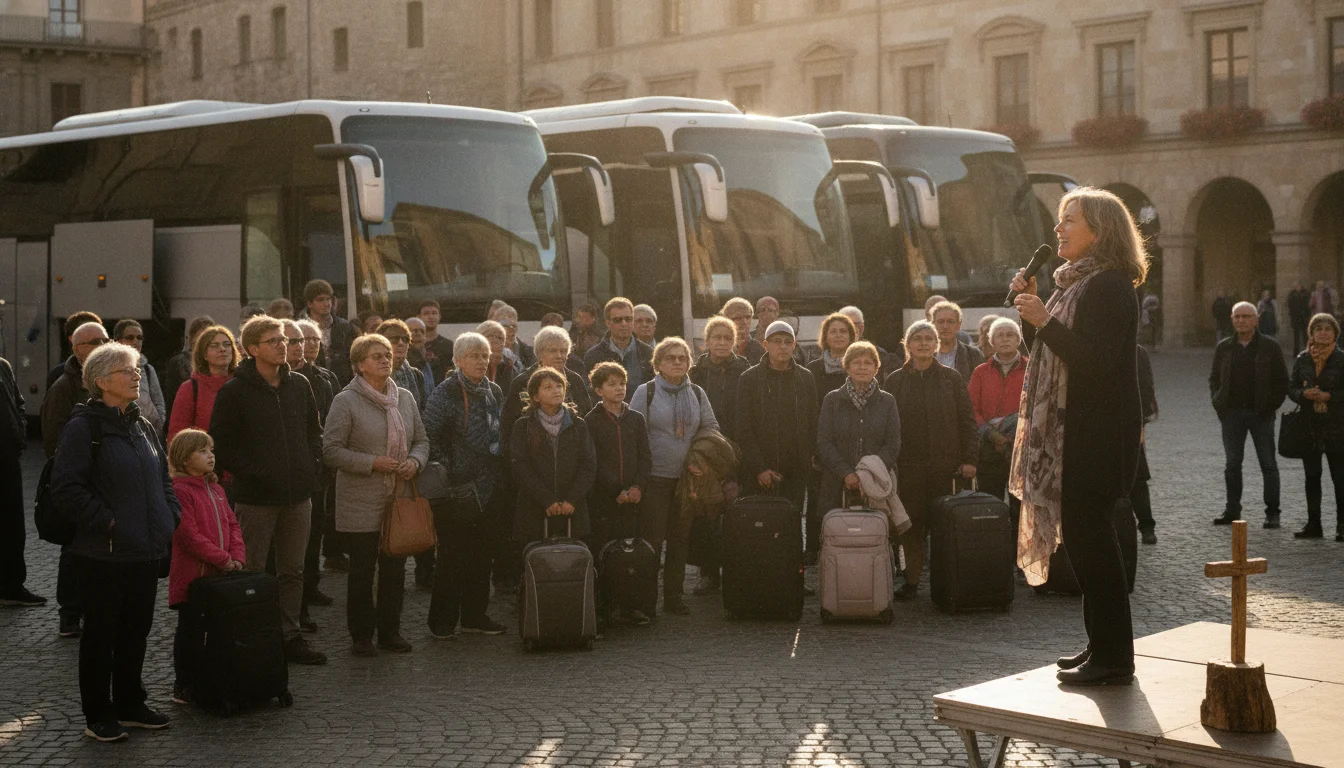
The first time a pastor tells me he wants to bring a hundred people, I can hear the worry underneath the excitement. He is not wondering whether his congregation wants to travel. He knows they do. He is wondering how one person is supposed to move a hundred travelers through airports, hotels, meals, and holy sites without the whole thing turning into a headcount he never finishes. That is the real question, and a good one.
I have built heritage journeys for more than forty years, and I have led groups of every size from a dozen up past a hundred. A hundred-person tour is not a bigger version of a fifteen-person tour. It is a different animal, and the leaders who do it well treat it that way from day one. This guide walks you through how I plan a group of that size: how the buses split, how the money works, how you handle a route that crosses borders, and how two congregations share one trip. If you want the full framework for any group size first, start with my complete guide to planning a group pilgrimage. This piece goes deep on the large-group problem specifically.
Start With the Number, Then Break It Down
A hundred people is an abstraction. Nobody experiences a trip as a hundred people. They experience it as the forty-something faces on their coach, the eight around their dinner table, the two in their hotel room. So the first thing I do with a large group is stop thinking about the hundred and start thinking about the units.
A modern touring motorcoach seats around fifty comfortably, and you never want to fill it to the last seat. Luggage, guides, a little breathing room, and the reality that people spread out all argue for planning around forty to forty-five travelers per coach. That means a hundred-person group is a two-bus trip, and often a two-and-a-half-bus trip once you account for spouses who join late and the friends your core travelers bring in.
Once you see it as two buses, the whole thing gets calmer. You are not leading a hundred people. You are leading two groups of roughly fifty, each with its own guide, its own coach, its own rhythm. Your job shifts from crowd control to coordination between two units that mostly run in parallel.
Splitting a Large Group Into Buses
This is the question I get most from leaders planning at scale, so let me be concrete about how the split actually works.
Keep Natural Groups Together
The worst way to split buses is alphabetically. The best way is by the relationships that already exist. Couples ride together, obviously. But go further. The Tuesday Bible study rides together. The families with teenagers ride together. The older travelers who prefer a calmer pace and a shorter walk to the coach ride together. When you assign buses along the lines your community already lives by, people feel at home from the first morning, and you spend zero energy managing friction that never starts.
Give Each Bus Its Own Guide and Leader
Each coach needs a professional guide, and each coach benefits from a group leader of its own. On a hundred-person trip you are not the only leader. You recruit or appoint a co-leader for the second bus, often an associate pastor, a lay elder, a trusted volunteer, or a spouse. That person is your counterpart, running the same day on the same route from the other coach. You stay in touch by phone through the day, but each of you owns your fifty.
Stagger, Do Not Stack
The single biggest logistical mistake with two buses is sending them into the same site entrance at the same minute. A hundred people at one turnstile is a bottleneck. Two buses of fifty, offset by twenty or thirty minutes, flow through a site smoothly, and each guide gets room to actually be heard. A good operator builds this staggering into the daily plan so Bus A takes the morning site first while Bus B takes breakfast a little longer, then they swap. You will barely notice it is happening, which is the point.
Plan the Meals and Hotels Around the Units
Restaurants and hotels care about your headcount as much as you do. A hundred-person dinner needs a venue that can seat a hundred and serve them in a reasonable window, which narrows your options in smaller heritage towns. Hotels rarely have a hundred beds in the room configuration a group wants on a single floor. Splitting into two hotels near each other, one per bus, is common and often better, because each group gets a lobby that belongs to them for the evening gathering. None of this is a problem. It is just planning, and it is exactly the planning your operator should be handling for you.
The Free-Leader Math at Scale
Here is where a large group actually works in your favor. On our model, the group leader travels free at fifteen or more paying travelers. That covers the leader’s full trip: flights, hotel, ground transportation, site entries, and the group meals built into the itinerary. It is not a discount. It is a complimentary seat that the economics of a full group absorb.
Now scale that up. A hundred-person trip is not one group of fifteen. It is closer to seven times that threshold. A group that size has real room in it, which is why large groups routinely unlock more than one free seat. The second bus leader, a co-leader, a spouse, in many cases each of those can be covered as the group grows. If you are building toward eighty or a hundred travelers, this is the first thing to raise with your operator, because the answer shapes how you recruit and who you invite to lead alongside you. I cover the underlying model in more detail in the piece on how many people you need for the leader to travel free and in the explainer on whether the pastor travels free.
The practical effect is that a hundred-person trip can send its entire leadership team at no personal cost, which is exactly what you want. You do not want your associate pastor paying out of pocket to help you shepherd fifty people. The group carries them, and it can, at this size.
How to Plan a Multi-Country Church Tour
Large groups and multi-country routes tend to arrive together, because once you are moving a hundred people you want the trip to be worth the effort, and the great heritage routes rarely stop at one border. A footsteps-of-Paul journey runs through Greece and Turkey. A Reformation route touches Germany and Switzerland. A Holy Land trip often adds Jordan for Petra and Mount Nebo. Here is how I keep a multi-country trip from becoming two disconnected trips stapled together.
Build the Route Around One Story, Not Two Countries
The countries are logistics. The story is the trip. When I plan Greece and Turkey together, I am not planning a Greece trip plus a Turkey trip. I am planning Paul’s journey, which happens to cross a modern border. Keep the narrative continuous and your travelers never feel the seam. The day you cross from Turkey into Greece should feel like the next chapter, not a new book. If a Pauline route is what you are weighing, the footsteps of Paul church trip guide and the Greece and Turkey groups overview both lay out how the two countries connect.
Respect the Border Crossings Early
Two countries means two sets of entry rules, sometimes two visas, and border transfers that eat time if you plan them badly. With a hundred people, a border crossing is a genuine logistical event, and it wants to sit at a natural break in the day, not in the middle of a packed sightseeing schedule. Your operator should know which crossings move groups quickly and which do not, and should build the day around that reality. This is not something to discover on the road.
One Currency of Coordination, Multiple Ground Teams
A multi-country trip has a ground operator in each country. The thing that keeps it seamless is a single operator coordinating all of them, so the coach that drops you at the border matches the coach that picks you up, the hotel handoffs line up, and nobody is left waiting because two local teams never spoke. When you interview operators, this is the capability to probe. Ask exactly how they handle the handoff between countries. The questions to ask an operator guide has the full list I would use.
Combining Two Churches on One Group Trip
Some of the best large groups I have run were not one congregation of a hundred. They were two congregations of fifty who decided to travel together. This is a genuinely smart way to reach the numbers that unlock the free seats and the better group rates, and it maps almost perfectly onto the two-bus structure. But it only works if you handle a few things up front.
Decide Who Leads What Before Anyone Signs Up
Two churches means two leaders, and the trip needs clarity about who owns what. My advice is simple. Each church leads its own bus. Each pastor shepherds their own people, teaches their own devotions, and handles their own congregation’s questions. You coordinate as equals on the shared logistics, the route, the dates, the pricing, but you do not try to merge two congregations into one undifferentiated crowd. People came with their church. Let them travel with their church.
Align on Theology and Tone Early
Two congregations may study the same Bible and still lead a trip very differently. One wants a contemplative pace with long reflection at each site. One wants energy, singing, and a fuller daily schedule. Neither is wrong, but you want to know before you are standing at the Sea of Galilee discovering you planned different trips. A single honest conversation early settles it. Usually the answer is that each bus runs the tone its own leader prefers, and the groups come together for the moments that benefit from being shared.
Split the Money Cleanly
Two churches sharing a trip need a clean financial arrangement so nobody is chasing the other for payments. The cleanest approach is that each church collects from its own travelers and pays its own share to the operator on its own schedule, rather than pooling everything through one account. It keeps the friendship intact, because money is the thing that strains partnerships fastest. A structured group trip payment plan makes this straightforward, and it is worth setting up before you take a single deposit.
The Timeline for a Group This Size
A hundred-person trip needs more runway than a small group, and the gap is mostly about recruiting, not logistics. For fifteen to thirty travelers, six to nine months works. For eighty to a hundred, I want nine to twelve months, and I am happiest at a year. That lead time is what lets people budget, request time off, and commit, and it gives you the months you need to grow two full buses. If the trip is timed around a holiday season or a specific anniversary, add more. The how far ahead to plan guide breaks the timeline down by group size, and the church group planning checklist gives you the task list to work against.
FAQ: Planning a Group Tour for 100 People
How many buses do I need for a group of 100?
Two, and often two and a half once late joiners are counted. Plan around forty to forty-five travelers per motorcoach rather than filling every seat, so you have room for luggage, guides, and comfort. Each bus gets its own professional guide and its own group leader.
How do I split 100 people into buses without upsetting anyone?
Split along the relationships that already exist rather than alphabetically. Keep couples, families, Bible study groups, and friends together, and group travelers who prefer a calmer pace on the same coach. When people ride with the community they already belong to, the buses feel like home from day one.
Can I combine two churches on one group trip?
Yes, and it is one of the smartest ways to reach the numbers that unlock free leader seats and better group rates. Each church leads its own bus and collects from its own travelers, you coordinate as equals on route and dates, and you align on tone early so both congregations get the trip they wanted.
How do I plan a multi-country church tour for a large group?
Build the route around one continuous story rather than two separate countries, place border crossings at natural breaks in the day, and use a single operator who coordinates the ground teams in each country. That is what keeps the handoff between countries invisible to your travelers.
How far ahead should I start planning a trip for 100 people?
Nine to twelve months, and a full year is better. The extra runway is mostly about recruiting two full buses and letting people budget and request time off, not about booking. Trips timed around a holiday season want even more lead time.
A hundred-person trip sounds daunting until you stop seeing a hundred people and start seeing two buses, a leadership team the group covers, and a story worth crossing borders for. That is a trip you can lead. See how the large-group experience comes together on our group heritage tours page.
Contact us and we will help you build the route, split the buses, and run the numbers for a group your size.