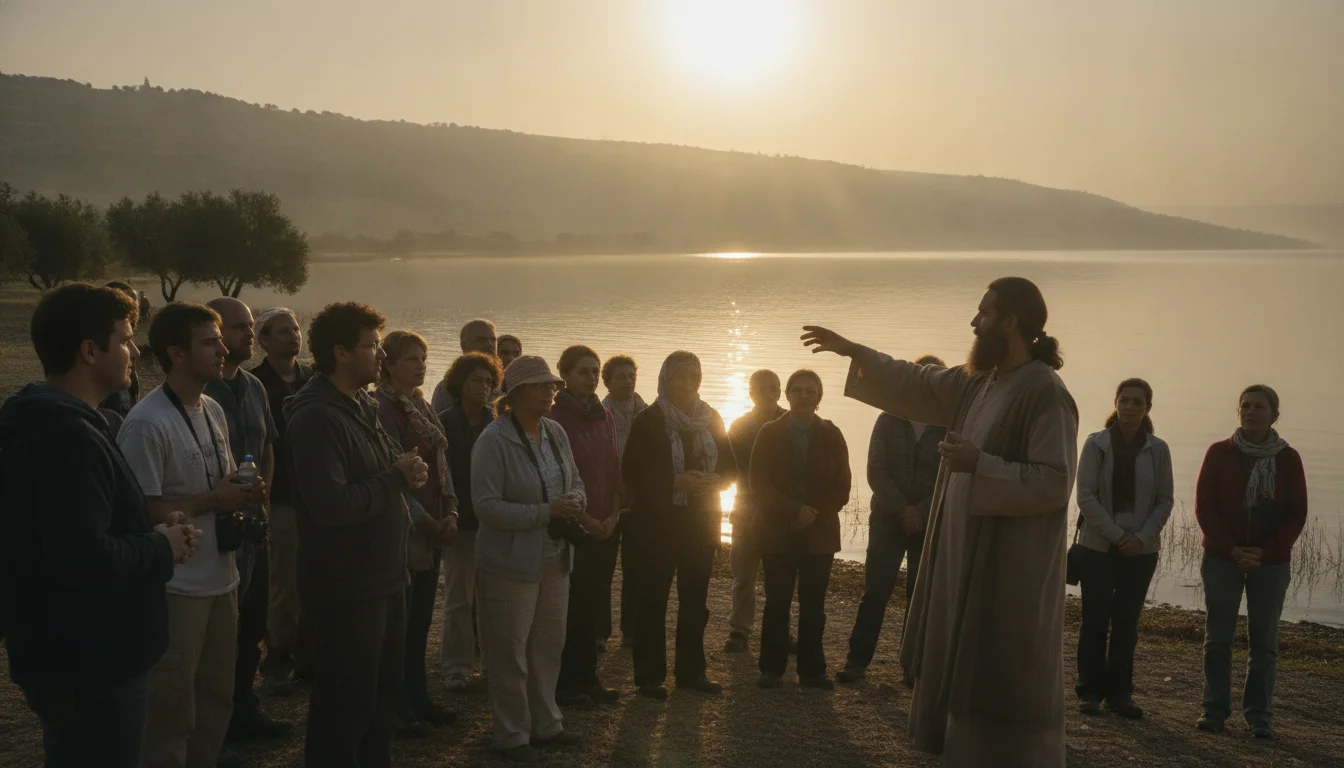
Most leaders who call me about a Messianic Jewish heritage tour are carrying two questions at once, and only one of them is on the surface. The surface question is logistics: where do we go, how long, what does it cost. The quieter question is whether they can actually pull it off, whether a congregation their size can fill a group, and whether they, the leader, are supposed to somehow fund their own seat on top of doing all the work. I want to answer both, because the planning only feels heavy until you see how the pieces fit.
I have built heritage journeys for more than forty years, and I have walked Israel with Messianic congregations, church groups, and synagogue communities more times than I can count. Messianic Jewish heritage tour planning has its own rhythm. It is not a Christian pilgrimage with a few Jewish stops added, and it is not a standard Israel package with a spiritual label. It sits in its own place, honoring both the Jewish roots and the faith in Yeshua that your community holds together. Let me walk you through how to plan it as the organizer, from the first idea to the group that actually boards the plane.
Start With Your People, Not the Map
The instinct is to open a map of Israel and start pinning sites. I would ask you to do the opposite first. Before a single location, answer this: who is this trip for, and what do you want them to walk away carrying?
A Messianic congregation is rarely one single profile. You have families who grew up in the faith, people who came to Yeshua later in life, some with deep Jewish background and some newer to it. A tour that lands for all of them is built around shared moments, not a checklist of ruins. When I plan with a leader, we name the three or four experiences that matter most to that specific community first. An immersion in the Jordan. Shabbat in Jerusalem. Standing where the early believers stood. Then the itinerary gets built to serve those moments, not the other way around.
This matters for you as the organizer because it makes recruiting far easier. When you can tell your people exactly what the trip is for, in language that fits your community, they decide faster. Vague interest never fills a group. A clear purpose does. If you want the full framework for building a group trip from the ground up, our complete guide to planning a group pilgrimage lays out every stage in order, and it applies directly to a Messianic itinerary.
The Free-Leader Model, and Why It Changes the Whole Decision
Here is the part that takes the weight off your shoulders. When you gather fifteen or more paying travelers, the group leader travels free. Your full trip is covered: flights, hotels, ground transportation, site entries, and the group meals built into the itinerary. You are not funding your own seat on top of leading. You are the reason the group exists, so the model is built around your seat being the covered one.
This is not a discount or a partial credit. It is a complimentary spot built into the economics of a group booking. Fifteen paying travelers generate enough margin within the trip’s costing to carry one more, and that one is you. For a congregation, this reshapes the entire conversation. You are no longer asking your community to send the leader on an expensive trip. You are organizing a journey your people pay into, and your participation is part of how it is structured.
I want you to sit with what that frees up, because it is more than money. When your seat is handled, your attention is handled too. You stop being the trip’s accountant and become its shepherd, which is the job you actually signed up for. If you want to see exactly how leaders make the cost work for themselves and their boards, how pastors and leaders afford to lead a trip walks through the numbers, and does the leader really travel free answers the question people ask me most.
What Happens Below Fifteen
Smaller groups are absolutely possible. We run trips for ten to fourteen people regularly, and they can be wonderful. They simply do not qualify for the free-leader benefit, because the fixed costs of a trip get spread across too few travelers to carry a complimentary seat. In that range, the leader pays a participant’s price, or the group agrees to absorb a small premium to cover the leader.
My honest advice: if you have twelve committed and a few maybes, start planning anyway. Interest firms up once people see real dates and a real itinerary. I have watched groups cross from thirteen to seventeen in the final two months simply because the trip became concrete. For the exact math on the threshold, how many people you need for the leader to travel free spells it out.
Best Heritage Sites for Messianic Groups
This is the question I get asked to answer directly, so let me answer it directly. When people search for the best heritage sites for Messianic groups, they are really asking which places hold both the Jewish roots and the presence of Yeshua in one visit. Israel does this better than anywhere, because for a Messianic community these are not two separate stories. They are one story.
Here is how I group the sites that matter most, and why each earns its place on the itinerary.
Jerusalem and the surrounding hills. This is the heart of the trip. The Western Wall for prayer and the weight of the Jewish covenant. The Southern Steps of the Temple, where Yeshua and the early believers actually walked and taught. The Mount of Olives and the Garden of Gethsemane. The Garden Tomb for a quiet resurrection reflection. The City of David, where the biblical story runs literally under your feet. Plan Shabbat in Jerusalem if you can. For a Messianic group, a Friday evening in the holy city carries both the ancient rhythm of the Jewish week and the fulfillment your community reads into it.
The Galilee. The north is where the ministry of Yeshua unfolded, and it is also where you slow the whole group down. Capernaum, the town he made his base, with its ancient synagogue. The Mount of Beatitudes above the lake. A boat on the Sea of Galilee. Magdala, with its first-century synagogue uncovered only recently, is one of the most moving Messianic stops in the country because it is a Jewish house of worship from exactly that generation.
The Jordan River. For many Messianic groups this is the emotional center of the entire journey. An immersion in the Jordan, whether a first one or a renewal, becomes the memory people talk about for years. Build time for it. Do not rush it.
Roots and remnant sites. Caesarea, where the message first opened to the nations. Masada and Qumran by the Dead Sea, holding the story of the Jewish people, the Dead Sea Scrolls, and the endurance of the nation. Tel Dan and Shiloh for the deeper Hebrew scriptures. These sites keep the Jewish heritage load-bearing in the trip rather than decorative.
You do not fit all of this into a short trip, and you should not try. A well-built Messianic itinerary usually runs nine to eleven days, moving from the Galilee in the north down through the center to Jerusalem, so the journey builds toward the holy city the way the biblical story does. If you want a sense of how a full route comes together day by day, our ten-day Holy Land itinerary is a strong starting frame, and the Israel heritage destination page shows the regions the trip can cover.
Building the Group That Reaches Fifteen
This is the part leaders worry about most, so let me be practical.
You do not need to recruit fifteen strangers. You need the eight to ten people in your community who already want to go, then let them bring others. Every heritage trip I have run started from a small core of committed travelers. Couples come together. Friends bring friends. Home groups and Torah study circles travel as a unit. Fifteen is reachable when you start from the people leaning in, not the whole membership roll.
Give people a real reason and a real date. “We might do an Israel trip someday” never converts. “We are immersing in the Jordan and keeping Shabbat in Jerusalem next spring, ten days, here is what we will see” gives people something to decide about. Tie the trip to something your congregation is studying or a season it observes, and the interest sharpens. For the recruiting playbook specifically, how to recruit for a congregation trip is the most practical piece we have written on filling seats.
Plan far enough ahead. Six to nine months is the sweet spot for a group of fifteen to thirty. That gives people time to budget, request time off, and commit, and it gives you runway to build interest, which is the real work. Trips timed around the Jewish holidays or the high season want nine to twelve months. If you are wondering about timing, how far ahead to plan a group trip covers the full calendar.
One more practical piece: offer a payment plan from day one. Nothing loses a committed traveler faster than a single large sum due all at once. Monthly installments keep your group intact through the months before departure. How a group trip payment plan works shows the structure I recommend.
Choosing Who Runs the Trip on the Ground
The itinerary is only as good as the people executing it in Israel. For a Messianic group specifically, you want an operator who understands that your community is neither a standard church group nor a standard Jewish heritage tour, and who can staff you with a guide fluent in both worlds. That guide is the difference between a trip that informs and a trip that moves people.
Ask hard questions before you commit. Who is the licensed guide, and have they led Messianic groups before? How is the pacing built for a mixed-age congregation? What is included, and what is not? The questions to ask a tour operator gives you a full list to bring to that first call, and how to choose a faith tour operator explains what separates a real heritage operator from a booking agent. When you are ready to see real numbers for your group and dates, you can request a custom quote and we will build it around your community, not a template.
The Leader’s Real Job
Here is what I most want you to hear as you plan. When the free-leader model takes your personal cost off the table, and a real operator takes the logistics off your plate, what is left is the reason you wanted to do this in the first place. Your job on a Messianic heritage journey is to shepherd your people through it. To read the text aloud at the place it happened. To stand with someone as they come up out of the Jordan. To hold the moment on the Southern Steps and let it land.
That is the whole point of planning it well. Everything I have laid out, the free seat, the group of fifteen, the right sites, the right operator, all of it serves one outcome: you get to lead, and your people get to encounter the land that holds their story.
FAQ: Planning a Messianic Jewish Heritage Tour
How many people do I need for the group leader to travel free?
Fifteen paying travelers. At fifteen or more, the leader’s full trip is covered, including flights, hotels, ground transportation, and site entries. Below fifteen, the trip is still possible, but the leader pays a participant’s price or the group covers the seat by agreement.
How long should a Messianic Jewish heritage tour be?
Nine to eleven days is the range I recommend. That gives you time to move from the Galilee in the north down to Jerusalem without rushing, and to build in the slow moments, like an immersion in the Jordan or Shabbat in the holy city, that a Messianic group came for.
What are the essential sites for a Messianic group in Israel?
Jerusalem is the heart: the Western Wall, the Southern Steps, the Mount of Olives, and the Garden Tomb. In the Galilee, Capernaum, the Mount of Beatitudes, and Magdala with its first-century synagogue. The Jordan River for immersion. Then roots sites like Caesarea, Masada, and Qumran that carry the Jewish heritage of the nation.
How far ahead should I start planning?
Six to nine months for a group of fifteen to thirty. Nine to twelve months if you are timing the trip around the Jewish holidays or the high season, or building toward a larger group. Most of that lead time is for recruiting your people, not just booking.
What if my congregation is small and I cannot gather fifteen?
We run trips for ten to fourteen, so the journey can still happen without the free-leader benefit. Many groups that start at twelve reach fifteen before departure once the dates and itinerary are real, so it is worth beginning the planning conversation even if you are not there yet.
If you are weighing whether a Messianic Jewish heritage tour is realistic for your community, start with the group. Once you have your core, the free-leader math usually tips the rest of the decision. You can see how the group experience works on our group heritage tours page.
Contact us and we will help you run the numbers for your congregation and your dates.