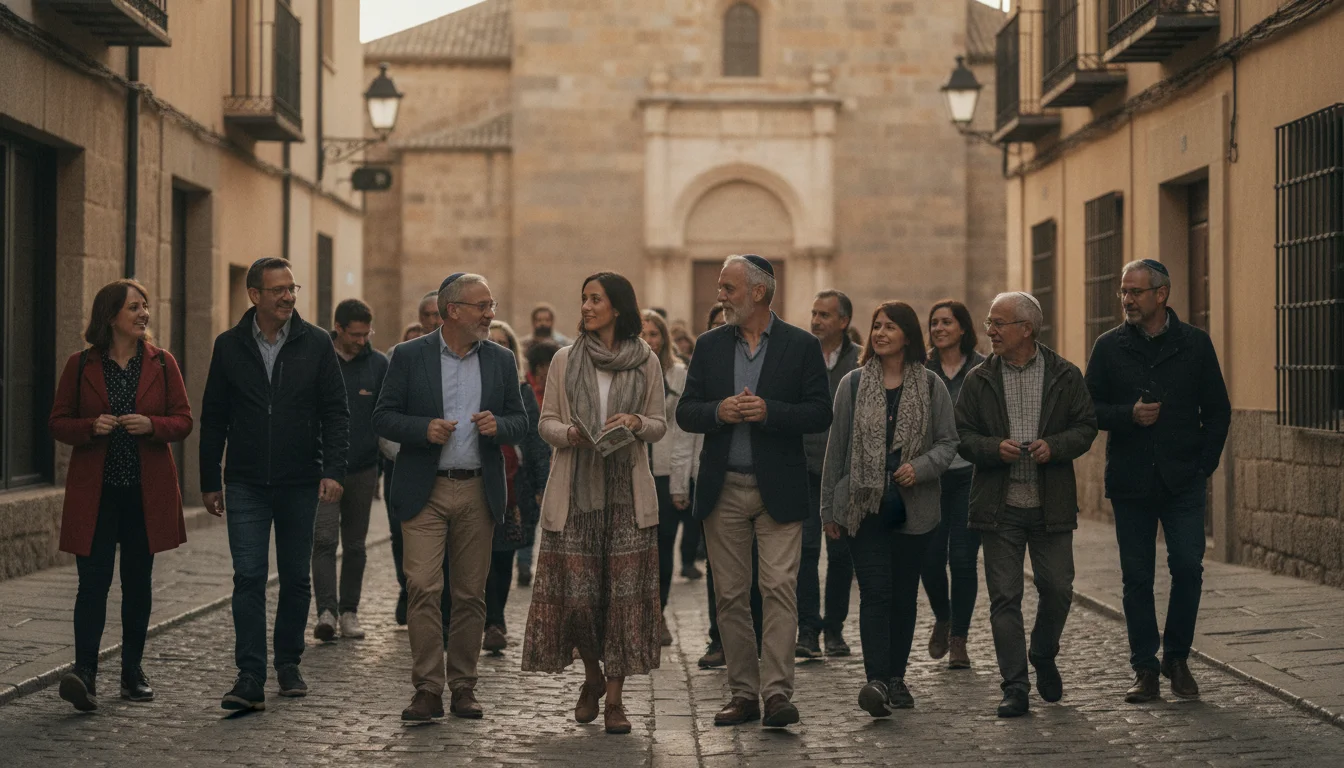
When a rabbi or a lay leader first calls me about taking the congregation to Spain, the trip already exists in their head. They have read about Toledo. Someone in the community traces their family name back to Seville or to a village near Girona. There is a bar or bat mitzvah class that just finished studying the Expulsion, or an adult education series on the Golden Age of Spanish Jewry. The desire is real. What they do not yet have is the shape of it: how many people it takes, what it costs, who leads, and whether the whole thing is actually feasible for a congregation their size.
I have built heritage journeys for more than forty years, and Spain is one of the routes I get asked about most. So let me give you the shape of it. This is written for you, the organizer, the person who will recruit the group, carry the logistics, and stand in front of your community and say “we are going.” Not for the individual traveler. For the leader.
What a Congregation Trip to Spain Jewish Heritage Actually Covers
Spain is not one Jewish site. It is a country layered with them, and a good congregation trip moves through several worlds in a single journey.
The classic route runs through the three great Sephardic centers. Toledo, where you can stand inside the Sinagoga del Tránsito and the Santa María la Blanca, two synagogues that survived because they were turned into churches. Córdoba, with the small medieval synagogue in the Judería and the statue of Maimonides a short walk away. Seville and Girona, each with an old Jewish quarter you can walk end to end. Around these anchors, we build in the wider story: the Alhambra in Granada, where the Expulsion decree was signed in 1492, and the coastal towns where families gathered before they left.
For a congregation, the point is not to tick off buildings. It is to give your people a place to stand inside their own history. A group standing together in the Tránsito, reading the Hebrew inscriptions still carved into the walls, is having an experience no classroom delivers. Your job as leader is to hold that moment. My job as the operator is to make everything around it invisible: the coach, the local guides, the hotels, the meals, the access.
If you want the full planning frame before you get into the country-specific detail, our guide to planning a group pilgrimage walks through the decisions every faith-group leader faces, and it applies just as cleanly to a Jewish heritage journey as to a Christian one.
The Free-Leader Model, and Why It Changes the Decision
Here is the part that usually settles the question for a congregation.
When your group reaches fifteen paying participants, the group leader travels free. That means your full trip cost is covered: international flights, hotel accommodation, ground transportation, site entry fees, and the group meals built into the itinerary. It is not a discount or a partial credit. It is a complimentary seat built into the economics of a group booking.
The reason this matters for a synagogue is simple. You are no longer asking the community to fund the rabbi’s expensive trip on top of everyone else’s. You are organizing a journey your members pay into, and your seat is structured as part of how the group works. A group of fifteen carries enough margin within its costing to absorb one more traveler, and that traveler is the person who made the group exist in the first place.
Larger groups make the math friendlier still. A group of twenty-five or thirty often has room for a reduced or complimentary second seat, which many congregations use for a spouse, a cantor, or a co-leader who helps carry the pastoral load. If you are building toward a bigger group, raise that early so we can plan around it. For a fuller breakdown of who qualifies and how the seat is funded, see how the pastor or leader travels free and how many people you need for the leader-free benefit. The mechanics are the same whether the leader is a rabbi or a pastor.
What Happens Below Fifteen
Smaller groups are absolutely possible. We run congregation trips for ten to fourteen people regularly, and they are often the warmest ones. They simply do not qualify for the free-leader seat, because the economics that fund it start at fifteen. In that range, the leader either pays a participant’s price or the group agrees to absorb a small premium to cover the leader’s seat.
If you are sitting at twelve committed with a handful of maybes, my advice is to start planning anyway. Interest firms up the moment people see real dates and a real itinerary. I have watched congregations move from thirteen to eighteen in the final two months for exactly that reason. The trip stopped being an idea and became a thing you could sign up for.
Synagogue Heritage Trip to Spain and Portugal: Should You Add Portugal?
A question I hear often from synagogue leaders: should we make it Spain and Portugal, not just Spain?
For many congregations, yes, and here is why. The Sephardic story does not end at the Spanish border. When Jews were expelled from Spain in 1492, tens of thousands crossed into Portugal, only to face forced conversion a few years later. Portugal carries the second half of the story, and it carries it beautifully.
A combined synagogue heritage trip to Spain and Portugal usually adds Lisbon and the town of Belmonte, where a community of hidden Jews, the Marranos, kept their traditions in secret for five centuries and only returned openly to Judaism in living memory. Standing in Belmonte with a congregation is one of the most moving stops I know. It is the story of survival, not just loss. From there, Porto and its restored Kadoorie Synagogue round out the Portuguese leg.
Adding Portugal typically extends the trip by three or four days and changes the recruiting conversation in your favor, because it turns a good trip into a complete arc: expulsion, hidden faith, and return. If your community has Portuguese Sephardic roots, or if you want the fuller narrative, it is worth the extra days. You can see how each country’s route is built on our Spain heritage page and our Portugal heritage page, and we can join them into one itinerary for your group.
Church Group Heritage Tour to Spain and the Camino
Spain is not only a Jewish heritage destination, and I want to speak directly to the pastors and church leaders reading this, because the same free-leader model and the same planning logic apply to you.
For a church group, the great Spanish journey is the Camino de Santiago, the pilgrimage route that has drawn Christians to the tomb of Saint James in Santiago de Compostela for over a thousand years. You do not need to walk the full 500 miles to make it meaningful. Most congregation groups I build walk selected stages, the final stretch into Santiago being the most common, and travel the rest by coach, so that people of every fitness level can take part. The point of a group Camino is not endurance. It is walking together, a congregation moving as one body toward a shared destination, with worship and reflection built into the days.
Many church groups also pair the Camino with the Jewish heritage sites, because the story of Spain’s faith is genuinely woven together, and a thoughtful itinerary can honor both. A pastor leading a congregation through Toledo, where church and synagogue and mosque stood within the same walls, has a rich teaching moment on their hands.
If you are a pastor weighing the leadership side of this, two of our guides speak straight to it: how pastors afford to lead a trip covers the free-seat economics from the church side, and how to choose a faith tour operator helps you vet who you hand your group to.
How to Build a Group That Reaches Fifteen
This is the work leaders worry about most, so let me be practical.
Start With Your Core, Not the Whole Roster
You do not need to recruit fifteen strangers. You need the eight or ten people in your community who already want to go, and then you let them bring others. Every heritage group I have run started from a small committed core. Couples come together. Friends bring friends. A study group travels as a unit. Fifteen is reachable when you begin with the people leaning in, not the full membership list.
Give People a Real Date and a Real Reason
Vague interest never fills a group. A specific journey on specific dates does. “We are walking the Sephardic route through Toledo, Córdoba, and Seville next April, ten days, here is what we will see” lets people decide. “We might do a Spain trip sometime” converts no one. Tie the trip to something your community is already studying, an adult education series, a milestone anniversary, a class finishing its unit on Spanish Jewry, and the interest sharpens fast.
Plan Far Enough Ahead
Six to nine months is the sweet spot for a group of fifteen to thirty. That gives people time to budget, request time off, and commit. It also gives you the runway to build interest, which is the real recruiting work. Larger groups, or trips timed around the Jewish holidays or a bar or bat mitzvah cohort, want nine to twelve months. Earlier is not just logistics. It is recruiting runway. For a deeper look at timing, see how far ahead to plan a group trip.
Make Paying Easy
A payment plan fills a group faster than a single lump-sum ask. When people can put down a deposit and pay in installments over several months, the trip fits inside a family budget instead of competing with it. We build these plans for congregations regularly, and our guide to group trip payment plans shows how to structure one. It is one of the quieter reasons a group crosses from twelve to fifteen.
The Leader’s Real Job Once the Money Is Handled
Here is what I most want you to hear. When the free-leader model takes your personal cost off the table, it also frees your attention. You stop being the trip’s accountant and become its shepherd.
That is the point of the whole structure. Your role on a heritage journey is to guide your people through an experience that touches them, to lead a prayer at the Tránsito, to read the story of the Expulsion aloud in Granada where it was decreed, to be present for your community in the places that move them. The coach, the hotels, the guides, the access, the meals, all of that is the operator’s job to make seamless. The free seat is part of how we keep your focus where it belongs, on your people, not on your spreadsheet.
FAQ: Organizing a Congregation Trip to Spain
How many people do I need for the group leader to travel free?
Fifteen. With fifteen or more paying participants, the group leader’s full trip cost is covered, including flights, hotels, ground transportation, and site entry fees. Below fifteen the trip is still possible, but the leader pays a participant’s price or the group agrees to cover the seat.
Can we combine Spain and Portugal into one synagogue heritage trip?
Yes, and many congregations do. Adding Portugal usually extends the journey by three or four days and includes Lisbon, Belmonte, and Porto, completing the Sephardic story from expulsion through hidden faith to return. We build Spain and Portugal as a single itinerary for your group.
Is Spain a good destination for a church group, not just a Jewish heritage trip?
Absolutely. Church groups travel to Spain for the Camino de Santiago, walking selected stages together and covering the rest by coach so every fitness level can take part. Many church groups also pair the Camino with the historic Jewish and multi-faith sites in Toledo and beyond.
How far ahead should we start planning?
Six to nine months for a group of fifteen to thirty, and nine to twelve for larger groups or trips timed around the holidays or a bar or bat mitzvah cohort. The lead time is as much about recruiting your group as it is about booking, so earlier is always better.
What if our congregation can only gather twelve people?
The trip can still happen. We run congregation groups of ten to fourteen regularly. It just will not include the free-leader seat, since that benefit starts at fifteen. Many groups that begin at twelve reach fifteen before departure, so it is worth planning as if you will get there.
If you are weighing whether a Spain trip is realistic for your community, the free-leader math is usually the thing that tips it. You can see how the group experience works on our group heritage tours page, and the recruiting guide for congregation trips will help you fill the seats.
Contact us and we will help you run the numbers for your congregation and your dates.