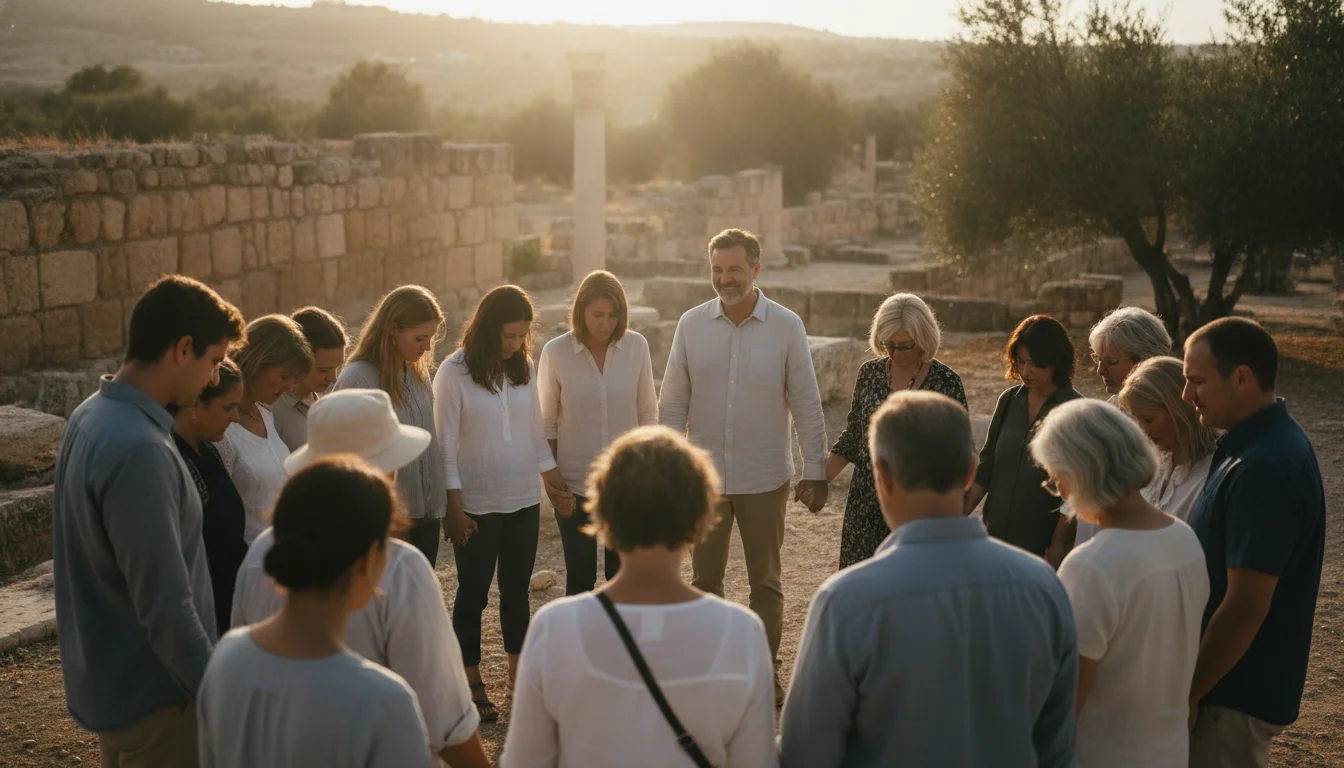
The question I get most often from pastors and rabbis is not about hotels or flights. It is this: how do I keep this trip from feeling like a bus tour with a Bible reading tacked on at the end. That is the right question, because it is the difference between a group that comes home changed and a group that comes home with photos. I have built heritage journeys for more than forty years, and the leaders who get this right plan the devotional life of the trip with the same care they plan the routing.
So let me walk you through how to build devotionals into an itinerary as the person organizing and leading the group. This is not advice for a solo traveler with a journal. It is for you, the decision-maker recruiting the group and setting the tone. I will cover how to structure the spiritual rhythm day by day, how to theme the whole trip around a book of the Bible, and how to plan the two moments leaders ask me about most: a baptism in the Jordan River and communion at the Garden Tomb.
Start With the Spine, Not the Sites
Most itineraries are built site by site. Athens, then Corinth, then the next stop. That is fine for logistics, but it is the wrong spine for a faith trip. The spine should be the spiritual arc you want your people to travel, and the sites hang off of that.
Before you approve a single hotel, decide what the trip is about. Paul’s missionary journeys. The life of Jesus from Galilee to Jerusalem. The Exodus and the wilderness. A single book. Once you name the spine, the devotional plan almost writes itself, because every stop earns its place by connecting to the arc.
On the first planning call I ask three things. What are you preaching or studying with your congregation right now. What do you want people to feel on the flight home. And where do your people have questions they cannot answer from a pew. Those answers shape the devotional life of the trip far more than any list of must-see ruins. If you want the full sequence, our guide to planning a group pilgrimage lays out the whole process from first idea to final payment.
How to Theme a Heritage Trip Around a Bible Book
Theming the whole journey around one book of the Bible is the single strongest way to give a heritage tour depth. It gives your group a shared text, a daily reading rhythm, and a sense of walking through a story rather than checking off landmarks. Here is how I help leaders do it.
Pick a book that matches the geography. The book and the route have to line up, or the theme feels forced. Acts and the Pauline letters map onto Greece and Turkey. The Gospels map onto Israel from Galilee to Jerusalem. Exodus maps onto Egypt and Jordan. Ruth, Joshua, and the divided kingdom all have real ground you can stand on in Israel. Choose the book whose story you can physically walk.
Break the book into daily portions before you leave. I ask leaders to divide the book into as many readings as there are days, so each morning has its passage and each passage has a place. Day one reads the opening at the site that matches it. By the last day the group has read the whole book on the ground where it happened. That structure does the heavy lifting for you.
Assign the reading to your people, not just yourself. You do not have to carry every devotional. Give couples or small groups a day to prepare and lead the morning reading. It builds ownership and takes the pressure off you to perform for ten straight days. Your job shifts from lecturer to shepherd, which is where you want to be.
Tie the closing devotional back to the opening. On the final evening, return to the first passage and ask what it means now that they have walked the whole story. That bookend is what people remember.
A book-themed trip also makes recruiting easier. When you tell your congregation you are walking the whole book of Acts from Philippi to Rome, people can picture it. Vague trips do not fill. Specific ones do, and our notes on recruiting for a church trip go deeper on turning a theme into a filled group.
Building the Daily Devotional Rhythm
Once you have the spine and the theme, you build the rhythm. This is mostly about protecting time and reading the room.
I plan three devotional touchpoints into a normal day, and I tell leaders to treat them as fixed appointments, not as things you fit in if there is time. There is never time. You make it.
The morning devotional is short and sets the frame. Ten to fifteen minutes on the coach or at breakfast, tied to the passage that matches where you are headed. It answers the question people are silently asking: why are we going here today.
The on-site moment is the heart of it. You stop at the actual place, read the text aloud, and let it land. At the river outside Philippi you read Acts 16. At the Sea of Galilee you read the calming of the storm. You do not lecture. You read, you let it breathe, and you let the place do the teaching. These are the moments people weep at, and they are worth guarding against a rushed schedule.
The evening reflection closes the loop. After dinner, gather the group and ask two or three questions about what they saw and felt. This is where community forms, and where you catch the person quietly struggling. It is your pastoral window, and it is worth more than any site you could cram in.
One warning I give every leader: do not overschedule. A group that is exhausted cannot worship. Build in slower afternoons, especially on the days you plan something spiritually heavy. The devotional life of the trip needs margin, or logistics crush it.
How to Plan a Worship-Focused Pilgrimage
Some leaders want the whole trip to lean toward worship rather than study. That is a legitimate and beautiful choice, and it changes how you build the itinerary. I plan fewer sites and more time at each one. The goal is not coverage, it is presence. You want your group to sing at the Garden Tomb, to sit in silence at Gethsemane, to worship on the shore of Galilee at sunrise. That means saying no to a packed itinerary and yes to depth at a smaller number of places.
I build in dedicated worship blocks, sometimes a full hour, at the sites that carry the most weight. I make sure the group has a worship leader or at least a strong singer who can carry a song without instruments. And I choose timing that lets us reach the holy sites early, before the crowds, when the space is quiet enough to actually worship. That early access is a logistics decision you make months ahead, and it separates a worship pilgrimage that works from one that fights the tour buses all day.
If your group is drawn to the Holy Land specifically, the Israel heritage page shows the sites where these worship moments happen, and the Jordan heritage page covers the eastern side of the story, including the Jordan River.
How to Plan a Study-Focused Heritage Tour
Other leaders, often rabbis and teaching pastors, want the opposite emphasis: a study-focused tour where the group learns deeply and comes home understanding the text and the history in a way they never did before.
For a study trip, I build the itinerary around teaching stops and bring in the right scholarly guide. The difference between a good study tour and a great one is almost always the guide. You want someone who can teach the archaeology, the history, and the text, not just point at ruins. Who teaches on the ground is one of your most important early decisions, so vet it carefully. Our notes on how to choose a faith tour operator cover what to ask about guides before you commit.
For study groups I also plan longer stops, built-in question and answer time, and evening sessions that go deeper than daylight hours allow. Send a reading list before departure so people arrive with the background. A group that has done the reading asks better questions, and better questions make the whole trip richer.
How to Include a Baptism in the Jordan River
Of all the devotional moments leaders ask me to build in, a baptism in the Jordan River is the most requested, and it is worth doing well.
The main baptismal site most groups use is Yardenit, at the southern tip of the Sea of Galilee, set up for exactly this with changing facilities, white robes to rent or buy, and calm water with steps into the river. There is also Qasr al-Yahud further south near Jericho, closer to where tradition places Jesus’ own baptism, which some groups prefer for that reason. As the organizer, you choose the site based on your routing and the meaning you want.
Here is what I tell leaders to plan for. Confirm who is being baptized before you travel, because this shapes your timing. Decide whether you are doing new baptisms, reaffirmations of faith, or both, since many on the trip will already have been baptized and want to renew their vows rather than be baptized again. Build in enough time, at least a couple of unhurried hours, because a rushed baptism is a wasted one. And prepare your people beforehand so the moment carries weight rather than surprising them. This is a decision you make and lead, and it is one of the trip’s high points when you plan it with care.
How to Include Communion at the Garden Tomb
Communion at the Garden Tomb in Jerusalem is the other moment leaders most want to build in, and for many Christian groups it is the emotional peak of the journey.
The Garden Tomb reserves private spaces for group worship and communion, and this is not something you can count on walking up. You book it. As the leader, you or your operator arranges a reserved communion slot in advance, because these spaces fill, especially around Easter. Once reserved, you have a quiet garden setting, benches, and a place to serve the elements without a crowd moving through.
Plan this for near the end of the itinerary, after the group has walked the passion and the resurrection. By then your people have stood at Gethsemane, walked the Via Dolorosa, and seen the empty tomb, so communion in that garden lands with a force it never could on day one. You lead the service yourself as the group’s pastor and let the place carry the rest. It is the clearest example of why devotionals belong inside the itinerary and not bolted on afterward: the location and the moment reinforce each other.
The Leader’s Real Work
When you plan the devotional life of the trip this carefully, something shifts. You stop being a tour host worried about the schedule and become the shepherd of a journey. The logistics, the routing, the reserved communion slot, the early access for worship, all of it exists to free you to be present for your people.
That is the job the free-leader model is built to protect. If you are still working out how you afford to lead the trip, our notes on how pastors afford to lead a trip walk through the economics. Once the cost and the logistics are handled, your attention is free for the thing only you can do.
FAQ: Building Devotionals Into Your Itinerary
How do I decide what to build the devotionals around?
Start with the spiritual arc, not the sites. Name what the trip is about, often a book of the Bible or a period like Paul’s journeys, then let the sites hang off that spine. If you are preaching through a book with your congregation, that is usually the strongest theme, because your people arrive already invested in the text.
How much time should I set aside for devotionals each day?
I plan three touchpoints: a short morning framing of ten to fifteen minutes, the main on-site reading at the place itself, and an evening reflection after dinner. Treat all three as fixed appointments, and build slower afternoons around the heavy days so your group is not too exhausted to worship.
How do I arrange a baptism in the Jordan River?
Choose your site first, usually Yardenit near the Sea of Galilee or Qasr al-Yahud near Jericho. Then confirm who is being baptized before you travel and decide whether you are doing new baptisms, reaffirmations, or both. Build in a couple of unhurried hours and prepare your people ahead so the moment carries weight.
Do I need to reserve communion at the Garden Tomb in advance?
Yes. The Garden Tomb sets aside private spaces for group worship, but they fill, especially around Easter, so you or your operator books a slot ahead. Plan it near the end of the trip, after your group has walked the passion and resurrection, and it lands as the emotional peak of the journey.
Should my trip lean toward worship or study?
That is your call, and it changes the build. A worship-focused pilgrimage means fewer sites, longer stops, early access before the crowds, and dedicated singing time. A study-focused tour means a strong teaching guide, longer stops with question and answer time, and a reading list sent before departure. Some groups blend both, and a good operator can weight the itinerary either way.
If you are shaping the devotional life of a trip for your congregation, build that plan alongside the routing, not after it. You can see how the group experience comes together on our group heritage tours page.
Contact us and we will help you build the itinerary and the devotional rhythm around the story you want your people to walk.