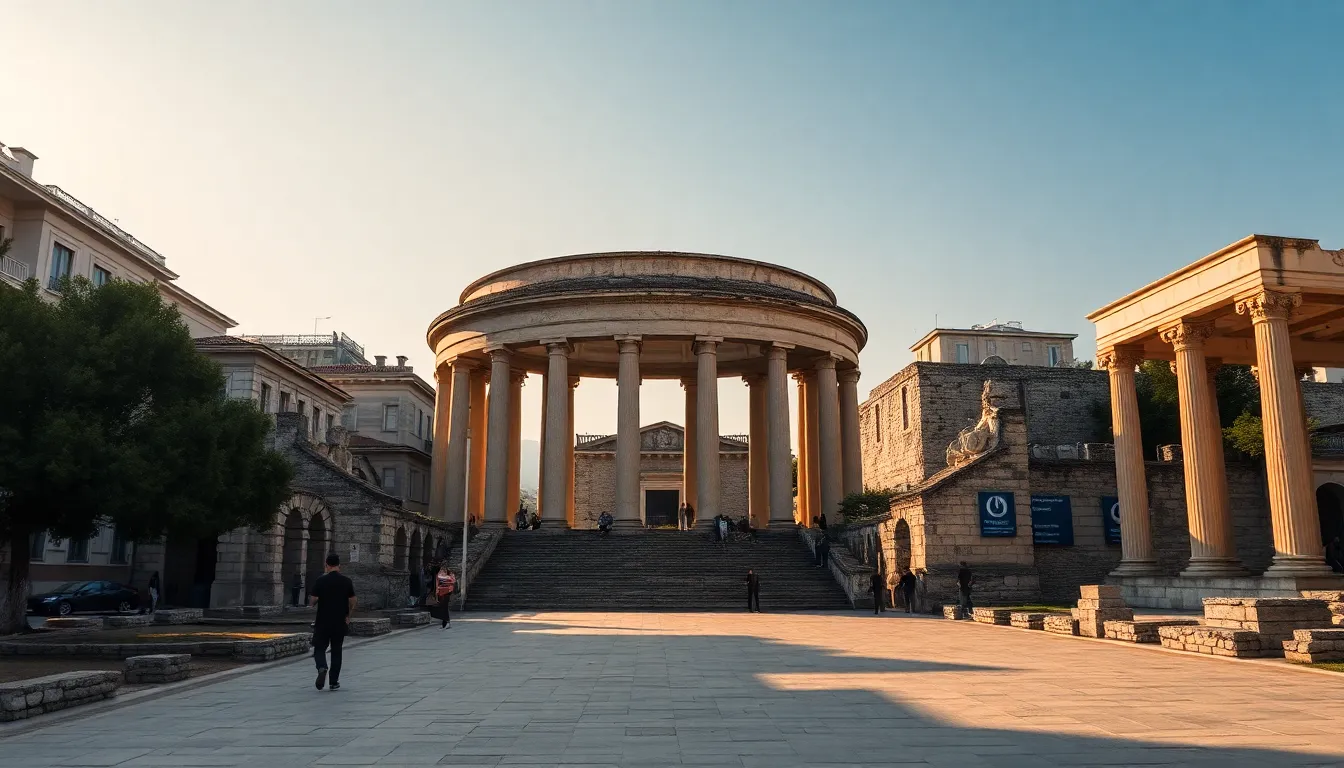
I tell every group leader the same thing before we reach Thessaloniki: this is not an open-air museum like Philippi or Corinth. This is a living city of a million people, and the heritage is woven right through the traffic and the cafes and the waterfront. That throws some people at first. Then they realize that is exactly the point. Paul wrote letters to a congregation here, in a city like this, busy and mixed and full of competing ideas. Standing in the middle of modern Thessaloniki, your group starts to feel how close that world actually was.
Thessaloniki carries three deep heritage layers, the Pauline, the Jewish, and the Byzantine, and unlike most cities, all three are still strong here. Let me orient you to each, and then to the practical side of moving a group through them.
The Layout: Heritage Stacked in a Working City
Thessaloniki runs along the curve of its bay. The waterfront, anchored by the White Tower, is your reference point. From there the city climbs uphill toward the Ano Poli, the old upper town, with the Byzantine walls at the top. Most of what a faith group wants to see sits in the band between the sea and the upper town, and much of it is walkable, though the climb to the upper churches is real.
Because the heritage is embedded in a functioning city, you experience it differently than you do at the ruined sites. You walk past a fourth-century church to get a coffee. That layering is the city’s character. For how Thessaloniki anchors a northern Greece route, see our Greece heritage travel guide.
The Pauline Layer: A Church That Received Two Letters
Paul came to Thessaloniki on his second journey, after Philippi, and preached in the synagogue for three Sabbaths, as Acts 17 records. The response was strong enough, and the backlash sharp enough, that he was hurried out of the city by night toward Berea. But the community he planted held, and he wrote back to it twice. First and Second Thessalonians are letters to this congregation, some of the earliest Christian documents we have.
That is what makes the city matter for a Christian group even without a single dedicated Pauline ruin to walk through. The text is the monument. I like to gather the group near the old Roman forum or on the waterfront and read passages from the Thessalonian letters, talking about what it meant to write encouragement to a young church in a pressured, cosmopolitan port. The city becomes the commentary.
The story here connects directly south to where Paul went next. For that, the Macedonia heritage trail guide traces the full northern route from Philippi through Berea.
The Jewish Layer: The Jerusalem of the Balkans
This is the layer that catches groups by surprise, and for me it is one of the most important stops in all of Greece.
For four centuries, Thessaloniki was the great Sephardic city of the world. After the expulsion from Spain in 1492, tens of thousands of Jews settled here, and by the early twentieth century the city was majority Jewish. It was called the Jerusalem of the Balkans, the Mother of Israel. The port shut down on Shabbat. Ladino was spoken in the streets. There were dozens of synagogues.
Almost all of it was destroyed. In 1943, the Nazis deported roughly fifty thousand Jews of Thessaloniki to Auschwitz. The overwhelming majority were murdered. The community that remains today is small but present, and it keeps the memory alive.
For a group, the essential stops are the Jewish Museum of Thessaloniki, which tells the story from the Sephardic golden age through the catastrophe, the Monastiriotes Synagogue, one of the few that survived, and the Holocaust memorial near the waterfront. The old Jewish cemetery, once one of the largest in Europe, was destroyed and the Aristotle University now stands partly on the site, a fact worth standing with for a moment. This city pairs powerfully with the Jewish heritage of Athens for groups doing both; I cover the southern side in the Athens heritage guide.
For interfaith groups, or any congregation that wants to honor both the Christian and Jewish stories of Greece, Thessaloniki is the place where they sit side by side most powerfully.
The Byzantine Layer: A Living Treasury of Churches
Thessaloniki was the second city of the Byzantine Empire, and its churches are so significant that a cluster of them is inscribed as a UNESCO World Heritage site. For an Orthodox-oriented group, this is one of the richest single cities in the world.
The Rotunda, originally a Roman structure from around 300, became a church and still holds early Christian mosaics worth seeing slowly. The Church of Hagios Demetrios, dedicated to the city’s patron saint and martyr, is built over the crypt where tradition says he was killed, and it is a major pilgrimage church to this day. Hagia Sophia of Thessaloniki, smaller cousin to the great one in Constantinople, carries beautiful mosaics in its dome. Higher up, in the Ano Poli, smaller Byzantine churches sit among the old houses and the city walls.
You do not need to see every church. Three or four, chosen well and given time, let a group feel the continuity of Orthodox worship in this place across sixteen centuries.
Practical Orientation for Group Leaders
What I tell leaders before we arrive:
- Stay near the waterfront or the city center. It puts the Roman forum, the main churches, the Jewish Museum, and the restaurants within reach on foot.
- The upper town involves a climb. The Ano Poli churches and the walls reward the effort, but for groups with limited mobility, plan transport up and walk down, or focus on the central churches.
- Coordinate the Jewish sites ahead. The synagogue and the museum need arrangement, and a knowledgeable local guide transforms the Jewish heritage day. We set this up.
- Give the city two days if you can. One day rushes all three layers. Two lets the Jewish heritage breathe and still covers Paul and the Byzantine churches.
One thing worth factoring in early: with Heritage Tours, the group leader travels free when you bring fifteen or more participants. For a pastor or rabbi assembling a congregational trip, that shifts the math, and it is easier to plan around when you know it from the start.
FAQ: Thessaloniki for Faith Groups
Why does Thessaloniki matter for a Christian group if there are no Pauline ruins to walk?
Because the city itself is the connection. Paul preached here, was driven out, and then wrote First and Second Thessalonians back to the church he planted. Reading those letters in the city that received them gives a Christian group a direct encounter with some of the earliest Christian writing, set in exactly the kind of busy port city Paul was addressing.
What is the Jewish heritage of Thessaloniki?
For four centuries Thessaloniki was the leading Sephardic Jewish city in the world, known as the Jerusalem of the Balkans, with a Jewish majority into the twentieth century. The Nazis deported and murdered roughly fifty thousand of its Jews in 1943. The Jewish Museum, the surviving Monastiriotes Synagogue, and the Holocaust memorial tell this story, and it is one of the most moving stops in Greece.
How many days should a group spend in Thessaloniki?
Two days is the right amount. It lets you give real time to the Jewish heritage, which deserves more than an hour, while still covering the Pauline connection and the major Byzantine churches. One day is possible but forces all three layers into a rush.
Is Thessaloniki walkable for older groups?
The central area along the waterfront is flat and walkable, and most key sites sit there. The upper town and its churches involve a steeper climb. For groups with mobility concerns, we arrange transport up to the upper sites and keep the central walking gentle, so no one is left out.
Can a trip combine the Christian and Jewish heritage here?
Yes, and Thessaloniki is the natural place to do it. The Pauline, Jewish, and Byzantine stories all sit in one city, so a single well-paced visit can honor each. We help interfaith and combined groups build an itinerary that gives each its due without feeling crowded.
If this is taking shape in your mind for your congregation, I would be glad to help you build it. Thessaloniki repays a group that gives it a little more time than the guidebooks suggest. You can see how we structure these journeys on our Greece heritage page or learn how the group experience works on our group heritage tours page.
Contact us whenever you are ready to start planning.