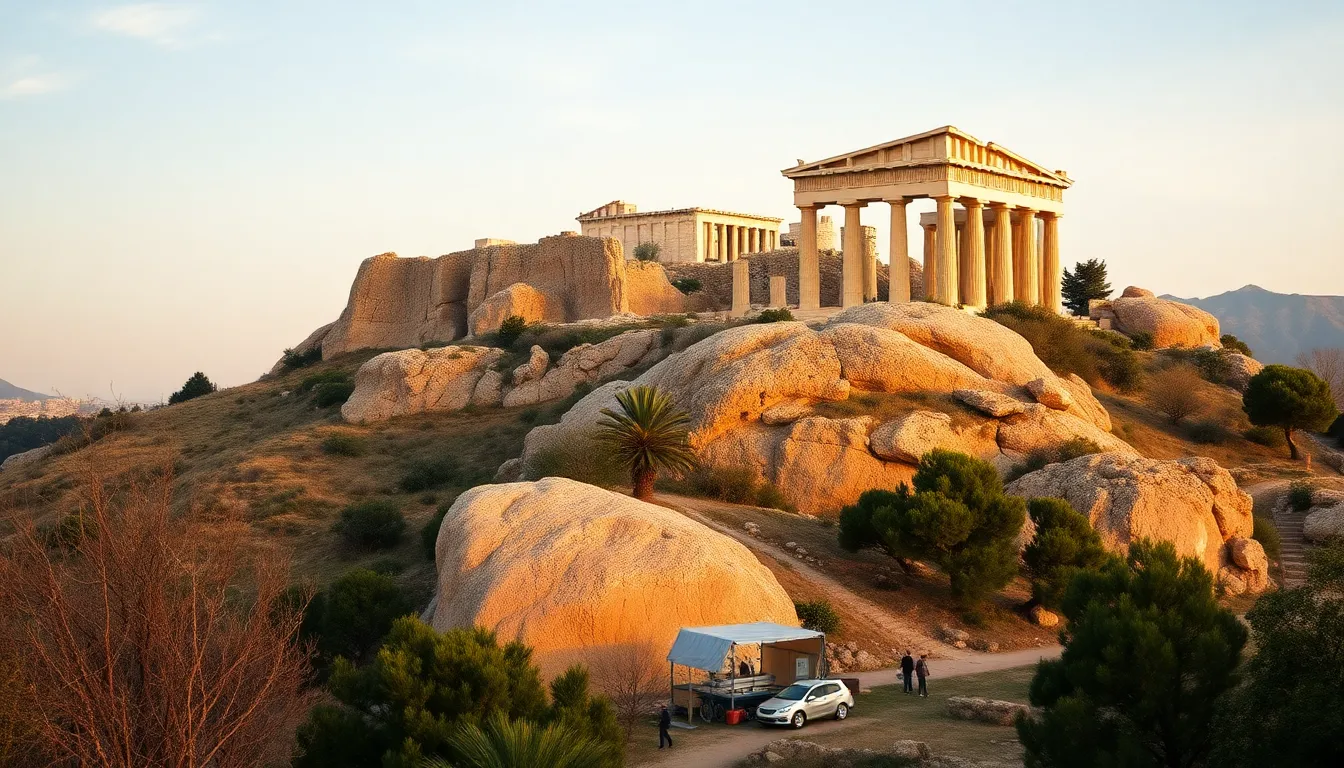
Most groups arrive in Athens thinking of it as the classical city, the Parthenon, the marble, the postcard. And it is that. But the first time I brought a congregation up onto the Areopagus and we read Acts 17 with the Acropolis right above us, I watched the whole trip reframe itself in their faces. Athens is not a warm-up before the biblical sites. Athens is a biblical site, and it is also a Jewish one, and a Byzantine one, and the layers sit almost on top of each other. That is what makes it such a rich place to start a Greece journey.
Let me give you the orientation I give my group leaders before we land, so you can see the city the way a faith traveler should see it.
The Layout: A Compact City You Can Actually Cover
Athens intimidates people on a map and then surprises them on the ground. The heritage core is small. The Acropolis sits in the center, and almost everything that matters to a faith group is within walking distance of it: the Areopagus on its northwest flank, the ancient Agora just below, the Plaka and Monastiraki neighborhoods wrapping around, and the old Jewish quarter a short walk west.
You can cover the essential sites in a focused day and a half. That matters when you are building an itinerary, because Athens is usually the start or the pivot point of a Greece trip, not the whole thing. For the bigger picture of how the city fits a full route, our Greece heritage travel guide lays out the regions in order.
The Christian Layer: Paul on Mars Hill
This is the heart of it for a Christian group, and it deserves to be done slowly.
The Areopagus, Mars Hill, is the bare rock outcrop just below the Acropolis where Paul stood before the council of Athens and delivered the sermon in Acts 17. He had walked the city, troubled by its altars, and found one inscribed “to an unknown god.” He used it as his opening. Standing there, looking up at the temples Paul looked at, your people understand the confrontation in a way no classroom can teach. He was speaking to the intellectual center of the ancient world, and he started where they were.
A bronze plaque at the base of the rock carries the full text of the sermon in Greek. I like to have someone read it aloud in English from the top while the group sits. It lands.
One practical warning I give every leader: the rock is worn smooth by centuries of feet and it gets genuinely slippery, especially after rain. There are metal stairs cut into the side. For older members, use them, take it slow, and do not let anyone scramble up the polished face. This is the single most common place I see a group leader caught off guard.
Below the Areopagus sits the ancient Agora, the marketplace where Paul “reasoned daily” with whoever he met. Walking it gives the sermon its setting. This is where the encounter began before it moved up to the rock.
The Jewish Layer: An Ancient and Living Community
Athens has a Jewish story that most itineraries skip, and I think that is a loss, especially for interfaith groups or any congregation that wants the fuller picture.
Jews have lived in Athens since antiquity. The ancient Agora holds the remains of what many scholars believe was a synagogue, and Paul himself, in Acts 17, “reasoned in the synagogue with the Jews.” The community thrived and suffered across the centuries, and the modern chapter is marked clearly in the city.
The old Jewish quarter sits in the Thiseio and Psyrri areas, west of the Agora. The city’s two active synagogues, Beth Shalom and the older Etz Hayyim across the street from it, stand on Melidoni Street and can be visited with advance arrangement. Nearby, the Jewish Museum of Greece tells the long story of Hellenic Jewry, from antiquity through the Sephardic communities to the Holocaust, when the overwhelming majority of Greece’s Jews were murdered. For groups that also visit the north, this connects directly to the much larger Jewish story of Thessaloniki, which I cover in the Thessaloniki heritage guide.
A Holocaust memorial stands near the synagogues, a quiet stop that gives a group room to reflect.
The Byzantine and Orthodox Layer: Churches in the Heart of the City
After Rome and before the modern nation, Athens was a Byzantine city, and the churches from that era are still woven into the streets. You do not go looking for them. You turn a corner and one is there.
The small Church of the Holy Apostles in the ancient Agora dates to around the year 1000 and is one of the oldest standing churches in Athens, built over an earlier site. Down in Monastiraki and along Ermou Street, the tiny Church of Kapnikarea sits in the middle of the shopping street like an island, an eleventh-century Byzantine chapel that the modern city simply built around. The Church of Panagia Gorgoepikoos, the “Little Metropolis,” next to the main cathedral, is studded with ancient carved marble reused in its walls, a literal layering of pagan, Christian, and Byzantine stone.
For an Orthodox-oriented group, or for any traveler who wants to feel the continuity of Christian worship in this city across two thousand years, these churches are the thread. They are also free, central, and quick, which makes them easy to fold into a walking morning.
The Byzantine and Christian Museum, a short way from Syntagma Square, gathers icons, mosaics, and liturgical art under one roof if you want to give your group a deeper grounding in the Orthodox tradition before you travel north toward Meteora and the monasteries.
Practical Orientation for Group Leaders
A few things I have learned bringing groups here:
- Base yourself near Syntagma or the Plaka. You want walkability. The Acropolis, the Agora, the Areopagus, the Jewish quarter, and the Byzantine churches are all reachable on foot from there.
- Do the Acropolis early. Gates open in the morning, and by midday in spring and fall both the heat and the crowds build. An early start gives your group the Parthenon in good light and gives you the rest of the day for the heritage sites at a calm pace.
- Athens is your gateway, not your whole trip. Most faith groups spend a day and a half to two days here, then move out to Corinth, the north, or the islands. Build it as the opening movement.
- Arrange synagogue and church visits in advance. Active houses of worship are not drop-in museums. We handle this coordination so your group is welcomed rather than turned away at the door.
One thing worth knowing as you plan: with Heritage Tours, the group leader travels free when you bring fifteen or more participants. For a pastor or rabbi building a congregational trip, that changes the budget conversation, and it is worth factoring in from the start.
FAQ: Athens for Faith Groups
Where exactly did Paul preach in Athens?
On the Areopagus, also called Mars Hill, a rock outcrop just northwest of and below the Acropolis. The sermon is recorded in Acts 17. A bronze plaque at the base carries the Greek text. Paul also reasoned in the synagogue and in the ancient Agora just below, so the whole encounter plays out across a small, walkable area you can cover in a single visit.
How many days should a group spend in Athens?
A day and a half to two days covers the heritage core comfortably: the Acropolis, the Areopagus, the Agora, the Jewish quarter, and the Byzantine churches. Athens usually works as the start or the pivot of a Greece itinerary rather than the destination, so most groups move on to Corinth or the north after this.
Can we visit the Jewish sites and synagogues in Athens?
Yes. The two active synagogues on Melidoni Street and the Jewish Museum of Greece can be visited, though the synagogues require advance arrangement since they are working houses of worship. This pairs naturally with the much larger Jewish heritage of Thessaloniki in the north for groups doing a fuller route.
Is Athens manageable for older group members?
Mostly, with planning. The city core is walkable and flat in places, but the Acropolis and the Areopagus involve uneven, polished stone and some climbing. The Areopagus rock in particular is slippery. We use the cut stairs, set the pace to the group, and make sure no one misses the meaningful moments because of the terrain.
When is the best time to visit Athens?
Late spring (May to June) and early fall (September to October) are ideal. The walking weather is comfortable and the peak summer crowds have eased. Athens can be visited year-round, and winter is quiet and mild, but the shoulder seasons give faith groups the best balance of climate and calm.
If you are picturing this for your congregation, I would be glad to help you shape it. Athens rewards a group that slows down enough to read its layers, and the sites are close enough together to do that well. You can see how we build these journeys on our Greece heritage page or learn how the group experience works on our group heritage tours page.
Contact us whenever you are ready to start planning.