Why Greece Is More Than Ancient History for Faith Travelers
When most people think of Greece, they picture the Parthenon, white-washed islands, and ancient philosophy. And those things are real, and they matter. But for communities rooted in Jewish or Christian tradition, Greece holds something far deeper than the classical world most travelers come to see.
This is the country where Paul walked into synagogues and debated scripture in the public squares. Where Sephardic Jews built one of the most extraordinary communities in the Diaspora. Where Romaniote Jews kept traditions alive for over two thousand years in the mountains of northwestern Greece, entirely separate from the Sephardic world most of us know.
I have spent more than forty years in tourism, and I can tell you honestly: Greece is one of the most underappreciated heritage destinations in the world. Not because people don’t visit, but because most visitors never see the layers that matter most to communities like yours.
Jewish Heritage in Greece: A Story That Most Travelers Never Hear
Greece’s Jewish story is not a footnote. It is central to the country’s identity, even though it has been largely erased from the standard travel narrative.
Thessaloniki: The Jerusalem of the Balkans
Before World War II, Thessaloniki was a city where Jews made up roughly half the population. Not a minority. Not a small quarter tucked behind a market. Half the city. The port closed on Shabbat. Ladino was the language of the streets and the docks and the coffeehouses. Thessaloniki was one of the great Sephardic centers of the world, built by Jews expelled from Spain in 1492 who found refuge in the Ottoman Empire.
In March 1943, the deportations began. Within months, nearly 50,000 Jews were sent to Auschwitz. The community that had defined the city for four and a half centuries was almost completely destroyed.
Today, the Jewish Museum of Thessaloniki tells that story with care and precision. The Monastir Synagogue, the only surviving synagogue in the city, still stands. Walking through these spaces with your congregation is a different experience than reading about them. The weight of the history becomes physical, present.
Rhodes, Ioannina, and the Sephardic and Romaniote Communities
Beyond Thessaloniki, two other communities hold profound meaning. On the island of Rhodes, the Jewish Quarter known as La Juderia remains one of the best-preserved in all of Europe. The Kahal Shalom Synagogue, built in 1577, is the oldest synagogue in Greece still in active use.
In Ioannina, in the northwest mountains, the Romaniote Jewish community has roots stretching back over two thousand years. This is a tradition entirely distinct from the Sephardic world. Their liturgy, their customs, their Hebrew pronunciation developed along a separate path, and what survives in Ioannina is genuinely rare.
Christian Heritage in Greece: Following in Paul’s Footsteps
For Christian communities, Greece is where the gospel first reached Europe. That is not a metaphor. It is a geographic fact, and the places where it happened still exist.
Athens, Corinth, and the Areopagus
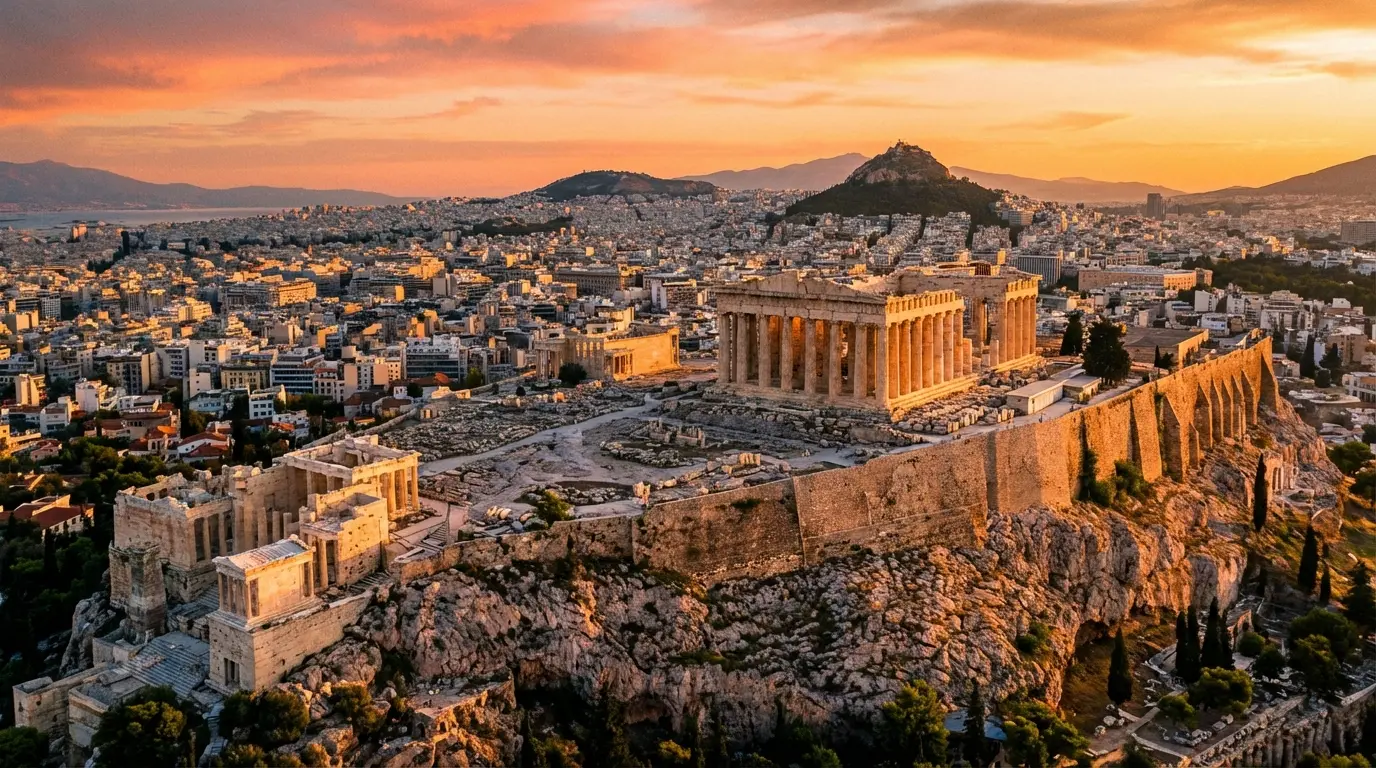
In Athens, Paul stood on the Areopagus, the rocky hill below the Acropolis, and delivered his sermon to the Athenians about the unknown god. That hill is still there. You can stand on it and read Acts 17 aloud with your group, and the city spreads out below you exactly as it did then.
In Corinth, where Paul lived and worked for a year and a half, the archaeological site preserves the marketplace where he preached. The bema, the judgment seat where Paul was brought before the Roman proconsul Gallio, has been excavated. You can stand in the place described in Acts 18 and trace the story with your own feet.
Thessaloniki’s Early Christian Churches
Thessaloniki is not only a Jewish heritage city. Paul wrote two letters to the Thessalonians, and the early Christian community he planted there became one of the most significant in the ancient world. The Church of the Acheiropoietos and the Rotunda, both dating to the early centuries of Christianity, are among the oldest surviving churches on earth. The mosaics alone are worth the journey.
Where the Two Stories Intersect
Here is something that standard travel content almost never acknowledges: in every Greek city where Paul preached, he began in the synagogue. Athens, Corinth, Thessaloniki, Berea, Philippi. The Jewish communities were already there. Paul’s missionary route and Greece’s Jewish heritage are not two separate stories. They are two threads of the same fabric.
For interfaith groups, or for any community that wants to understand the full picture, this intersection is what makes Greece extraordinary. Thessaloniki is the single best place to see both traditions side by side, in the same city, across two thousand years.
Planning a Group Heritage Tour to Greece: What Leaders Need to Know
If you are a rabbi or pastor considering Greece for your community, here is what I would want you to know.
Greece heritage tours typically run seven to ten days. A focused Jewish heritage itinerary might center on Thessaloniki, Rhodes, and Ioannina. A Christian heritage itinerary might follow Paul’s route from Philippi to Thessaloniki to Athens to Corinth. A combined itinerary can cover the key sites of both traditions in ten days with thoughtful planning.
Group leaders travel free with fifteen or more participants. That changes the financial picture for many congregations, and it means the spiritual leader can focus entirely on guiding the group’s experience rather than worrying about personal travel costs.
The right tour operator for Greece will build your itinerary around your community’s identity, not hand you a standard package. At Heritage Tours, we design each trip from the ground up because a synagogue group visiting Thessaloniki and a church group following Paul’s route need very different journeys, even when they visit the same city.
Frequently Asked Questions About Heritage Travel to Greece
What are the most important Jewish heritage sites in Greece? Thessaloniki is the anchor, with the Jewish Museum, the Monastir Synagogue, and the memorial at the old railway station. Rhodes’ La Juderia and the Kahal Shalom Synagogue are essential. Ioannina’s Romaniote synagogue and Jewish museum complete the picture. Together, these three cities tell the full arc of Greek Jewish history.
Is Greece on Paul’s missionary route a suitable Christian pilgrimage destination? Absolutely. Paul’s second missionary journey brought him through Philippi, Thessaloniki, Berea, Athens, and Corinth. These sites are well-preserved and deeply moving for congregations studying Acts and the Pauline epistles. Greece is one of the strongest Christian heritage destinations outside of Israel.
What makes Thessaloniki significant for Jewish heritage travelers? Before World War II, Thessaloniki was roughly half Jewish. It was the center of Sephardic culture in the eastern Mediterranean, with dozens of synagogues, Jewish schools, and a thriving Ladino-speaking community. The near-total destruction of that community in 1943 makes Thessaloniki one of the most important Holocaust memorial sites in Europe.
How long does a Greece heritage tour typically take? Most heritage-focused group tours run seven to ten days. A shorter trip of five to six days can cover Athens, Corinth, and Thessaloniki. A fuller itinerary that includes Rhodes or Ioannina requires eight to ten days. We work with group leaders to match the itinerary to the time your community has available.
Can Jewish and Christian groups share a meaningful Greece heritage itinerary? Yes, and Thessaloniki is the key. It is both one of the most important Jewish heritage cities in Europe and a foundational Christian city where Paul established an early church. Groups that include both traditions often find that Greece is where the shared roots of their faith become most visible.