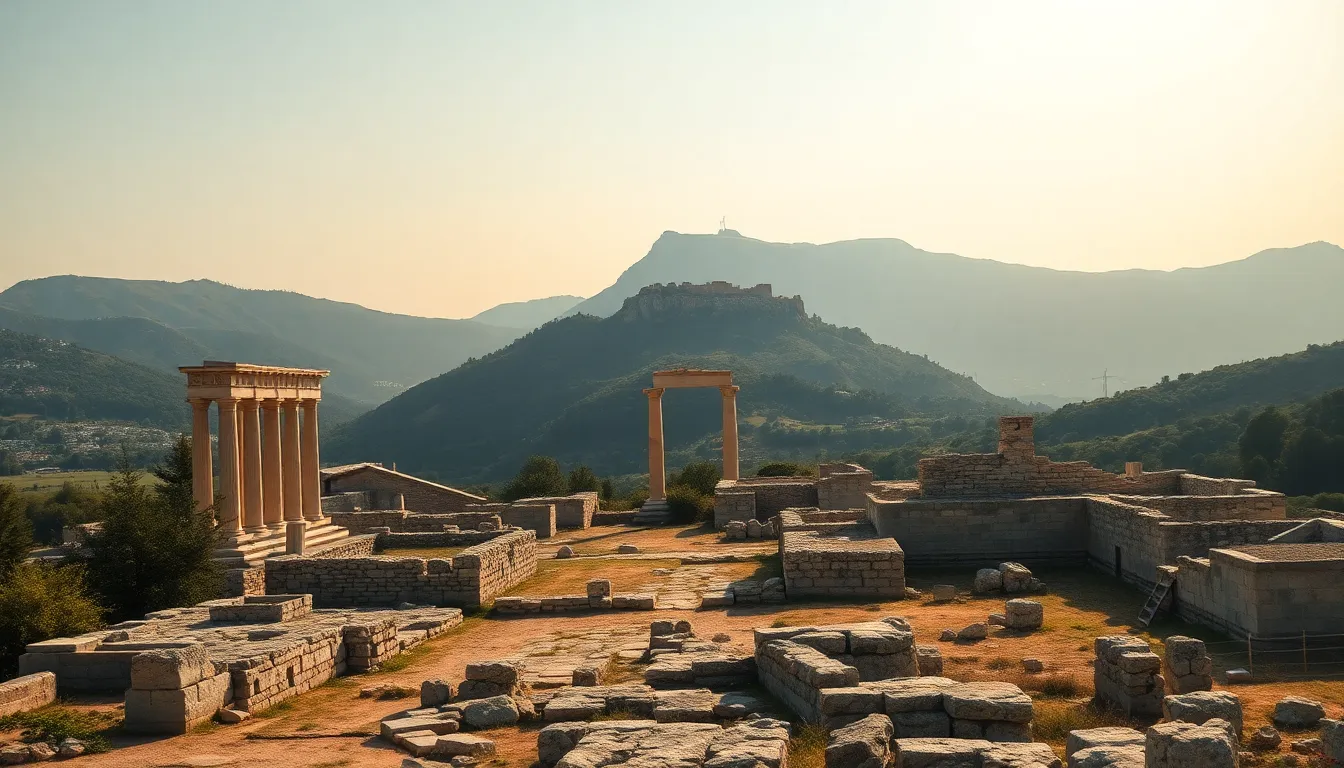
Most groups come to Greece, do Athens, maybe head north to Philippi and Thessaloniki, and go home. They never cross the canal into the Peloponnese. I understand why, the schedule is tight, the north has the famous Pauline sites. But every time I take a group south, somebody pulls me aside near the end and says some version of the same thing: this was the part I will remember. The Peloponnese is where Greek heritage goes deep, where the layers stack up thicker than almost anywhere else in the country. Bronze Age, biblical, Byzantine, all within an easy drive of each other.
Let me lay out the trail the way I would drive it with you, because the Peloponnese rewards a route, not a list.
Why the Peloponnese Is Worth the Extra Days
The Peloponnese is the broad peninsula that hangs off the southern end of mainland Greece, joined to it by a narrow neck of land at Corinth. For a faith heritage group, it holds something unusual: three different chapters of the human and biblical story, each at its peak, each visitable in the same trip.
You have Corinth, one of the most important cities in the New Testament, where Paul stayed longer than anywhere else in Greece. You have Mycenae, the citadel of Agamemnon, three thousand years older, from the world of Homer and the age that sits just behind the early books of the Hebrew Bible in time. And you have Mystras, a Byzantine city that was a center of Orthodox Christian life and learning right up to the fall of Constantinople. Three civilizations, one peninsula.
That is why I tell group leaders the Peloponnese is the natural extension once your people have the core route under their belt. It takes them from the familiar biblical ground into the wider sweep of the story.
Corinth: The Anchor of the Trail
Corinth is the reason most faith groups cross into the Peloponnese, and it should be the anchor of your southern days. Paul spent eighteen months here, working as a tentmaker, building a church, and writing letters that became First and Second Corinthians.
Walking the site, you stand in the agora where he was dragged before the proconsul Gallio, a moment recorded in Acts 18 and dated by an inscription that helps anchor the entire New Testament timeline. You see the temple of Apollo, the shops, the public fountains, and above it all the Acrocorinth, the towering fortified rock that dominated the city. When you read First Corinthians on site, in a city that was wealthy, cosmopolitan, and morally chaotic, the letter’s worries about division and excess suddenly make complete sense. I give Corinth fuller treatment alongside the rest of Paul’s route in our guide to the footsteps of Paul in Greece.
Corinth is about an hour and a half from Athens, just across the famous canal, which makes it the easy gateway into the peninsula.
Mycenae: The World Behind the Bible’s Oldest Pages
From Corinth it is a short drive to Mycenae, and here the trip steps back more than a thousand years before Paul. This is the Late Bronze Age, the world of Homer’s Iliad, the citadel of the kings who, in legend, sailed against Troy.
Why does this belong on a faith trip? Because it sets the timeline. Mycenae flourished roughly in the era of the Hebrew patriarchs and the Exodus, give or take. Standing at the Lion Gate, the oldest monumental sculpture in Europe, your group is looking at a civilization that was already ancient and fallen by the time of King David. It puts the long arc of biblical history into a frame people can see and touch. For educators especially, Mycenae is a gift. It makes the deep antiquity of the Bible’s earliest chapters real in a way no chart ever will.
The site itself is dramatic. The cyclopean walls, the beehive tombs like the so-called Treasury of Atreus, and the hilltop setting all reward the climb. Nearby Nafplio, one of the prettiest towns in Greece, makes an excellent base for this stretch.
Mystras: The Byzantine Crown of the Trail
Then comes Mystras, and for many of my groups this is the surprise of the entire trip. Tucked against a steep hillside near Sparta, Mystras was a thriving Byzantine city, a center of Orthodox Christianity, art, and philosophy in the final centuries before Constantinople fell in 1453.
What survives is extraordinary. A whole hillside of churches, monasteries, palaces, and houses, many of the churches still holding their original frescoes. You climb through layers of a living Christian city as it was on the eve of its fall. For groups interested in the Orthodox layer of Greek heritage, the part of the story that runs from the early church through Byzantium to the Greek church of today, Mystras is the richest single site in the country. I treat it on its own in our dedicated Mystras heritage guide, because it deserves a full day and a careful walk.
Mystras is the deep south of the trail, near the heart of ancient Sparta, and it makes a powerful contrast with the pagan and biblical sites to the north. The peninsula gives you the whole sweep in one journey.
The Jewish Layer of the Peloponnese
The Peloponnese also carries a quiet Jewish history that most itineraries miss entirely. There were Jewish communities here from antiquity. Corinth had a synagogue in Paul’s day, mentioned in Acts, and a stone inscription reading “synagogue of the Hebrews” was found at the site. Later, towns like Patras and the wider region held Romaniote and Sephardic communities for centuries.
For a Jewish or interfaith group, the Corinth synagogue inscription is a moving thing to stand near. It is physical evidence of the Jewish presence that Paul, himself a Jew, walked into when he arrived. The Christian and Jewish stories in the Peloponnese are not separate. They begin in the same buildings.
How to Structure a Peloponnese Trail for a Group
Here is the shape I recommend for the southern extension:
- Day 1: Cross from Athens, stop at the Corinth Canal, then ancient Corinth with time to read the Corinthian letters on site. Base in Nafplio.
- Day 2: Mycenae and the Bronze Age, with an afternoon in Nafplio’s old town.
- Day 3: Drive south to Mystras for a full day in the Byzantine city. Overnight near Sparta or return north.
- Optional Day 4: Olympia, the birthplace of the games, on the western side, if your route loops that way.
Three days covers the heart of the trail at a humane pace. You can fold this into a longer Greek itinerary, and our heritage travel guide for Greece shows how the south fits with the north.
One practical note as you plan: with Heritage Tours, the group leader travels free when you bring fifteen or more participants. For a pastor or educator weighing whether to add the southern days, that changes the budget conversation early, and it is worth knowing from the start.
FAQ: The Peloponnese Heritage Trail
Is the Peloponnese worth adding to a Greece heritage trip?
For most groups, yes. It holds Corinth, one of the most important New Testament cities, alongside Mycenae from the Bronze Age and Mystras from the Byzantine era. Few places let a group walk three peaks of civilization in three days. If your schedule allows even a southern extension, it gives the trip a depth that a north-only route does not reach.
How many days do you need for the Peloponnese?
Three days covers the core trail comfortably: Corinth, Mycenae, and Mystras, with Nafplio as a base for the first two nights. Add a fourth day if you want to include Olympia on the western side. Trying to do it in a single rushed day from Athens means seeing Corinth only and missing the rest, which I would not recommend.
What is the connection between the Peloponnese and the Bible?
Corinth is the main link. Paul lived there for eighteen months and wrote two of his letters to its church, and the site preserves the agora where he stood before Gallio and an inscription marking the ancient synagogue. Mycenae, while not in the Bible, sits in the same era as the Hebrew patriarchs and helps a group grasp the deep timeline of scripture.
Is the Peloponnese suitable for older group members?
Largely yes, with planning. Corinth is mostly flat and easy. Mycenae and Mystras both involve uphill walking on uneven ground, so we pace those days carefully and make sure everyone can reach the meaningful parts. We build the walking around the group you bring.
What is the best base for touring the Peloponnese?
Nafplio is the natural base for Corinth and Mycenae. It is a beautiful seaside town, central to those sites, and a pleasant place to spend two nights. For Mystras in the deep south, an overnight near Sparta works well so you are not rushing the drive in a single day.
If the Peloponnese sounds like the layer that would make your group’s Greece trip whole, I would be glad to help you build the southern route into your itinerary. The drive is easy, the sites are real, and the three civilizations tell one long story once your people are walking them. You can see how we shape these trips on our Greece heritage page or learn how the group experience works on our group heritage tours page.
Contact us whenever you are ready to start planning.