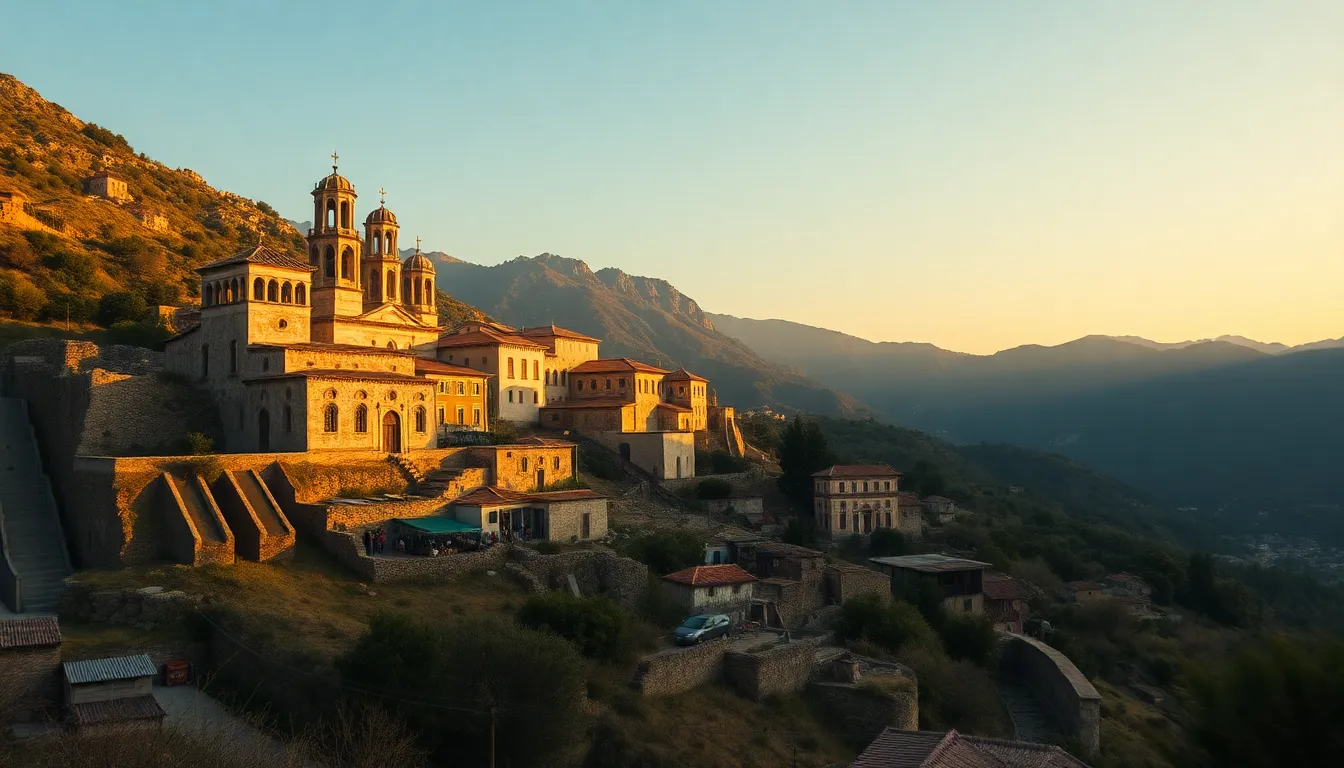
I will tell you the moment Mystras gets people. We climb up to one of the churches, the Pantanassa or the Peribleptos, and step out of the bright Greek sun into the cool dim interior. And there, covering the walls and the curve of the dome, are frescoes that have been looking down on visitors for six hundred years. Saints, the life of Christ, the whole Byzantine world in paint, still vivid. Somebody in the group always whispers, “How is this still here?” That question is the doorway into one of the most moving heritage sites in Greece, and one almost no standard tour visits.
Mystras is not on most itineraries. It should be. Let me walk you through why, and how to lead a group through it well.
What Mystras Is
Mystras is a fortified Byzantine city built on a steep hillside near ancient Sparta, in the deep south of the Peloponnese. It began in 1249 as a fortress and grew into a thriving city, eventually the capital of the Despotate of the Morea, one of the last strongholds of the Byzantine Empire. In its final centuries it was a center of Orthodox Christian life, art, and philosophy, second in importance only to Constantinople itself.
When Constantinople fell to the Ottomans in 1453, Mystras held out for a few more years, then surrendered. The last Byzantine emperor, Constantine XI, was crowned here before he rode off to die defending the capital. People lived in the city for centuries afterward, but it slowly emptied, and by the nineteenth century it was abandoned. Today it stands as a near-complete Byzantine city, churches, monasteries, palaces, and houses, climbing the hillside in silence. The locals call it the ghost city. The name fits.
Why Mystras Matters to a Faith Group
For groups tracing the Christian story in Greece, most of the trip is about the early church, Paul and the first century. Mystras is the other end of that story. It shows you what Greek Christianity became over the next fourteen hundred years: the Orthodox world, with its icons, its monasteries, its theology of beauty.
This is the layer most faith trips never reach. You can spend a week in Greece and only ever see the ancient pagan and early Christian sites. Mystras fills in the long middle and the rich end. It is where your group understands that the Greek church did not stop at Paul. It deepened, painted its walls, built its monasteries, and carried the faith through the entire Byzantine millennium right up to the gates of the modern world.
For Orthodox travelers, Mystras is close to holy ground. For Protestant and Catholic groups, it is a revelation, a chance to see a tradition many have only read about, alive in stone and paint. And the monasteries are still active. Nuns live and pray at the Pantanassa today, which means your group is not walking through a dead museum. The prayer never stopped.
The Churches You Should Not Miss
Mystras has many churches, and you cannot teach them all in one visit. These are the ones I make sure my groups see.
The Metropolis (Saint Demetrios)
The cathedral of Mystras, near the lower entrance. A double-aisled church with frescoes spanning the city’s history. There is a carved marble slab in the floor marking the spot where, by tradition, Constantine XI was crowned. Standing on it, you are standing at the literal end of the Byzantine Empire.
The Pantanassa Monastery
The most beautiful church in the city, and still a working convent. The frescoes here, especially the Raising of Lazarus and the Entry into Jerusalem, are among the finest of the late Byzantine world. The nuns sometimes offer visitors a small treat at the gate. It is a gracious, living place.
The Peribleptos Monastery
Built into the rock, its frescoes are the most complete cycle in Mystras, covering the walls in a near-unbroken program of the life of Christ. Stepping inside is like stepping into a Byzantine prayer book. Take your time here.
The Hodegetria (Brontochion)
Part of a large monastery complex, with elegant proportions and frescoes that include scenes of the city’s despots. Good for understanding how church and power intertwined in the Byzantine world.
How to Read the Frescoes With a Group
Byzantine frescoes are not decoration. They are theology you can walk into. I tell my groups to slow down and read them the way the original worshippers did, from the dome down. Christ at the top, the heavenly order beneath him, the saints and the life of Christ on the walls, the worshipper standing in the middle of it all. The whole church is a model of the cosmos, and you are inside it.
This is a teaching moment most leaders do not expect to have. For Protestants especially, the role of icons and images can be unfamiliar or even uncomfortable. Rather than skip it, I lean in. I explain what the images meant, why a tradition that could not always read built its theology on walls, and how beauty itself was understood as a way to God. The conversations that follow are some of the best of the trip. I place Mystras in its wider regional context in our Peloponnese heritage trail guide.
The Setting and the Spartan Connection
Mystras sits just a few kilometers from the site of ancient Sparta. The contrast is worth pointing out to your group. Sparta, the famous warrior city of antiquity, left almost nothing standing. Mystras, the Christian city that came long after, survives nearly whole. There is a sermon in that, and I usually let the group find it for themselves.
The modern town of Sparti at the foot of the hill makes a practical base. The Eurotas valley around it, green and fertile, frames the whole site beautifully, especially in spring.
Practical Orientation for Group Leaders
Mystras is a steep site, and that is the main thing to plan around. The city climbs a hillside from a lower gate to the fortress at the top, and it is a real climb.
- Two entrances. There is a lower gate and an upper gate. The smart move with a group is to enter at the upper gate and walk down, which spares everyone the worst of the climb. Arrange transport to drop at the top and collect at the bottom.
- Uneven ground. The paths are old stone, sometimes steep and slick. Good shoes are essential. For less mobile members, the lower churches including the Metropolis and Pantanassa hold much of the beauty and are reachable with less climbing.
- Modest dress. The active monastery expects covered shoulders and knees. Tell your group in advance so no one is turned away.
- Time. Give Mystras a full half day at least, ideally most of a day, to walk it without rushing and to sit inside the churches.
- Season. Spring and fall are ideal for the climb and the heat. Summer midday is punishing on the exposed slope. Our best time to visit Greece guide breaks the seasons down.
One thing worth knowing as you plan: with Heritage Tours, the group leader travels free when you bring fifteen or more participants. For a pastor or educator building a trip into the southern Peloponnese, that changes the math early, and it is worth factoring in from the start.
FAQ: Visiting Mystras With a Faith Group
Why visit Mystras on a Christian heritage trip?
Mystras shows the Orthodox chapter of the Christian story that most Greece trips skip. While the famous sites cover Paul and the first century, Mystras reveals what Greek Christianity became over the next thousand years: a world of icons, monasteries, and painted churches. It deepens a group’s understanding of the faith’s long arc, and the monasteries there are still active and praying today.
How physically demanding is Mystras?
It is a steep hillside city, so it asks something of the legs. The best approach with a group is to enter at the upper gate and walk down rather than climbing up. The lower churches, including the cathedral and the Pantanassa convent, hold much of the beauty and require less climbing, so even less mobile members can reach the heart of the visit.
What should I tell my group about the frescoes?
That they are theology, not decoration. Byzantine churches were painted as a model of the cosmos, read from the dome down, with the worshipper standing inside the whole order of heaven. For Protestant groups especially, this opens a rich conversation about icons, images, and beauty as a path to God. Slowing down to read the walls is one of the trip’s best teaching moments.
Is there a dress code at Mystras?
Yes, because of the active monastery. Visitors are expected to have shoulders and knees covered. Let your group know in advance so everyone comes prepared and no one is turned away at the convent gate.
How does Mystras fit into a larger Greece itinerary?
It pairs naturally with the rest of the Peloponnese: Corinth and Mycenae to the north, with Mystras as the deep southern anchor. It makes a strong contrast with the pagan and early Christian sites elsewhere on the trip. Our Peloponnese trail guide shows how to sequence all three in a few days.
If Mystras sounds like the layer that would give your group’s Greece trip its full depth, I would love to help you fit it into your route. It is off the standard path, which is exactly why it lands so hard. You can see how we build these journeys on our Greece heritage page or learn how the group experience works on our group heritage tours page.
Contact us whenever you are ready to start planning.