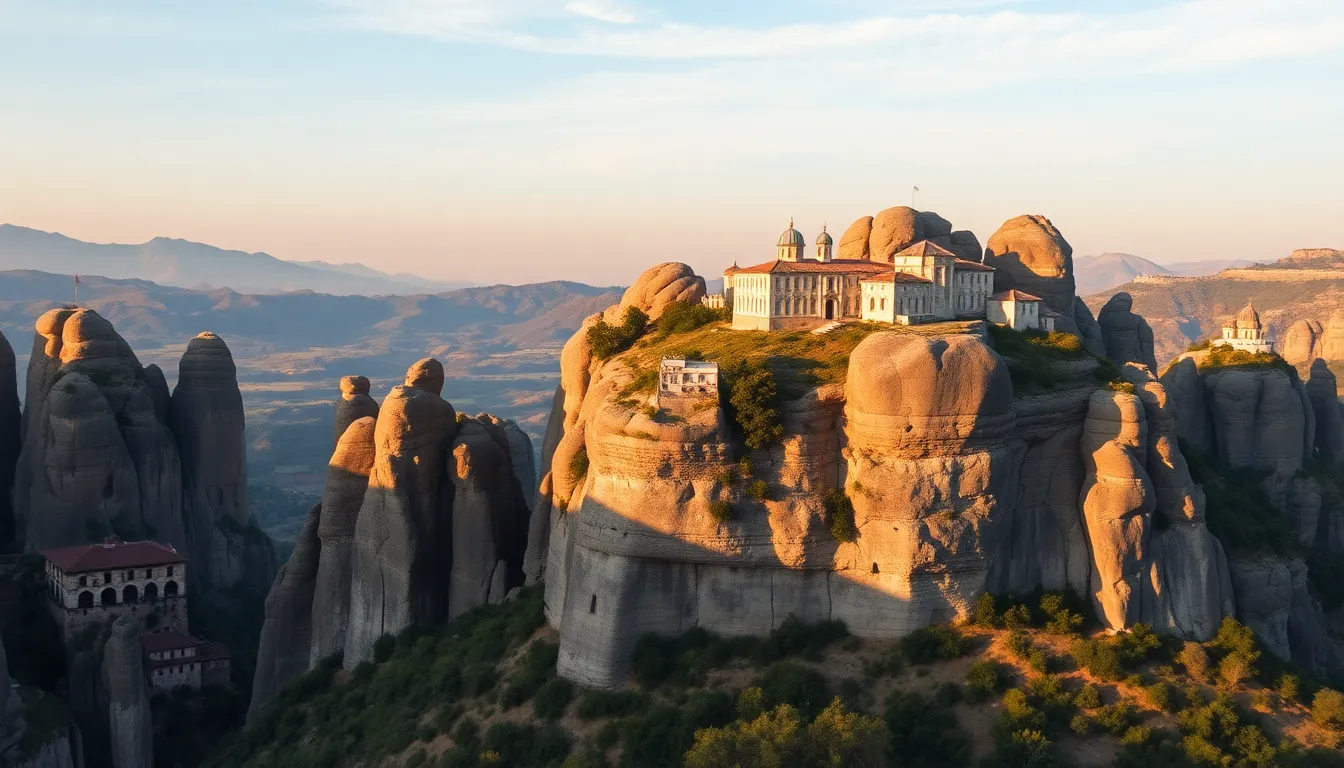
The first time I brought a group to Meteora, we came up the road from the plain in the late afternoon, and the bus went quiet on its own. Nobody told them to stop talking. The rock pillars just rose up out of the valley, hundreds of feet of bare grey stone, with monasteries sitting on top of them like they had grown there. One of the pastors leaned over to me and said, “I have read about this place for thirty years, and I did not understand it until right now.” That is Meteora. It does not photograph the way it feels.
Meteora means “suspended in the air,” and once you see it, the name stops being poetry and becomes a plain description. For a faith group, this is one of the most affecting stops in all of Greece, and it works for almost everyone you might bring, whether they come from a Protestant, Catholic, or Orthodox background. Let me orient you to the region the way I would on the ground.
Where Meteora Sits and Why It Matters
Meteora is in Thessaly, in central Greece, near the town of Kalambaka. You reach it from the south by driving up through the plain, and the monasteries appear long before you arrive. The setting is the whole point. Hermits came to these rocks as early as the ninth century, climbing the pillars to live alone in caves and clefts, looking for a place where the world could not easily follow them.
By the fourteenth and fifteenth centuries, those scattered hermits had organized into communities, and the great monasteries were built on the summits. At the peak there were twenty-four of them. Today six remain active, and all six are open to visitors. Getting building materials, monks, and supplies up those cliffs took rope ladders, baskets, and windlasses, and the stories of how it was done are part of what makes the visit so memorable for a group.
For a heritage traveler, Meteora matters because it is living Orthodox Christianity in its most dramatic setting. These are not ruins. Monks and nuns still pray here, still keep the hours, still welcome pilgrims the way they have for six hundred years.
The Six Active Monasteries
You cannot see all six well in a single day with a group, and you should not try. Most leaders pick two or three. Here is how I think about them.
Great Meteoron
The Holy Monastery of the Transfiguration, usually called Great Meteoron, is the largest and the oldest, founded in the fourteenth century by Saint Athanasios. It sits at the highest point. The main church holds frescoes that stop people in their tracks, and the old kitchen, refectory, and storerooms have been turned into a small museum that helps your group understand daily monastic life. If you visit only one, this is often the one.
Varlaam
Varlaam is just across from Great Meteoron and a little easier to reach. It is known for its sixteenth-century frescoes and for the original net and windlass tower, where you can still see how monks and goods were hauled up the cliff. Groups find Varlaam moving precisely because the human effort of building it is so visible.
Roussanou, Saint Nicholas, Saint Stephen, and Holy Trinity
Roussanou, now a convent, sits lower and is reached by a short bridge, which makes it one of the more accessible for older travelers. Saint Nicholas Anapausas is small and intimate, with frescoes by the Cretan painter Theophanes. Holy Trinity sits on the most isolated pillar and rewards the climb with the view many people recognize from films. Saint Stephen, also a convent, is the easiest of all to enter because it connects to the road by a small bridge with no long stair climb, which makes it my usual choice for groups with limited mobility.
The Spiritual Landscape of Thessaly
What I try to give a group at Meteora is not just a list of monasteries but a sense of why anyone built here in the first place. The whole region carries the question that these rocks ask: how far would you go to be undistracted before God?
The hermits who first climbed these pillars were answering that question with their bodies. They wanted silence, height, separation. When you stand at the edge of a monastery courtyard and look down at the plain spread out below, the logic of the place becomes clear without anyone explaining it. I often give groups a few minutes of quiet here and let the view do the teaching.
Thessaly itself is the broad agricultural heart of Greece, ringed by mountains, and Meteora rises right at its edge where the plain meets the Pindus range. That contrast, the flat fertile valley and the sudden vertical rock, is part of why the site feels set apart. For groups also tracing the New Testament, Meteora pairs naturally with the Pauline route through northern Greece. You can see how that journey runs in our guide to the footsteps of the Apostle Paul in Greece.
Kalambaka and Practical Orientation
The town of Kalambaka sits directly beneath the rocks and is where most groups stay. It is small, walkable, and used to pilgrims. The neighboring village of Kastraki is even closer to the pillars and quieter. Either makes a good base, and I usually recommend one or two nights so the group is not rushed.
A few practical notes I always give leaders before a Meteora day:
- Dress code is enforced. The monasteries require modest dress. Women need skirts that cover the knee, and most monasteries lend wrap skirts at the entrance, but men also need long trousers and covered shoulders. Tell your group the night before so nobody is turned away.
- There are stairs. Most monasteries involve climbing steps cut into the rock. Saint Stephen and Roussanou are the gentlest. Great Meteoron has the most steps. Plan the order around the group you bring.
- Opening days vary. Each monastery closes one or two days a week, and the days differ between them. Confirm the schedule before you fix your route, because a closed monastery can wreck a tight itinerary.
- Mornings are best. Light is better, crowds are thinner, and the heat is lower in summer. Start early.
Kalambaka also has a Byzantine cathedral, the Church of the Dormition of the Virgin, worth a short visit if you have time, with frescoes and an ancient marble pulpit.
Fitting Meteora Into a Greece Itinerary
Meteora is roughly halfway between Thessaloniki and the central and southern sites, which makes it an easy and rewarding stop on a longer route. Groups following the Pauline journey often add a Meteora day between the north and Athens. Jewish heritage groups traveling to Ioannina can reach Meteora in a couple of hours through the mountains, and the two pair well. You can read about that side of the country in our guide to Jewish heritage in Greece and our Ioannina heritage guide.
One day at Meteora covers two or three monasteries comfortably with time to breathe. Two days lets you see more and gives your group a slower morning to absorb the place. I rarely recommend less than a full day here, because the drive in and the sites themselves deserve unhurried time.
One thing worth knowing as you plan: with Heritage Tours, the group leader travels free when you bring fifteen or more participants. For a pastor building a trip for a congregation, that changes the math, and it is worth factoring in early.
FAQ: Visiting the Meteora Region
How many of the Meteora monasteries can a group visit in one day?
Two or three is realistic and unhurried. Trying to see more turns a contemplative place into a checklist. I usually pair one of the larger monasteries, like Great Meteoron or Varlaam, with one of the more accessible convents, like Saint Stephen or Roussanou, so the group gets both the grandeur and the gentler walk.
Is Meteora accessible for older travelers?
Parts of it are. Most monasteries involve stairs cut into the rock, but Saint Stephen and Roussanou are reached by short bridges with the least climbing. We plan the order of monasteries around the group you bring, so older members can still take part in the meaningful moments without being pushed past what is comfortable.
What should my group wear to the monasteries?
Modest dress is required and enforced. Women need skirts covering the knee, men need long trousers, and both need covered shoulders. Most monasteries lend wrap skirts at the door, but it is easier to brief the group the night before so no one is caught out.
How does Meteora fit with the rest of a Greece trip?
It sits between the northern cities and the central and southern sites, so it slots naturally into a Pauline route between Thessaloniki and Athens, or into a northern journey toward Ioannina. One full day is the minimum I recommend, and two days suits groups who want a slower pace.
Are the monasteries still active?
Yes. Six remain active, home to monks and nuns who keep the daily cycle of prayer. This is living Orthodox Christianity, not a museum, which is part of why the visit affects people the way it does. Visitors are welcome during open hours, with respect for the communities who live there.
If you are imagining Meteora for your group, I would be glad to help you shape the visit so the rocks do their work on your people. The setting carries the meaning once you are standing in it. You can see how we build these trips on our Greece heritage page or learn how the group experience works on our group heritage tours page.
Contact us whenever you are ready to start planning.