Three Jewish Traditions, One Country: Understanding Greece’s Jewish World
Most people, even people deeply knowledgeable about Jewish history, do not realize what Greece holds. This is a country where three distinct Jewish traditions developed over the course of two millennia. Not one. Three.
The Sephardic communities of Thessaloniki, who arrived after the expulsion from Spain in 1492 and built one of the most extraordinary Jewish civilizations in the Diaspora. The Sephardic community of Rhodes, which developed its own island culture within the medieval walled city. And the Romaniote Jews of Ioannina, whose presence in Greece predates the Sephardic world by over a thousand years and whose traditions are unlike anything else in Jewish life.
I grew up in Jerusalem. I have worked in heritage tourism for more than forty years. And when I first understood the depth of what existed in Greece, it changed the way I think about Jewish history outside of Israel. Greece is not a minor chapter. It is one of the great ones.
This guide is written for rabbis and community leaders who are considering Greece for a group heritage journey. The story is profound. It deserves to be told fully.
Thessaloniki: The Jerusalem of the Balkans
There is no other city quite like Thessaloniki in the entire Jewish world. Not before the war, and certainly not after it.
A City That Was Half Jewish: The Sephardic Golden Age
When the Jews expelled from Spain in 1492 arrived in the Ottoman Empire, many settled in Thessaloniki. Over the following centuries, they transformed the city. By the early twentieth century, Thessaloniki was roughly half Jewish. The port closed on Shabbat. Ladino, the Judeo-Spanish language the exiles carried from Iberia, was the common tongue of the streets, the markets, the docks. There were dozens of synagogues, each associated with a different community of origin: Jews from Castile, from Aragon, from Portugal, from Italy.
Thessaloniki was not a city with a large Jewish population. It was a Jewish city with other populations alongside it. That distinction matters. The scale of what was built there, the culture, the commerce, the intellectual life, the printing presses producing Ladino texts, has no equivalent anywhere else in the Sephardic Diaspora.
The Deportation of 1943 and What Was Lost
In March 1943, the deportations from Thessaloniki to Auschwitz began. Within a few months, nearly 50,000 Jews, the vast majority of the community, were deported and murdered. Entire neighborhoods were emptied. The great Sephardic civilization of Thessaloniki, which had flourished for four and a half centuries, was destroyed in a matter of weeks.
The speed and scale of this destruction is difficult to absorb. Thessaloniki went from being one of the most important Jewish cities on earth to a city with almost no Jews in the span of a single spring. What was lost was not just lives but an entire world: a language community, a musical tradition, a legal and rabbinical tradition, an economic culture, a way of life that had developed in that city and nowhere else.
What Remains: The Jewish Museum, the Monastir Synagogue, and the White Tower
Today, the Jewish Museum of Thessaloniki tells this story with rigor and with care. The collection includes religious objects, photographs, documents, and personal items that survived. It is not a large museum, but what it holds is irreplaceable.
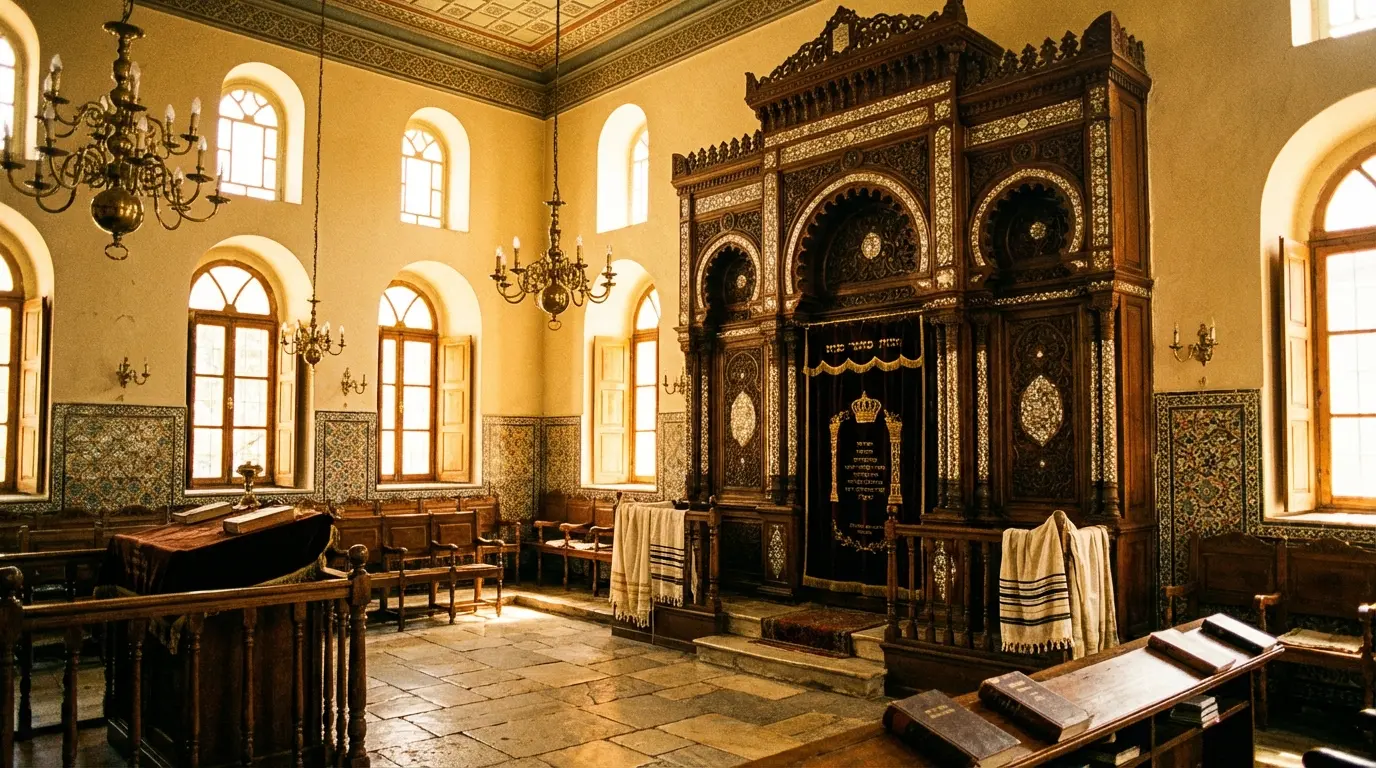
The Monastir Synagogue is the only surviving synagogue in Thessaloniki. Before the war, there were more than thirty. Walking into the Monastir Synagogue with your congregation, knowing this, gives the space a weight that no photograph can convey.
Near the old railway station, a Holocaust memorial marks the site from which the deportation trains departed. For many groups, this is the most difficult moment of the trip and the most important.
Rhodes: La Juderia and the Sephardic Island Community
The island of Rhodes, in the far southeastern corner of Greece, developed a Jewish community with its own character, connected to the Sephardic world but shaped by island life and proximity to Turkey.
One of the Best-Preserved Jewish Quarters in Europe
La Juderia, the Jewish Quarter of Rhodes, sits inside the medieval walled city. The narrow streets, the stone buildings, the small synagogue courtyards are still physically intact. Unlike many Jewish quarters in Europe, which were either destroyed during the war or redeveloped afterward, La Juderia’s architecture survived.
Walking through these streets, you can see the scale of the community. These were not grand buildings. They were homes, workshops, small businesses. The community was modest in size, roughly 2,000 before the war, but its physical footprint within the walled city tells you that Jewish life was woven into the fabric of Rhodes for centuries.
The Kahal Shalom Synagogue: The Oldest in Greece Still in Use
The Kahal Shalom Synagogue, built in 1577, is the oldest synagogue in Greece that still holds services. The interior is beautiful in its simplicity, with an elevated bimah and a women’s gallery in the Sephardic tradition. During summer months, services are held for the small remaining community and for visitors who come to pray.
The Square of the Jewish Martyrs, with its memorial fountain, stands at the heart of La Juderia. In July 1944, the entire Jewish community of Rhodes, roughly 1,700 people, was assembled in this square and deported. The names are inscribed on the memorial. Reading them aloud with your group is a practice we encourage. These were not abstract numbers. They were people who lived in the houses you just walked past.
Ioannina: The Romaniote Jews, Greece’s Most Ancient Jewish Tradition
Ioannina is where the story goes deepest. The Romaniote Jewish community here is not a branch of the Sephardic tree. It is an entirely separate tradition with roots stretching back more than two thousand years.
A Community Predating the Sephardic Expulsion by Over a Thousand Years
The Romaniote Jews are Greek-speaking Jews whose ancestors lived in the eastern Mediterranean long before the Spanish expulsion. Their liturgical practices, their musical traditions, their customs developed along a path entirely independent of the Sephardic world. When Sephardic Jews arrived in Greece after 1492, the Romaniote communities had already been established for well over a millennium.
This distinction matters for understanding Jewish diversity. The Romaniote tradition shows that Jewish life in Greece was not a single story imported from Spain. It was indigenous, ancient, and profoundly rooted in this particular place.
The Ioannina Synagogue and What Survived
The Kehila Kedosha Yashan synagogue in Ioannina still stands. The community’s Jewish museum, housed in a building adjacent to the synagogue, tells the story of a population that numbered roughly 2,000 before the war. In March 1944, nearly the entire community was deported to Auschwitz. Fewer than 100 returned.
What survived, the synagogue, the museum, the oral histories collected by descendants, is among the last living evidence of a tradition that existed almost nowhere else on earth. For a congregation seeking to understand the breadth of Jewish experience in the Diaspora, Ioannina is not optional. It is essential.
Building a Jewish Heritage Itinerary Around Greece
A dedicated Jewish heritage tour of Greece typically runs eight to ten days and centers on three cities: Thessaloniki, Rhodes, and Ioannina. Each represents a different tradition, a different chapter, and a different kind of encounter.
Thessaloniki requires at least two full days. The Jewish Museum, the Monastir Synagogue, the memorial sites, and the old city neighborhoods where the community lived all deserve unhurried time. Rhodes needs a day and a half: the walled city, La Juderia, the Kahal Shalom Synagogue, and time to sit in the Square of the Martyrs. Ioannina can be covered in a day, but the journey there, through the mountains of northwestern Greece, is part of the experience.
At Heritage Tours, we build these itineraries from the ground up for each community. A synagogue group visiting from New York will have different questions and different points of connection than a Jewish community group from Los Angeles. The itinerary should reflect that.
Group leaders travel free with fifteen or more participants. For many congregations, this makes a dedicated Jewish heritage trip to Greece financially possible in a way it might not otherwise be. If you are a rabbi considering this journey for your community, we would be glad to talk through what it could look like.
Frequently Asked Questions
Why was Thessaloniki called the Jerusalem of the Balkans? Because the Jewish community was not a minority there. By the early twentieth century, Jews made up roughly half of Thessaloniki’s population. The city had dozens of synagogues, a thriving Ladino-speaking culture, Jewish schools, printing presses, and a rabbinical tradition that influenced the entire Sephardic world. No other city outside of Israel had a comparable Jewish presence.
What are the main Jewish heritage sites in Greece? The primary sites are in three cities. In Thessaloniki: the Jewish Museum, the Monastir Synagogue, and the Holocaust memorial near the old railway station. In Rhodes: La Juderia (the Jewish Quarter), the Kahal Shalom Synagogue, and the Square of the Jewish Martyrs. In Ioannina: the Kehila Kedosha Yashan synagogue and the adjacent Jewish museum. Athens also has a small but significant Jewish museum.
What is the Romaniote Jewish tradition and where can I see it in Greece? The Romaniote Jews are Greek-speaking Jews whose presence in Greece predates the Sephardic communities by well over a thousand years. Their liturgy, customs, and traditions developed independently. Ioannina, in northwestern Greece, is the primary surviving center of this tradition. The synagogue and museum there are open to visitors and can be included in a group itinerary.
What is the oldest synagogue in Greece still in use? The Kahal Shalom Synagogue in the Jewish Quarter of Rhodes, built in 1577, is the oldest synagogue in Greece that still holds services. During summer months, the small remaining community and visiting groups gather for prayer there.
How many Jews lived in Thessaloniki before the Holocaust? Estimates vary, but the Jewish population of Thessaloniki before 1943 was approximately 50,000 to 56,000, representing roughly half of the city’s total population. Nearly all were deported to Auschwitz beginning in March 1943. Fewer than 2,000 survived.