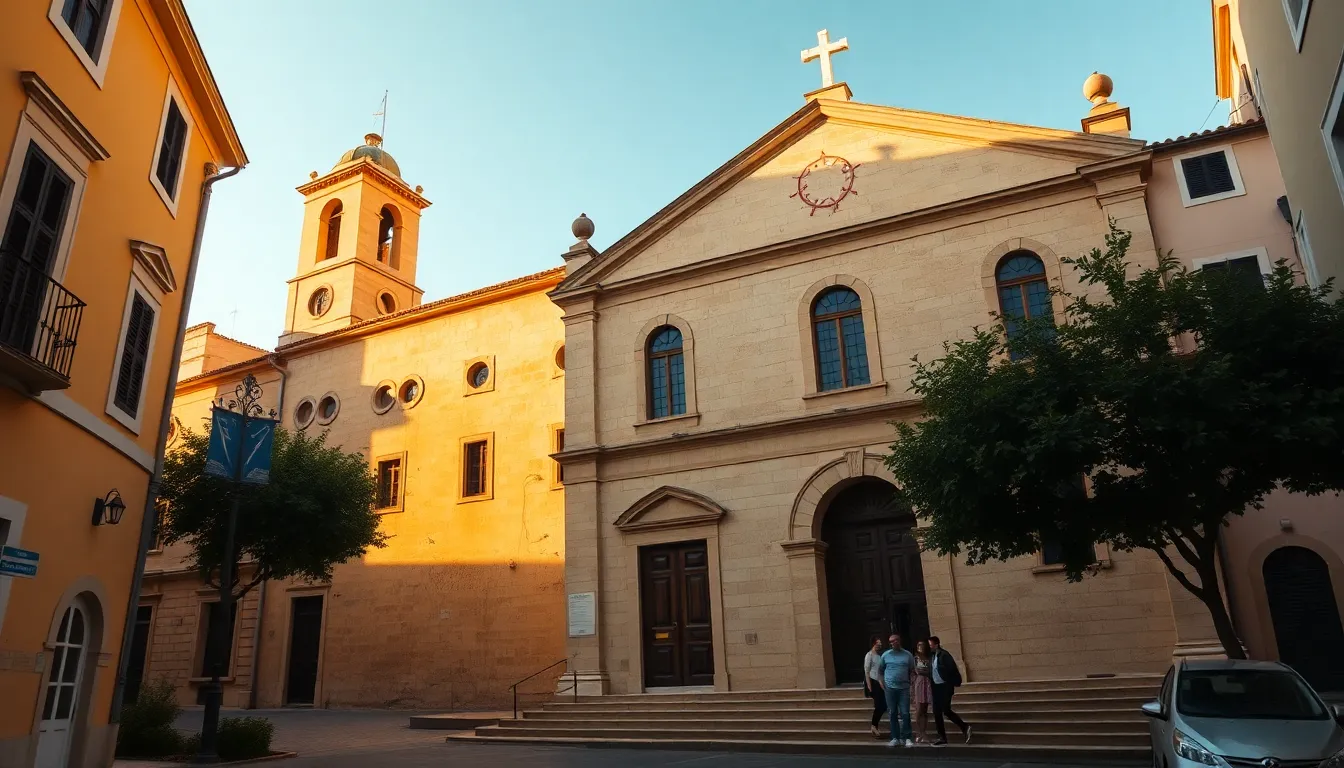
The first thing I tell a group when we arrive in Corfu is to forget, for a moment, everything they think they know about Greek Jewry. Most people come to Greece with Thessaloniki and Salonica in their minds, the Ottoman Sephardic world, Ladino in the markets. Corfu is a different story entirely. This island was never Ottoman. It was Venetian for four centuries, then briefly French, then British, and its Jewish community grew up facing Italy across the Adriatic rather than Anatolia across the Aegean. Stand in the old Jewish quarter of Corfu Town and you feel closer to Venice than to Salonica. That is what makes this place worth the journey.
Corfu sits in the Ionian Sea off the northwestern coast, and its separateness from the rest of Greece is exactly the point for a heritage group. It shows that Jewish life in this country was never a single tradition. It was shaped by whoever ruled the land, and on Corfu that was the Republic of Venice.
Let me take you through it the way I would on the ground.
A Community Shaped by Venice, Not the Ottomans
To understand Jewish Corfu, you have to understand who ruled it. From the late fourteenth century until 1797, Corfu belonged to Venice. The island never fell under Ottoman control, which set its Jewish community on a path entirely different from Thessaloniki, Rhodes, and the rest of Sephardic Greece.
Two Congregations Side by Side
Corfu’s Jewish community was not one group but two. There was a Romaniote congregation, the ancient Greek-speaking tradition, and an Italian-speaking congregation, sometimes called the Apulian or Pugliese Jews, who came from southern Italy. For centuries these two communities lived side by side in the same quarter, each with its own synagogue, its own liturgy, its own dialect. The Italian Jews spoke a Judeo-Italian dialect rather than Ladino, which immediately marks Corfu as distinct from the Sephardic world.
This dual character is one of the most interesting things about Corfu for a heritage group. It is a place where you can see two separate Jewish traditions sharing a single small quarter for hundreds of years. Our map of the Jewish communities of Greece places Corfu within the wider constellation, but on the ground its Venetian-Italian character stands apart.
Under Venetian and British Rule
Venetian rule brought the Jews of Corfu both protection and the familiar constraints of the age, including periods confined to the quarter. After Venice fell, the island passed to France and then to Britain, which held it until Corfu joined Greece in 1864. Through all of this the community endured, trading across the Adriatic and keeping its distinctive Italianate culture alive.
The Evraiki: Corfu’s Jewish Quarter
The old Jewish quarter of Corfu Town is called the Evraiki, and it sits in the heart of the historic center, a short walk from the Venetian fortifications. The quarter is a tangle of narrow lanes and tall, faded Venetian-style buildings, the laundry strung between them, the architecture unmistakably Italian.
Walking the Evraiki, you are walking the same streets where a thriving community lived and worked for centuries. The scale is intimate. These were homes, small workshops, shops. Before the war the quarter held a community of around 2,000, woven into the commercial life of the town. The atmosphere is closer to a Venetian back street than to anything else in Greece, and for a group that has already seen Thessaloniki or Rhodes, the contrast is striking and instructive.
The Scuola Greca Synagogue
At the heart of the Evraiki stands the Scuola Greca, the surviving synagogue of Corfu and the one place every heritage group should sit quietly for a while.
Before the war, Corfu had several synagogues serving its different congregations. The Scuola Greca, the synagogue of the Greek-speaking Romaniote rite, is the one that survived and the one that still functions today for the small remaining community. The building is in the Italian style, with the bimah and the ark at opposite ends of the room and a women’s gallery above, a layout that reflects the community’s Venetian and Italian heritage rather than the Ottoman Sephardic pattern you find elsewhere in Greece.
To sit in the Scuola Greca is to sit in the last functioning expression of a community that traced two ancient traditions and was very nearly erased. The building does not announce itself. It is modest from the street. What it holds is the continuity of a Jewish presence on this island going back many centuries.
June 1944: The Deportation
The end came late and fast. Corfu was under Italian occupation for much of the war, and the Italians did not deport the island’s Jews. That changed when Germany took over the occupation in 1943.
In June 1944, the Jews of Corfu, nearly 2,000 people, were rounded up in the old fortress and deported. They were taken first by boat, then overland, to Auschwitz. Very few returned. The community that had lived on this island under Venice, France, Britain, and Greece, that had kept two ancient traditions alive in the narrow lanes of the Evraiki, was destroyed in a matter of days.
I take groups to understand this with care and without spectacle. The deportation of Corfu is not as widely known as Thessaloniki, partly because the community was smaller and the island remote. That is one reason to come. The people of Corfu deserve to be remembered, and standing in the Evraiki and the Scuola Greca, reading their story where it happened, is how a group keeps that memory.
How Corfu Fits a Greek Heritage Itinerary
Corfu is an island, and that means it takes deliberate planning to include. It is reached by ferry or by a short flight, and it works best as a focused two-day extension rather than a quick stop. The reward is a side of Greek Jewry that no mainland city can show you.
A group drawn to the breadth of the Greek Jewish story will pair Corfu with the mainland communities. Thessaloniki for the Sephardic golden age, Ioannina for the ancient Romaniote heartland, and Corfu for the Venetian and Italian thread together give a remarkably complete picture. Our broader history of Greek Jewry helps you see how Corfu’s separate path fits the whole, and our coming-of-age guide shows how an island community can anchor a family milestone.
With Heritage Tours, the group leader travels free when you bring fifteen or more participants. For a congregation considering the extra days an island adds, that can make the Corfu extension easier to justify. We handle the ferries, the timing, and the coordination with the local community so the logistics never get in the way of the experience.
FAQ: Jewish Heritage in Corfu
Why is the Jewish community of Corfu so different from the rest of Greece?
Because Corfu was never under Ottoman rule. It belonged to Venice for four centuries, then France and Britain, before joining Greece in 1864. Its Jewish community grew up under Venetian influence, facing Italy across the Adriatic, and included an Italian-speaking congregation alongside the ancient Greek-speaking Romaniote one. The culture, architecture, and dialects were Italianate rather than Ottoman Sephardic.
What is the Scuola Greca synagogue?
The Scuola Greca is the surviving synagogue of Corfu, in the old Jewish quarter of Corfu Town. It served the Greek-speaking Romaniote rite and still functions today for the small remaining community. Its layout, in the Italian style, reflects the community’s Venetian heritage. It is the central heritage site for any group visiting Jewish Corfu.
What happened to the Jews of Corfu in the Holocaust?
The island was under Italian occupation for much of the war, and the Italians did not deport its Jews. After Germany took over in 1943, the roughly 2,000 Jews of Corfu were rounded up in June 1944 and deported to Auschwitz. Very few returned. The community was almost entirely destroyed.
Can Corfu be included in a wider Greece heritage tour?
Yes. Corfu is reached by ferry or a short flight and works best as a focused two-day extension to a mainland itinerary. Pairing it with Thessaloniki and Ioannina gives a group the Sephardic, Romaniote, and Venetian-Italian threads of Greek Jewry in a single journey.
Is the old Jewish quarter of Corfu still standing?
Yes. The Evraiki, the historic Jewish quarter in the center of Corfu Town, survives with its narrow lanes and Venetian-style buildings intact. Walking it gives a group a vivid sense of the intimate, centuries-old Jewish life of the island, and the Scuola Greca synagogue stands at its heart.
If a journey to this distinctive corner of the Jewish world speaks to your community, I would be glad to help you plan it. Corfu rewards the groups that make the effort to reach it. You can see how we structure these trips on our Greece heritage page or learn how the group experience works on our group heritage tours page.
Contact us whenever you are ready to start planning.