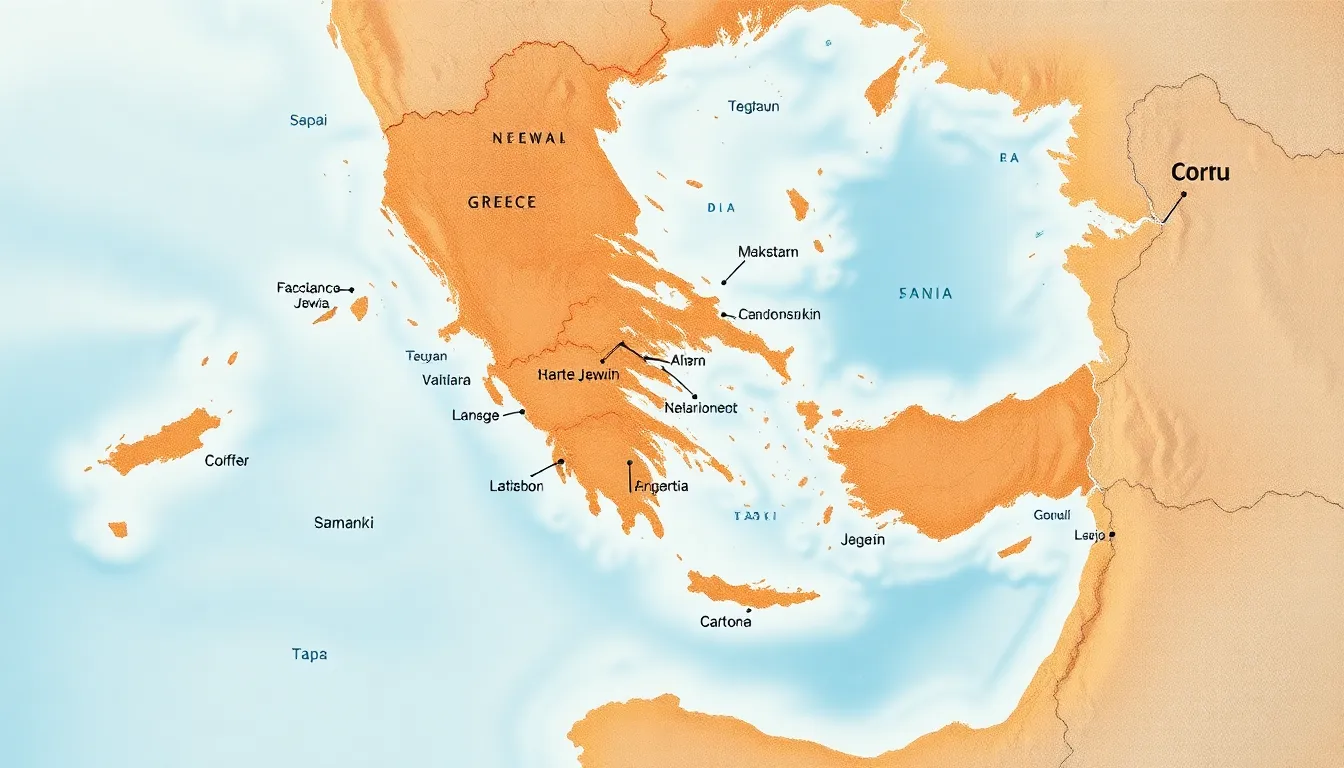
The first time I tried to explain Greek Jewry to a visiting group, I made the mistake every newcomer makes. I started with Thessaloniki and stopped there. By the end of that trip I understood my error. Thessaloniki is the headline, but it is one community among more than a dozen, and some of the smaller ones tell parts of the story that Thessaloniki cannot. So now I start with a map. I lay out where the communities were, what made each one different, and what survives in each place today. That is the conversation I want to have with you here.
Greek Jewry is not one thing. It is a constellation of communities, some Sephardic, some Romaniote, some shaped by Venetian or Italian influence, scattered across the mainland and the islands. For a rabbi or community leader building a heritage itinerary, understanding the map is the first real planning step. It tells you which threads you want to follow and which towns belong on your route.
Let me give you the map the way I would draw it on a napkin for you.
The Two Great Traditions Behind the Map
Before the towns, the framework. Greek Jewry runs along two main lines, and almost every community sits on one of them.
The Romaniote tradition is the ancient one. These are Greek-speaking Jews whose presence in the region predates the Spanish expulsion by well over a thousand years. Their liturgy, their customs, and their music developed independently of the Sephardic world. The Sephardic tradition arrived after 1492, when Jews expelled from Spain settled across the Ottoman Empire and reshaped many Greek communities, bringing Ladino and Iberian customs with them. In some towns the two traditions met and blended. In others, one or the other stayed dominant. Our history of Greek Jewry traces how these lines developed over the centuries.
Knowing which tradition a community belonged to tells you what you will encounter when you stand in its synagogue. That is why the map matters before the itinerary.
The Northern Heart: Thessaloniki and Veria
The north is where Sephardic Greece reached its height, and where the deepest losses fell.
Thessaloniki
Thessaloniki was the great city, once roughly half Jewish, with dozens of synagogues and a Ladino-speaking culture that had no equal in the Sephardic Diaspora. Nearly 50,000 Jews were deported to Auschwitz beginning in March 1943. Today the Jewish Museum, the Monastir Synagogue, and the Holocaust memorial near the old railway station carry the story. No heritage map of Greece can begin anywhere else, and most itineraries make this the anchor. The full account is in our guide to Jewish heritage in Greece.
Veria
Veria, ancient Berea, holds one of the most atmospheric surviving Jewish quarters in the country. The Barbuta, the old Jewish neighborhood, sits along the river with its narrow lanes and the restored synagogue still standing. The community here was small and ancient, with Romaniote roots later joined by Sephardic families. Veria is often skipped on rushed itineraries, and I think that is a loss. Walking the quiet Barbuta gives a group a sense of intimate, everyday Jewish life that the scale of Thessaloniki cannot.
Central Greece: Volos and Larissa
Moving south into Thessaly, the map shifts. Here the Romaniote presence stayed strong, and two communities are worth knowing.
Volos
Volos has a remarkable wartime story. The community was largely Romaniote, and when the deportations threatened in 1944, the Chief Rabbi Moshe Pesah, working with the Greek Orthodox Metropolitan and the resistance, helped most of the community escape into the mountain villages. A majority survived, which was rare in Greece. The synagogue in Volos still functions, and the survival story makes it a meaningful stop for groups who want to honor not only the loss but the rescue.
Larissa
Larissa holds one of the oldest continuous Jewish presences in Greece, Romaniote in origin, and it remains one of the larger active communities in the country today. There is a functioning synagogue and a community still living its life, which matters. Not every stop on a heritage trip should be a memorial. Larissa lets a group meet Greek Jewry in the present tense, not only the past.
The Ionian Islands: Corfu and the Venetian Influence
Cross to the western islands and the map changes character again. Corfu was never under Ottoman rule. It was Venetian, and later British, and its Jewish community absorbed strong Italian influence.
Corfu held two distinct congregations, a Romaniote community and an Italian-speaking Apulian community, side by side. The Scuola Greca synagogue still stands in the old Jewish quarter of Corfu Town. The community was largely destroyed in June 1944, when nearly 2,000 Jews were deported. What survives in Corfu shows a Jewish world shaped by the Adriatic rather than the Aegean, closer in feel to Venice than to Salonica. We give Corfu its own full treatment in our guide to Jewish Corfu.
The Romaniote Anchor: Ioannina
No map of Greek Jewry is complete without Ioannina, in the mountains of the northwest. This is the beating heart of the Romaniote tradition, an ancient Greek-speaking Jewish world entirely separate from the Sephardic story. The Kehila Kedosha Yashan synagogue still stands, with an adjacent museum. The community numbered around 2,000 before the war, and fewer than 100 returned. For any group trying to understand the full breadth of Jewish life in Greece, Ioannina is essential, not optional.
The Capital: Athens
Athens is the practical hub and, today, the center of organized Jewish life in Greece. The community here grew in the twentieth century and absorbed survivors from across the country after the war. The Jewish Museum of Greece in Athens is an excellent place to set the historical frame at the start of a trip, and the city has active synagogues. Most heritage itineraries begin or end here for simple logistical reasons, and the museum makes that arrival meaningful rather than purely practical.
Reading the Map for Your Itinerary
You cannot visit every community in one trip, and you should not try. The map is a tool for choosing. A group focused on the Sephardic golden age and its destruction will center on Thessaloniki and the north. A group drawn to the ancient Romaniote tradition will weight Ioannina, Volos, and Larissa. A group interested in the Venetian and Italian thread will make the journey to Corfu. Most strong itineraries pick two or three communities and go deep rather than skimming many.
A dedicated Jewish heritage tour of Greece typically runs eight to ten days. That is enough to do three communities justice with the unhurried time each deserves, plus the travel between them, which through the Greek mountains and across to the islands is part of the experience.
With Heritage Tours, the group leader travels free when you bring fifteen or more participants. For a congregation, that often makes a dedicated heritage journey financially realistic in a way it might not otherwise be. We build each itinerary from the ground up around the communities your group most wants to encounter.
FAQ: The Jewish Communities of Greece
How many Jewish communities are there in Greece?
Historically there were dozens of Jewish communities across mainland Greece and the islands. Today around nine organized communities remain active, including Athens, Thessaloniki, Larissa, Volos, Veria, Corfu, and a handful of others. The total Jewish population of Greece now numbers a few thousand, concentrated mainly in Athens and Thessaloniki.
What is the difference between Romaniote and Sephardic communities in Greece?
Romaniote Jews are Greek-speaking and ancient, with a presence predating the Spanish expulsion by well over a thousand years and a liturgy that developed independently. Sephardic Jews arrived after the 1492 expulsion from Spain, bringing Ladino and Iberian customs. Communities like Ioannina, Volos, and Larissa are Romaniote in origin, while Thessaloniki and Rhodes are Sephardic.
Which Greek Jewish communities survived the Holocaust most intact?
Volos stands out. Through the efforts of Chief Rabbi Moshe Pesah, the Orthodox Metropolitan, and the resistance, most of the community escaped into the mountain villages before deportation. Athens also had a higher survival rate than the north. By contrast, Thessaloniki, Rhodes, Corfu, and Ioannina lost the overwhelming majority of their communities.
Can a heritage trip cover both mainland and island communities?
Yes, though it requires planning. Pairing mainland communities like Thessaloniki, Veria, and Ioannina with an island community such as Corfu or Rhodes makes for a rich itinerary that shows the breadth of Greek Jewry. Most groups choose two or three communities and go deep rather than attempting to see everything.
Where should a first-time Jewish heritage group to Greece focus?
For a first visit, Thessaloniki, Ioannina, and either Rhodes or Corfu give the fullest picture: the Sephardic golden age and its destruction, the ancient Romaniote tradition, and an island community with its own character. That combination covers all the major threads of the Greek Jewish story.
If you are starting to map a heritage journey for your community, I would be glad to help you read this map for your group and choose the communities that matter most to your people. You can see how we structure these trips on our Greece heritage page or learn how the group experience works on our group heritage tours page.
Contact us whenever you are ready to start planning.