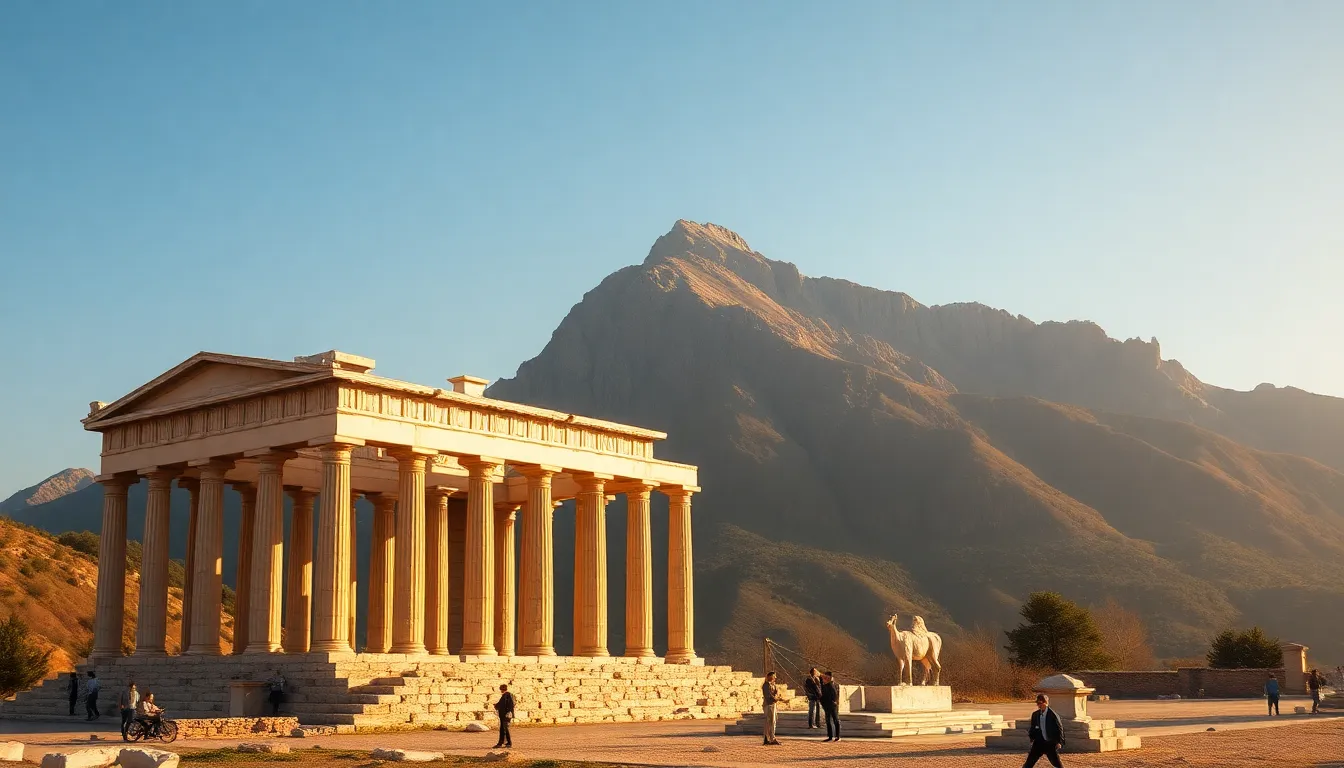
The first time I brought a group up to Delphi, a pastor in the back of the bus asked me why we were going. “It’s a pagan oracle,” he said. “What does that have to do with our trip?” It is a fair question, and I have come to think Delphi answers it better than almost any site in Greece. We do not go to Delphi to admire the oracle. We go to understand the world Paul walked into, the mind he was arguing with, the spiritual hunger that built a sanctuary on the side of a mountain. By the end of the day that pastor was the one who did not want to leave.
Let me explain how I frame Delphi for a faith group, because the framing is everything. Done wrong, it is a tourist stop with a nice view. Done right, it is one of the clearest windows into the religious world of the New Testament you will find anywhere.
Why Delphi Belongs on a Faith Heritage Itinerary
Delphi sat at the center of the Greek world. The Greeks called it the navel of the earth, and they meant it literally. There is a carved stone there, the omphalos, that marked the spot. Kings, generals, and ordinary people traveled for weeks to ask the oracle a question and walked away ordering their lives around the answer. For roughly a thousand years, this was the spiritual capital of the Greek mind.
That is the point for a faith group. When Paul stood on Mars Hill in Athens and spoke to the philosophers, when he wrote to the church at Corinth about the wisdom of the world, he was speaking to people shaped by exactly this. The Greeks were not godless. They were saturated with religion. They had altars, oracles, sacrifices, and a deep conviction that the divine spoke and that human beings needed to hear it. Delphi is where you see that hunger at full scale.
I tell my groups: you cannot understand what Paul was offering until you understand what the Greeks already had. Delphi shows you what they had. It makes the gospel he preached land with more weight, not less.
What You Are Actually Looking At
The sanctuary climbs the slope of Mount Parnassus, and you walk it from the bottom up, the way the ancient pilgrims did. The Sacred Way switchbacks past the foundations of treasuries, small temple-like buildings where Greek cities stored their offerings. The Athenian Treasury has been reconstructed and is the easiest to picture as it was.
Above that stands the Temple of Apollo, the heart of the site. This is where the Pythia, the priestess, delivered the oracles. She sat over a fissure in the rock, breathed in vapors, and spoke in a way the priests then interpreted. Modern geologists have studied the faults under the temple and found gases that may explain the trance. Your group will find that detail fascinating, and it is worth sharing, because it grounds the legend in something physical.
Higher still are the theater and, at the top, the stadium where the Pythian Games were held, second only to the Olympics. The climb rewards the effort. From the upper terraces you look out over a sea of olive trees falling away toward the Gulf of Corinth. It is one of the great views in Greece.
Do not skip the museum at the entrance. It holds the Charioteer of Delphi, a bronze from the fifth century BC that is one of the finest surviving statues from the ancient world. Standing in front of it, your group understands the level of civilization the early church was speaking into.
How to Teach Delphi to a Christian Group
This is where a thoughtful leader earns the trip. I do not stand at Delphi and condemn it. I stand there and explain it, and then I let the contrast do the work.
The oracle was famous for answers that were true either way. The classic example is the king who asked whether to go to war and was told that if he did, he would destroy a great empire. He went, and the empire he destroyed was his own. That ambiguity was the genius and the limit of Delphi. It gave people something, but it never gave them certainty, and it never gave them a relationship.
When you read Paul’s words at the Areopagus against that backdrop, they cut deep. He told the Athenians about a God who is not far off, who does not deal in riddles, who can be known. For a group standing in the shadow of the oracle’s ruins, that message is no longer abstract. They have just seen the alternative. I cover the Athens side of this in our guide to the Areopagus in Athens, and the two sites work powerfully together.
How to Frame Delphi for a Jewish or Interfaith Group
For Jewish groups, Delphi is a different kind of lesson, and an honest one. The Hebrew Bible is full of warnings against divination and consulting oracles, and Delphi is the most magnificent example of exactly the practice Israel was told to reject. Standing here, you can talk with real specificity about what the prophets were contrasting themselves against. The prophet did not perform tricks or read entrails. The prophet spoke a word and let it be tested by whether it came true.
Delphi also belongs to the broader story of the Hellenistic world that pressed in on Judea, the world of the Maccabees and the Seleucids. For educators teaching the Second Temple period, seeing a major Greek religious center in person makes that pressure tangible. I find interfaith groups have some of the richest conversations of the whole trip right here, because everyone in the group, whatever their tradition, is reckoning with the same question Delphi asked: how does the divine speak, and how do we know.
The Orthodox and Later Layers
Delphi’s religious life did not end cleanly. A small Christian community grew on the site in late antiquity, and the oracle finally fell silent under Christian emperors in the fourth century. The village of Kastri sat directly on top of the ruins until the late nineteenth century, when it was moved so the French could excavate. That long arc, pagan sanctuary to silenced oracle to Christian Greece, is itself a heritage story, and it connects Delphi to the Orthodox world your group will see everywhere else in the country.
Practical Orientation for Group Leaders
Delphi is about two and a half hours by road from Athens, which makes it a long but very doable day trip, or a comfortable overnight. I prefer the overnight when the schedule allows. Arriving the evening before and walking the sanctuary early, before the day buses arrive, changes the experience completely.
A few things to know before you go:
- The site is steep. The Sacred Way is a continuous uphill climb on uneven ancient stone. For older group members, go slow, bring water, and know that the lower section and the museum still deliver the heart of the visit if someone cannot make the full climb.
- Sun and heat. There is little shade on the slope. In summer, start early. Spring and fall are far kinder, which I cover in our best time to visit Greece guide.
- Give it real time. Rushing Delphi in ninety minutes wastes it. Budget three to four hours for the site and museum together so there is room to teach and to sit quietly.
- Pair it well. Delphi fits naturally with an Athens base or as a stop on the way to or from the north and Meteora. See how it fits a longer route in our heritage travel guide for Greece.
One thing worth knowing as you plan: with Heritage Tours, the group leader travels free when you bring fifteen or more participants. For a pastor or educator building a trip, that changes the math early, and it is worth factoring in from the start.
FAQ: Visiting Delphi With a Faith Group
Why visit a pagan oracle on a Christian heritage trip?
Because it explains the world the New Testament was preached into. The Greeks Paul addressed at Athens and Corinth were shaped by sites exactly like Delphi. Seeing the scale of Greek religious devotion makes the gospel Paul offered land with more force. You are not endorsing the oracle. You are understanding what came before it and what Paul was contrasting it with.
How much time should a group spend at Delphi?
Plan three to four hours for the archaeological site and the museum together. That gives you room to walk the Sacred Way at a teaching pace, reach the temple and theater, and see the Charioteer in the museum without rushing. Add travel time from Athens, about two and a half hours each way, when you build the day.
Is Delphi physically difficult for older travelers?
The main path is a steady uphill climb on uneven ancient stone, so it asks something of the legs. The good news is that the lower sanctuary and the museum, which hold much of what matters, are reachable without the full climb. We pace the visit around the group you bring and make sure no one misses the heart of it.
Does Delphi connect to the Jewish story too?
It does, by contrast. The Hebrew Bible warned sharply against oracles and divination, and Delphi is the grandest example of the practice Israel rejected. For Jewish and interfaith groups, standing here opens an honest conversation about how the prophets understood God’s voice differently. It also illustrates the Hellenistic world that pressed on Judea in the Second Temple period.
Can Delphi be done as a day trip from Athens?
Yes. It is about two and a half hours by road from Athens, so a full day trip works. When the schedule allows, I prefer an overnight nearby so the group can walk the sanctuary early, before the crowds, which is a far quieter and more meaningful experience.
If Delphi sounds like the kind of stop that would deepen your group’s trip rather than distract from it, I would love to help you place it well in your itinerary. The site rewards a leader who knows how to frame it. You can see how we build these journeys on our Greece heritage page or learn how the group experience works on our group heritage tours page.
Contact us whenever you are ready to start planning.