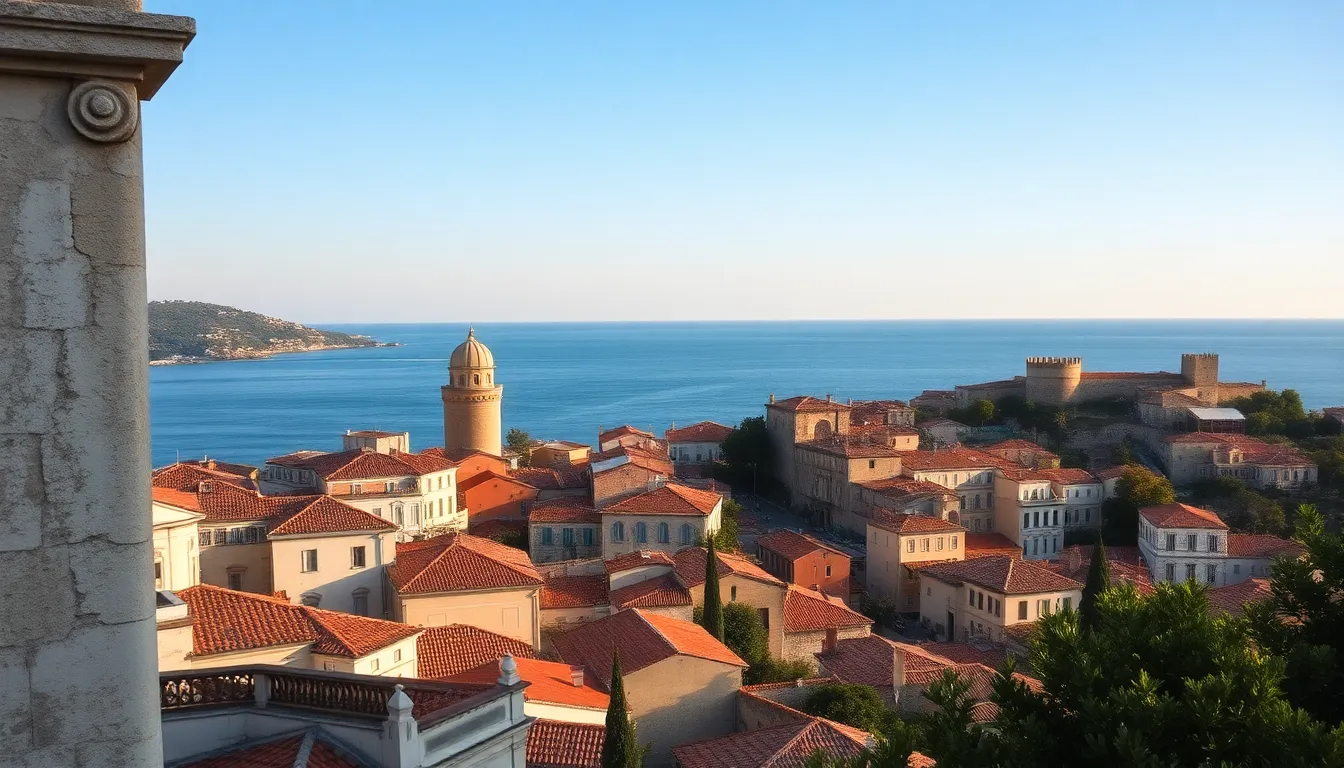
Corfu surprises groups. They expect another Greek island and they get something that looks almost Italian, tall Venetian townhouses, arcaded streets, a grand esplanade that could be in Venice itself. Then you take them into the old Jewish quarter, the Evraiki, and a few streets later into the church that holds the relics of the island’s beloved saint, and the picture fills in. Corfu sat at the crossroads of the Ionian Sea for centuries, never conquered by the Ottomans, shaped instead by Venice, France, and Britain in turn. For a heritage group, that makes it one of the most distinctive islands in all of Greece.
Corfu lies off the northwestern coast, the greenest and most northern of the major Greek islands. Its old town is a protected treasure, and within it three heritage layers sit side by side: Venetian, Orthodox, and Jewish. Let me orient you to each.
Venetian Corfu: The Island That Never Fell to the Ottomans
This is the fact that explains Corfu. While most of Greece spent centuries under Ottoman rule, Corfu was held by Venice for some four hundred years, and the Venetians fortified it so heavily that the Ottomans besieged it and failed. That continuity is why Corfu feels so different from the rest of the country.
The Two Fortresses
Two great Venetian fortresses guard the old town. The Old Fortress, on a rocky promontory jutting into the sea, and the New Fortress on the hill behind the town. Both are walkable with a group, and the views from the ramparts give your people the whole shape of the old town at a glance. I like to start a Corfu day on the Old Fortress, because it sets the geography in everyone’s mind.
The Old Town and the Liston
The streets of the old town, the kantounia, are narrow, tall, and shaded, built in the Venetian manner. The Liston, an elegant arcaded promenade modeled on the Rue de Rivoli in Paris, was built during the French period and remains the social heart of the town. Walking the old town is itself the experience. There is no need to rush between monuments. The fabric of the place is the monument.
Orthodox Corfu: Saint Spyridon
Corfu’s Orthodox faith centers on one figure: Saint Spyridon, the island’s patron, whose presence is felt everywhere. His relics rest in the Church of Saint Spyridon, marked by the tallest bell tower in the old town.
The Church and the Saint
Saint Spyridon is deeply loved here, credited by tradition with saving the island repeatedly from siege, famine, and plague. His preserved body is kept in a silver reliquary, and several times a year it is carried through the streets in great processions that the whole town joins. For an Orthodox group, this is a moving and central stop. For a Protestant or Catholic group, it is a window into the living devotion of Greek Orthodoxy, the kind of faith that is woven into the daily life of a place rather than kept in a museum. I always take time here to explain who Spyridon is and why the island loves him, because it helps a group read everything else they see.
Corfu also holds Byzantine churches and icon collections worth a visit, and the Orthodox layer runs deep beneath the Venetian surface. For groups tracing the broader Christian story of Greece, our guide to the footsteps of the Apostle Paul in Greece sets the wider New Testament journey.
Jewish Corfu: The Evraiki
Tucked into the old town is the Evraiki, the Jewish quarter, and it carries one of the island’s most important and most painful stories. Corfu’s Jewish community was old and distinctive, blending Romaniote roots, the ancient Greek-speaking Jewish tradition, with later Italian and Sephardic arrivals who came under Venetian rule. The mix gave Corfu its own Jewish character.
The Scuola Greca Synagogue
The Scuola Greca, the Greek Synagogue, is the last surviving synagogue of several that once served the community. It sits in the heart of the Evraiki, and its interior, in the Italian style with the ark and bimah at opposite ends, reflects the blended heritage of Corfu’s Jews. The synagogue is opened for visitors and still serves the small remaining community. Walking into it, your group stands in the one surviving house of a community that filled this quarter for centuries.
What Was Lost
In June 1944, the Jewish community of Corfu, around two thousand people, was rounded up and deported to Auschwitz. Very few survived. The Evraiki, once full of Jewish life, lost almost its entire community in that single deportation. The synagogue and the quarter remain as memory. Reading the names and standing in the streets where the community lived is, for many groups, the most affecting hour of the visit. Our Jewish heritage in Greece guide places Corfu within the wider story of the country’s communities.
How the Layers Fit Together
What I want a group to carry away from Corfu is how naturally the three layers sit together in one small old town. Within a few minutes’ walk you have the Venetian fortresses and the Liston, the bell tower of Saint Spyridon, and the synagogue of the Evraiki. Venice, Orthodoxy, and Judaism shared these streets for centuries. Corfu is a place where you do not study the layers separately. You walk through all of them in an afternoon.
That density is what makes Corfu work for so many kinds of groups. A Christian group encounters living Orthodoxy and a piece of European history they rarely expect in Greece. A Jewish group finds a distinctive blended community and a Holocaust memory that deserves to be honored. A mixed group experiences all of it together, in one walkable town.
Practical Orientation for a Group Visit
A few things I tell leaders planning Corfu:
- The old town is walkable and car-free in its core. Wear good shoes for the cobbles and plan a steady, unhurried pace. Most sites are close together.
- Confirm synagogue hours. The Scuola Greca keeps limited visiting hours and serves a small community. Check before you fix the day.
- Time the Saint Spyridon processions if you can. They happen a few times a year and are extraordinary to witness, but the church is worth visiting any day.
- Build in fortress time. The Old Fortress involves some climbing for the best views. Plan it for the cooler part of the day and let slower walkers take it gently.
Corfu is reached by air from Athens or by ferry, and most heritage groups fly to save time. It pairs well with a northern itinerary, since it sits off the coast near Epirus and the route to Ioannina, the heart of the Romaniote tradition. See our Ioannina heritage guide for that connection.
One thing worth knowing as you plan: with Heritage Tours, the group leader travels free when you bring fifteen or more participants. For a pastor or community leader building a trip, that changes the math, and it is worth factoring in early.
FAQ: Visiting Corfu for Heritage Travel
Why does Corfu look so different from the rest of Greece?
Because it was never under Ottoman rule. Venice held Corfu for some four hundred years and fortified it heavily, fending off Ottoman sieges. French and British periods followed. That continuity left the island with Venetian townhouses, arcaded streets like the Liston, and a character closer to Italy than to the rest of the country.
Who is Saint Spyridon, and why does Corfu love him?
Saint Spyridon is the patron saint of Corfu, whose relics rest in the church named for him in the old town. Tradition credits him with saving the island repeatedly from siege, famine, and plague. His preserved body is carried through the streets in great processions several times a year. For any group, he is a window into the living devotion of Greek Orthodoxy.
What is the Evraiki, and can groups visit the synagogue?
The Evraiki is Corfu’s old Jewish quarter. The Scuola Greca, or Greek Synagogue, is the last of several that once served the community and still serves the small remaining one. It is opened for visitors during limited hours, so confirm access before planning. The community blended ancient Romaniote roots with later Italian and Sephardic arrivals.
What happened to the Jewish community of Corfu?
In June 1944, around two thousand Jews of Corfu were deported to Auschwitz, and very few survived. The Evraiki lost almost its entire community in that single deportation. The surviving synagogue and the quarter stand as memory, and many groups find the hour spent there the most affecting of the visit.
Does Corfu suit both Christian and Jewish groups?
It suits both, and mixed groups especially. Within one walkable old town you have the Venetian fortresses, the Orthodox devotion of Saint Spyridon, and the Jewish heritage of the Evraiki. A Christian group, a Jewish group, or a combined one can each find a full and meaningful day here.
If Corfu is drawing you for your group, I would be glad to help you shape a visit that does justice to all three of its layers. The Venetian town, the saint, and the Evraiki sit within a few streets of each other, and they reward an unhurried day. You can see how we build these trips on our Greece heritage page or learn how the group experience works on our group heritage tours page.
Contact us whenever you are ready to start planning.