I have a ritual when I bring a group into the old Jewish cemetery in Worms. I do not say much. I let them walk among the leaning stones, some of them nearly a thousand years old, the oldest Jewish gravestones still standing in their original place anywhere in Europe. Then I gather them at the grave of Rashi’s teacher and I say: the people buried here were building the foundations of Ashkenazi Judaism while most of Europe could not read. This is not a ruin. This is a root. The group always goes still. Worms does that.
I have led faith groups through Germany for over twenty years, and the ShUM cities are where I take groups who want to understand how deep Jewish life in Europe actually goes, centuries before the catastrophe of the twentieth century. Worms and Speyer, together with nearby Mainz, formed a triangle of scholarship and faith on the Rhine that shaped Jewish thought across the continent. This guide pairs the two cities that sit closest together, Worms and Speyer, and shows how to lead them well.
What ShUM Means
ShUM is an acronym formed from the medieval Hebrew names of three Rhineland cities: Speyer (Shpira), Worms (Varmaisa), and Mainz (Magenza). From the tenth and eleventh centuries onward these communities were the intellectual heart of Ashkenazi Jewry. Their rabbis produced legal rulings, liturgical poetry, and commentaries that became authoritative across European Judaism. The customs and structures of Jewish communal life that spread through Ashkenaz were forged here.
In 2021, the ShUM sites in Speyer and Worms were inscribed as a UNESCO World Heritage Site, recognizing them as the cradle of Ashkenazi Jewish civilization. For a Jewish group, walking these sites is walking the foundations of a whole tradition. For a Christian group, it is essential context for understanding the Jewish world that medieval Europe both depended on and persecuted.
I want to be honest with groups about that second part. These same cities were sites of terrible violence. The First Crusade in 1096 brought massacres of the Jewish communities of the Rhineland, and the memory of those killings became part of the liturgy itself. The glory and the suffering sit side by side here, and a thoughtful visit holds both.
Worms: The Heart of ShUM
The Rashi Synagogue
The synagogue in Worms is one of the most significant Jewish sites in Europe. The original building dates to 1034, and the great commentator Rashi is traditionally said to have studied here. The synagogue was destroyed on Kristallnacht in 1938 and again damaged in the war, but it was carefully reconstructed using original stones in the early 1960s. Standing inside, your group is standing in a space that has been a house of Jewish prayer, on and off through destruction and rebuilding, for nearly a thousand years.
Adjacent to the synagogue is the Rashi House, now a Jewish museum and archive, which gives your group the wider history of the community. The name honors the connection to Rashi, whose commentaries on the Torah and Talmud remain central to Jewish study to this day.
The Mikveh
Beneath the synagogue complex is the medieval mikveh, the ritual bath, one of the oldest in Europe. You descend a long stone stair into the cool dark to reach the groundwater. For a group, the mikveh makes the daily texture of medieval Jewish life real in a way the grand buildings do not. This was the rhythm of an ordinary observant life, carried out in stone a thousand years ago.
The Heiliger Sand Cemetery
The Heiliger Sand, the Holy Sand, is the old Jewish cemetery of Worms and one of the most moving sites in all of Jewish Europe. It holds graves dating back to the eleventh century, the oldest in-place Jewish cemetery on the continent. Among the leaning, weathered stones are the graves of revered medieval scholars, and visitors still leave pebbles and prayer notes on them.
I always give groups unhurried time here. There is nothing to rush toward. The cemetery is the message: a thousand years of Jewish presence, persistence, and faith, written in stone that has outlasted empires.
The Worms Cathedral
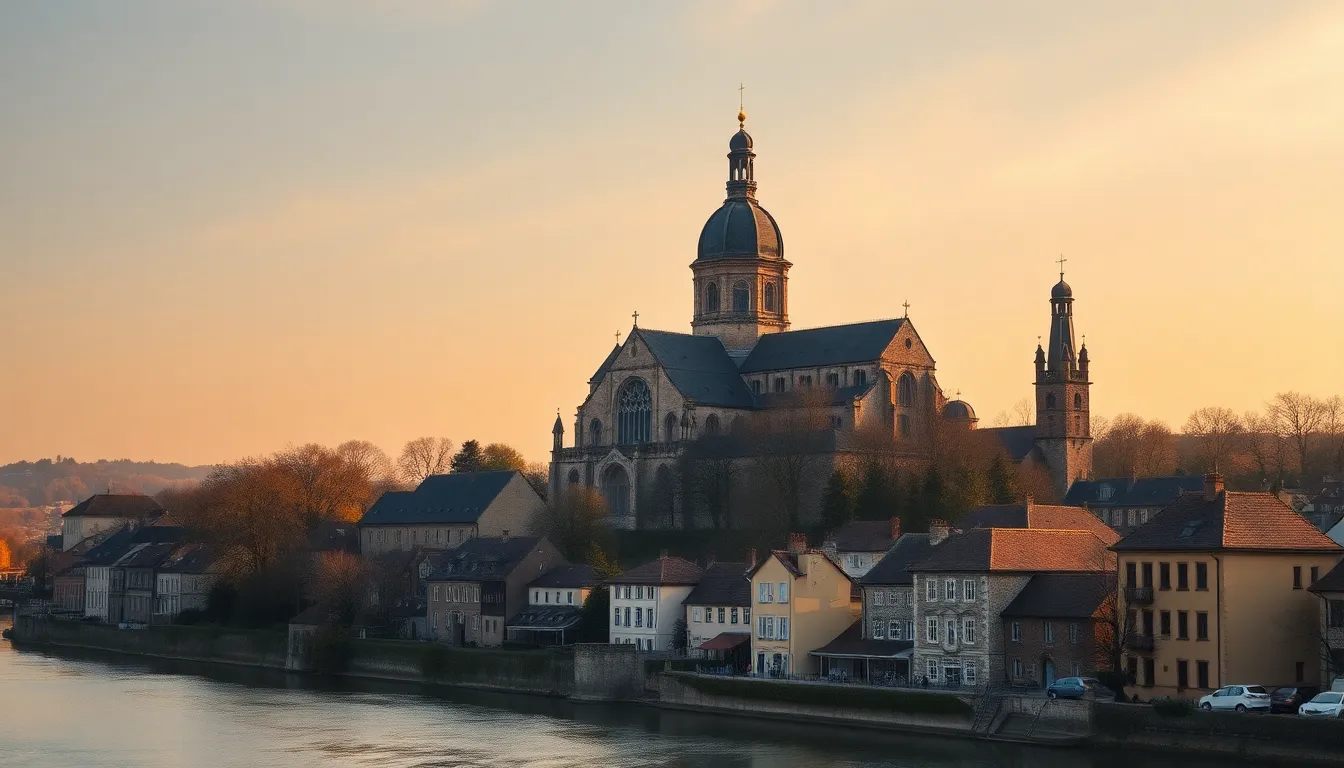
Worms is also a major Christian site. The Worms Cathedral is one of the great Romanesque cathedrals of the Rhineland, and the city was the setting for one of the pivotal moments of the Reformation. It was at the Diet of Worms in 1521 that Martin Luther, summoned before the emperor, refused to recant his writings, with the words traditionally remembered as “Here I stand.” A monument in the city marks the moment.
For a Christian group, or a mixed group, Worms is remarkable precisely because it holds both stories: the cradle of Ashkenazi Judaism and the stage of Luther’s defiance, within the same small city. I build the day to honor both.
Speyer: The Imperial City on the Rhine
The Speyer Cathedral
Speyer is dominated by its cathedral, the largest surviving Romanesque church in the world and a UNESCO World Heritage Site in its own right. It was built as the burial place of the Holy Roman Emperors, and several of them lie in the crypt beneath. The scale of it is staggering, and for a Christian group it is one of the great sacred spaces of medieval Europe. Standing in the vast nave, your group feels the weight of the imperial church that shaped the continent.
The Speyer Synagogue Courtyard and Mikveh
The Jewish heritage of Speyer centers on the SchPIRA museum and the Judenhof, the Jewish courtyard, where the remains of the medieval synagogue and women’s synagogue stand. The jewel of the site is the Speyer mikveh, built around 1120, one of the most beautiful and best-preserved medieval ritual baths in Europe. A long stone stairway descends to a vaulted chamber over the groundwater. It is an architectural marvel and a spiritual one.
Speyer was, in some ways, the founding community of the ShUM triangle. Its bishop issued a charter in 1084 inviting Jews to settle and granting them protections, an attempt to build a thriving community on the Rhine. For a Jewish group, the Speyer courtyard and mikveh complete the picture of how these communities lived, worshipped, and organized themselves.
Planning a Worms and Speyer Visit
The two cities sit close together in the Rhineland and pair naturally into one or two days. I usually give Worms the bulk of the time, the synagogue, the mikveh, the Heiliger Sand cemetery, and the cathedral, and add Speyer for its cathedral and its exquisite mikveh and synagogue courtyard. Both old towns are compact and walkable, which suits mixed-age groups.
These cities are the deep Jewish heart of the wider Germany heritage journey covered in our Germany heritage travel guide. They connect directly to Mainz, the third ShUM city, which most groups visit alongside Worms and Speyer to complete the triangle. Groups tracing the Reformation also link Worms to the wider Luther route and to Augsburg.
This is where an operator who knows the territory makes the difference. Heritage Tours builds custom itineraries, so a Jewish group can go deep on the ShUM sites and the cemetery while a Christian group can weight the visit toward the cathedrals and the Diet of Worms. Mixed groups can hold the full thousand-year sweep together. You can see how we structure these journeys on our Germany destination page and our group heritage tours page.
Group leaders with 15 or more participants travel free. For a congregation planning a trip, that is a straightforward benefit worth knowing from the start.
FAQ: Worms and Speyer Heritage Travel
What are the ShUM cities?
ShUM is an acronym from the medieval Hebrew names of Speyer, Worms, and Mainz, three Rhineland cities that were the intellectual heart of Ashkenazi Jewry from the tenth century onward. Their rabbis shaped Jewish law, liturgy, and communal life across Europe. The Speyer and Worms sites were named a UNESCO World Heritage Site in 2021 as the cradle of Ashkenazi Jewish civilization.
What is the most important Jewish site in Worms?
The Heiliger Sand cemetery and the Rashi Synagogue stand out. The cemetery is the oldest in-place Jewish cemetery in Europe, with graves from the eleventh century, including revered medieval scholars. The synagogue dates to 1034, is linked by tradition to Rashi, and was rebuilt with original stones after Nazi destruction. The medieval mikveh beneath the complex is among the oldest in Europe.
Why is the Speyer Cathedral significant?
The Speyer Cathedral is the largest surviving Romanesque church in the world and a UNESCO World Heritage Site. It was built as the burial place of the Holy Roman Emperors, several of whom lie in its crypt. For Christian groups it is one of the great sacred spaces of medieval Europe, and it sits a short walk from the city’s important medieval Jewish courtyard and mikveh.
Should we visit Worms and Speyer together or add Mainz?
Worms and Speyer pair naturally into one or two days because they sit close together. Most groups also add Mainz, the third ShUM city, to complete the triangle that gave rise to Ashkenazi Judaism. We commonly build all three into a single Rhineland segment so the full ShUM story holds together.
How do you handle the history of violence at these sites?
Honestly. These cities were sites of massacres during the First Crusade in 1096, and that memory entered the liturgy itself. The glory of the scholarship and the suffering of the persecutions sit side by side here. I prepare groups for both, give them time at the cemetery and the synagogues, and frame the day so the thousand-year story of persistence and faith stands alongside the loss.
If the ShUM cities speak to your community, the deep roots of Jewish Europe, the Reformation drama at Worms, the great Romanesque cathedrals, I would welcome the chance to talk it through. These are some of the most meaningful days I lead anywhere in Germany. Every congregation brings a different focus, and the itinerary should reflect yours. Contact us whenever you are ready to start that conversation.