Why Germany Is One of the Most Powerful Heritage Destinations in the World
Germany is not an easy destination. It is not a place you visit casually. But for a faith community, for a group of people who want to stand together in the places where history cut deepest and where hope returned against all odds, Germany is one of the most meaningful journeys you can take.
I have walked through these sites with groups for over twenty years. Every time, I watch something shift in people. At a memorial, at an ancient synagogue, at a cathedral where Martin Luther’s words still echo off the stone. Germany asks something of you. And if you are a rabbi or pastor considering this trip for your congregation, that is exactly what makes it worth doing.
The Two Germanys Every Heritage Traveler Needs to Understand
There are really two stories unfolding across this country. One is the story of destruction, of communities erased, of a chapter in human history that faith communities carry in their bones. The other is the story of what came before and what is happening now: a thousand years of Jewish life along the Rhine, the birthplace of the Protestant Reformation, and a Jewish revival in Berlin that would have been unimaginable fifty years ago.
A meaningful heritage tour holds both of those stories at the same time. Not one or the other. Both.
Jewish Heritage in Germany: Ancient Communities and Living Revival
The Medieval Jewish Heartland: Worms, Frankfurt, and the Rhine Valley
Long before the horrors of the twentieth century, Germany was home to some of the most important Jewish communities in European history. The ShUM cities, Worms, Speyer, and Mainz, were centers of Jewish scholarship and spiritual life starting in the tenth century. The Rashi Synagogue in Worms, originally built in 1034, was a seat of learning that influenced Jewish thought across the continent. The ancient Jewish cemetery in Worms, the Heiliger Sand, holds tombstones dating back nearly a thousand years.
In Frankfurt, the Judengasse, once the heart of a tightly packed Jewish quarter, gave rise to families like the Rothschilds who would shape European finance. Today, excavations beneath the modern city reveal the outlines of that vanished world.
These are not tourist attractions. They are the foundations of a civilization.
Berlin Today: The Fastest-Growing Jewish Community in Europe
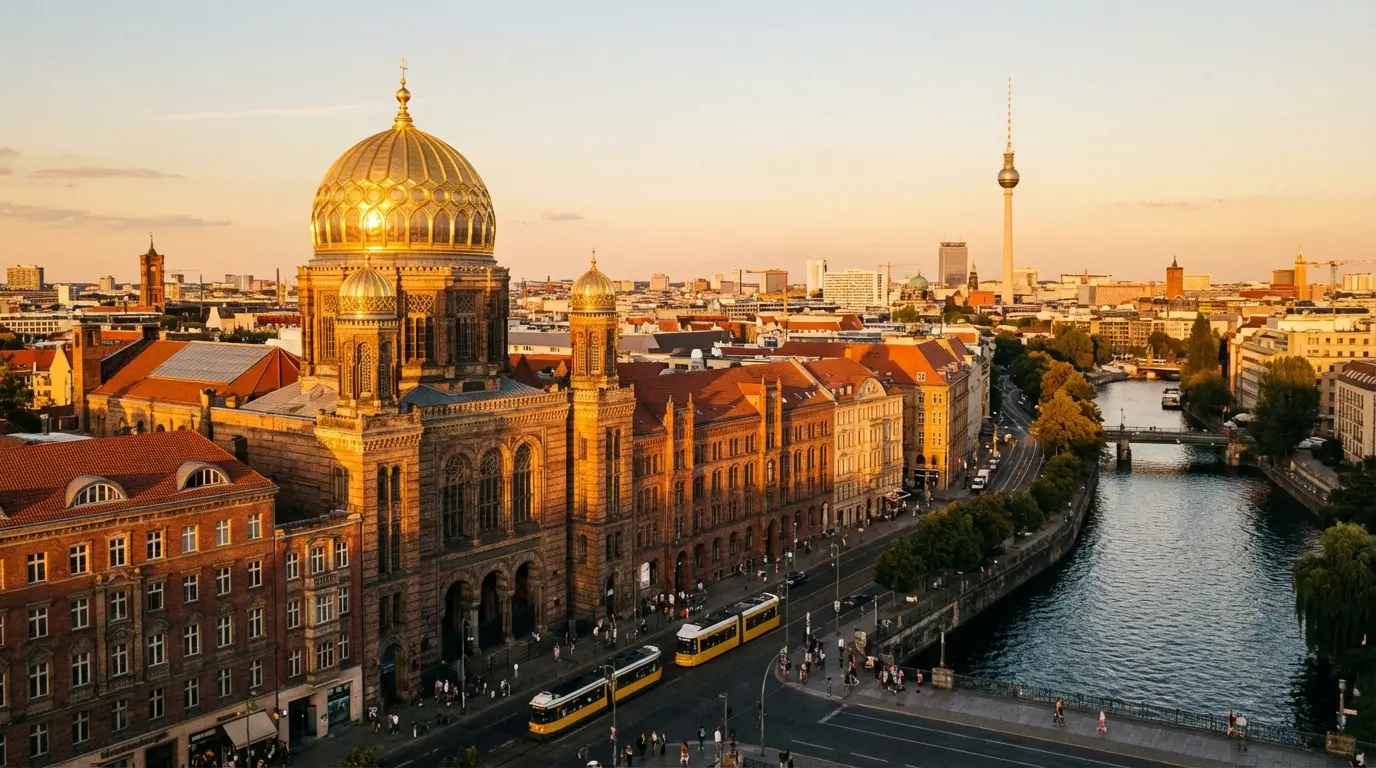
Here is the part of the story most people do not know. Berlin today is home to the fastest-growing Jewish community in Europe. Young Jewish families from Israel, from the former Soviet Union, from across the world are building lives there. The New Synagogue on Oranienburger Strasse, partially destroyed during Kristallnacht and rebuilt after reunification, stands as a symbol of that return.
For a Jewish group, walking from the Holocaust Memorial to a thriving Berlin synagogue on the same day is an experience that changes how you understand resilience.
Holocaust Memorial Sites: How to Approach Them with Your Group
Dachau, Bergen-Belsen, and the Berlin Memorial Landscape
If you are leading a group to Germany, you will visit Holocaust memorial sites. This is not optional in a heritage context. But how you approach them matters enormously.
Dachau, just outside Munich, was one of the first concentration camps and is now a deeply affecting memorial and museum. Bergen-Belsen, in Lower Saxony, is where Anne Frank died and where the landscape itself carries a weight that photographs cannot convey. In Berlin, the Memorial to the Murdered Jews of Europe, the Topography of Terror, and the Sachsenhausen camp north of the city form a constellation of remembrance.
What I have learned from years of guiding groups through these places: give people time. Do not rush from site to site. Build in moments for your group to sit together, to reflect, to talk or to be silent. A good itinerary makes room for the emotional reality of these visits, not just the schedule.
Christian Heritage Sites Worth Building a Pilgrimage Around
Lutherstadt Wittenberg and the Reformation Trail
For Christian groups, Germany is where the Reformation began. In 1517, Martin Luther nailed his 95 Theses to the door of the Castle Church in Wittenberg, and the Christian world was never the same. Today, Lutherstadt Wittenberg is a living museum of Reformation history. The Luther House, where he lived and taught, the Town Church where he preached, and the Castle Church itself are all open to visitors.
The Reformation Trail extends beyond Wittenberg to Erfurt, where Luther studied and became a monk, and to Eisleben, where he was born and where he died. For a pastor leading a group, tracing Luther’s footsteps is not simply historical. It is a chance to connect your congregation to the roots of their faith in the very places where it was forged.
Cologne Cathedral and Rothenburg ob der Tauber
Cologne Cathedral, a Gothic masterpiece that took over six hundred years to complete, remains one of the great sacred spaces in Europe. Standing inside it, looking up at the vaulted ceilings, your group will feel the centuries of devotion that built it.
Rothenburg ob der Tauber, a medieval walled town in Bavaria, offers a different kind of spiritual encounter. Its preserved churches and cobblestone streets feel like stepping into a painting of old Christian Europe. The St. James’s Church houses the famous Holy Blood Altar by Tilman Riemenschneider, a masterwork of religious art.
Planning a Group Heritage Tour to Germany: What Leaders Need to Know
Germany covers a lot of ground. The Jewish heritage sites are concentrated along the Rhine Valley and in Berlin. The Reformation sites run through central Germany. Holocaust memorials are spread across the country. A well-planned itinerary connects these threads without exhausting your group.
This is where working with an operator who knows the territory makes a real difference. Heritage Tours builds custom itineraries, which means a Jewish group can spend more time in Worms and Berlin while a Christian group can center the Reformation Trail. Mixed-faith groups can experience both traditions in a single journey.
Group leaders with 15 or more participants travel free. That is a straightforward benefit that makes organizing a heritage trip more accessible for congregations of any size.
If Germany is on your mind for your community, we would welcome the chance to talk through what a trip might look like. Every group is different, and the itinerary should reflect yours. You can explore our Germany destination page to start.
Frequently Asked Questions About Heritage Travel to Germany
What are the most important Jewish heritage sites in Germany?
The ShUM cities of Worms, Speyer, and Mainz are the oldest and most historically significant. Berlin’s Jewish Museum, the Holocaust Memorial, and the New Synagogue are essential for understanding both the destruction and the revival. Frankfurt’s Judengasse rounds out the picture of medieval Jewish life.
Is Germany appropriate for a faith-based group tour?
Absolutely. Germany’s heritage sites speak directly to both Jewish and Christian communities. The key is working with an operator who understands the emotional weight of the destination and builds the itinerary accordingly, with time for reflection, not just sightseeing.
How do you handle Holocaust memorial visits respectfully with a group?
Preparation matters. Brief your group before each visit. Build in time for silence and processing afterward. Do not schedule a memorial visit right before a lighthearted activity. The best itineraries treat these sites with the gravity they deserve and give your group room to feel what they feel.
What is the difference between Jewish heritage in Berlin vs. the Rhine Valley?
The Rhine Valley, particularly Worms, Speyer, and Mainz, represents the medieval chapter of German Jewish history, communities that thrived for centuries before the Crusades and beyond. Berlin represents both the twentieth-century destruction (Holocaust memorials, Sachsenhausen) and the twenty-first-century revival (the fastest-growing Jewish community in Europe).
When is the best time of year to take a heritage tour to Germany?
Spring (April and May) and early autumn (September and October) offer mild weather, manageable crowds, and comfortable conditions for walking outdoor sites. Summer works but brings larger tourist crowds. Winter is cold but offers a quieter, more reflective atmosphere, especially around the November 9th Kristallnacht anniversary.