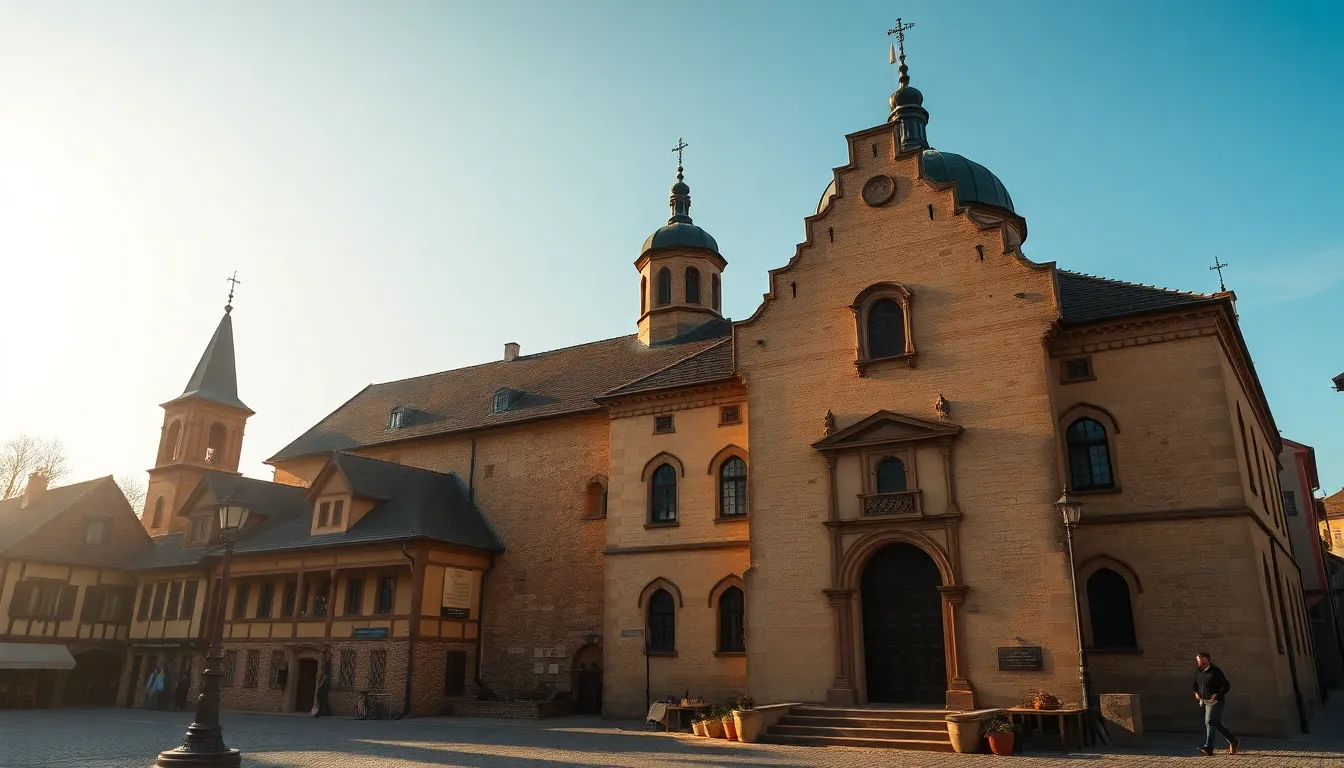
I have watched a lot of groups walk into the Rashi Synagogue in Worms, and the reaction is almost always the same. People go still. Someone usually reaches out and touches the stone. For a congregation that opens a Chumash with Rashi’s commentary every single week, walking into the building where Rashi himself studied is not a sightseeing stop. It is a meeting across nine centuries.
Worms holds the oldest documented Jewish community in Germany, and for many of the groups I lead, it is the single most moving day of the entire trip. Let me walk you through what is actually here, and how a congregation can experience it with the depth it deserves.
Why Worms Matters: One of Europe’s Oldest Jewish Communities
Jewish life in Worms reaches back to at least the tenth century. By the time most of the cities your group knows from later Jewish history had any Jewish presence at all, Worms was already an established community with scholars, courts, and institutions.
Worms was one of the three ShUM cities, alongside Speyer and Mainz, that together formed the legal and intellectual heart of Ashkenazi Judaism. The rulings issued by the rabbis of these communities, the takkanot ShUM, shaped Jewish practice across Europe for centuries. When you stand in Worms, you are standing in a place where Ashkenazi law and custom were not just studied but actually made.
That is the frame I give every group before we begin. Worms is not a museum of something that ended. It is a source point for the Judaism your congregation lives today.
The Rashi Synagogue: A Building That Was Raised Again
Rashi’s Real Connection to Worms
Rabbi Shlomo Yitzchaki, Rashi, the commentator whose words sit on nearly every page of Torah and Talmud study, studied in Worms as a young man in the eleventh century. The connection is not legend or marketing. He learned in this city, in this community, before returning to Troyes in France.
The synagogue, first built in 1034, carries his name because of that connection. Adjoining it is the Rashi Chapel, the study house associated with his memory. For a learning congregation, sitting in this space and opening the very commentary that was shaped in this place is an encounter with Jewish continuity that goes past anything words can carry.
Destroyed and Rebuilt From Its Own Stones
I always make sure groups understand the building’s full history, because it carries a lesson on its own. The synagogue was devastated during Kristallnacht in November 1938, when Nazi violence tore through Jewish communities across Germany. After the war, the building was reconstructed, much of it from its own salvaged original stones.
That act of rebuilding is part of what your group encounters. The community did not replace the synagogue with something new. It raised the old building again from what survived the destruction. The walls hold both the medieval origin and the twentieth-century wound and recovery in the same stones.
The Judengasse and the Medieval Jewish Quarter
Worms grew up around its Jewish quarter, and the Judengasse, the Jews’ street, was its spine. Walking it gives your group the physical shape of a medieval Jewish community: the synagogue, the study house, the communal institutions, all clustered in the streets where Jewish life was lived day to day.
This is where context matters most. A guide who can explain how the community governed itself, how it related to the city around it, how it endured periods of restriction and violence and still produced scholarship that shaped a continent, turns a quiet street into a living history. The stones alone are silent. The story makes them speak.
How Worms Survived and Why That Matters
There is a question groups often ask me in Worms, usually quietly, usually at the cemetery. How did so much survive? The Rhineland Jewish communities endured wave after wave of persecution across the medieval centuries, from the violence of the Crusades onward, and then the catastrophe of the twentieth century. And yet the synagogue stands, the cemetery stands, the street still bears its old name.
The honest answer is that survival here was never guaranteed and never complete. The community was attacked, expelled, restricted, and finally destroyed in the Shoah. What survived did so partly by chance, partly by the stone durability of a cemetery, and partly by the deliberate choice after the war to rebuild rather than let the ruins stand as ruins.
I share this with groups because it shapes how you hold the place. Worms is not a story of unbroken continuity. It is a story of a community that was broken more than once and whose memory was carried forward anyway, in stone and in the choice to raise the synagogue again. That is a different and in some ways harder kind of endurance, and it is worth naming for your congregation rather than letting the survival look effortless.
The Holy Sand: Europe’s Oldest Jewish Cemetery
No visit to Worms is complete without the Heiliger Sand, the Holy Sand, the oldest surviving Jewish cemetery in Europe, with tombstones reaching back to the eleventh century. The graves of scholars and community leaders rest here, some of them places of pilgrimage for centuries.
The cemetery deserves its own unhurried time, and many groups treat it as the heart of the Worms visit. I have written more fully about the Holy Sand and how to approach it with reverence, because it asks for a particular kind of presence that is worth preparing your group for in advance.
Touring Worms With a Congregation
Worms rewards an unhurried morning. The synagogue compound, the Rashi Chapel, the Judengasse, and the Holy Sand cemetery sit close together, all walkable, which means the day is gentle on the body even when it is heavy on the heart.
I usually build study time directly into the Worms visit. Sitting in or near the Rashi Synagogue and learning a piece of his commentary, in the place where his learning was formed, is the kind of moment that defines a trip. For congregations that come to study, this is where the studying and the standing become one thing.
Worms connects naturally to the rest of the ShUM trail. Most groups pair it with Speyer’s medieval mikveh and Judenhof and Mainz, the cradle of Ashkenaz, and set the whole visit within the wider story of Jewish heritage in Germany.
Heritage Tours builds every Worms visit around your congregation’s pace and interests, with study sessions, reverent time at the cemetery, and proper context-setting throughout. Group leaders travel free with fifteen or more participants, which makes a dedicated Rhineland heritage trip reachable for communities of nearly any size. You can see how we structure these journeys on our Germany destination page and our group heritage tours page.
FAQ: Visiting Worms
Did Rashi really study in Worms?
Yes. Rabbi Shlomo Yitzchaki, known as Rashi, studied in Worms as a young man in the eleventh century before returning to Troyes in France. The synagogue, first built in 1034, carries his name because of this connection, and the adjoining Rashi Chapel is associated with his memory.
Is the Rashi Synagogue the original building?
The synagogue is a reconstruction. The original 1034 building was devastated during Kristallnacht in 1938, then rebuilt after the war, much of it from its own salvaged original stones. The walls hold both the medieval origin and the story of destruction and recovery.
What else is there to see in Jewish Worms besides the synagogue?
The Judengasse and medieval Jewish quarter, the Rashi Chapel study house, and the Heiliger Sand, the oldest surviving Jewish cemetery in Europe. Together they form a compact, walkable visit that covers the synagogue, the lived community, and the resting place of its scholars.
How much time should we plan for Worms?
An unhurried morning is a comfortable plan, and many groups give it more. The synagogue compound, the Judengasse, and the Holy Sand cemetery sit close together and are all walkable, but each asks for stillness, so it is worth resisting the urge to rush through.
Is Worms part of the ShUM cities?
Yes. Worms (Warmaisa) was one of the three ShUM cities, along with Speyer and Mainz, that formed the legal and intellectual heart of Ashkenazi Judaism. The ShUM sites received UNESCO World Heritage status in 2021.
If standing where Rashi studied is something you want your congregation to experience rather than only imagine, I would be glad to talk through what a Worms-centered journey could look like for your community. Contact us whenever you are ready to begin.