The mikveh in Speyer is the moment I wait for. I have led groups through grand synagogues and vast memorials, and yet it is this narrow stone staircase, descending into the earth toward still groundwater, that most often brings a congregation to silence. You go down step by worn step, the light fades, and at the bottom there is water that has been gathering the same way for nine hundred years. For a group that understands what a mikveh is, the descent is a kind of prayer.
Speyer, Shpira in its medieval Hebrew name, is where many ShUM journeys begin, and it sets a tone of quiet depth that carries through the whole trip. Let me walk you through what is here and why it lands the way it does.
Speyer’s Place in the ShUM Story
Speyer was one of the three ShUM cities, alongside Worms and Mainz, that formed the legal and intellectual heart of Ashkenazi Judaism from roughly the tenth century onward. The Hebrew acronym ShUM comes from the three cities’ medieval names, and the communities operated as a connected world, their rabbis corresponding and ruling together.
What makes Speyer distinctive in the trio is its origin story. In the late eleventh century, the bishop of Speyer invited Jewish settlement and granted the community a charter of protections, an unusually formal recognition for its time. That charter helped a structured community take root, and the physical heart of that community, the Judenhof, survives today.
In 2021, the Speyer Judenhof was inscribed, along with the other ShUM sites, as a UNESCO World Heritage Site. The recognition has protected the grounds while keeping them remarkably free of crowds.
The Judenhof: The Medieval Jewish Courtyard
The Synagogue and Women’s Shul
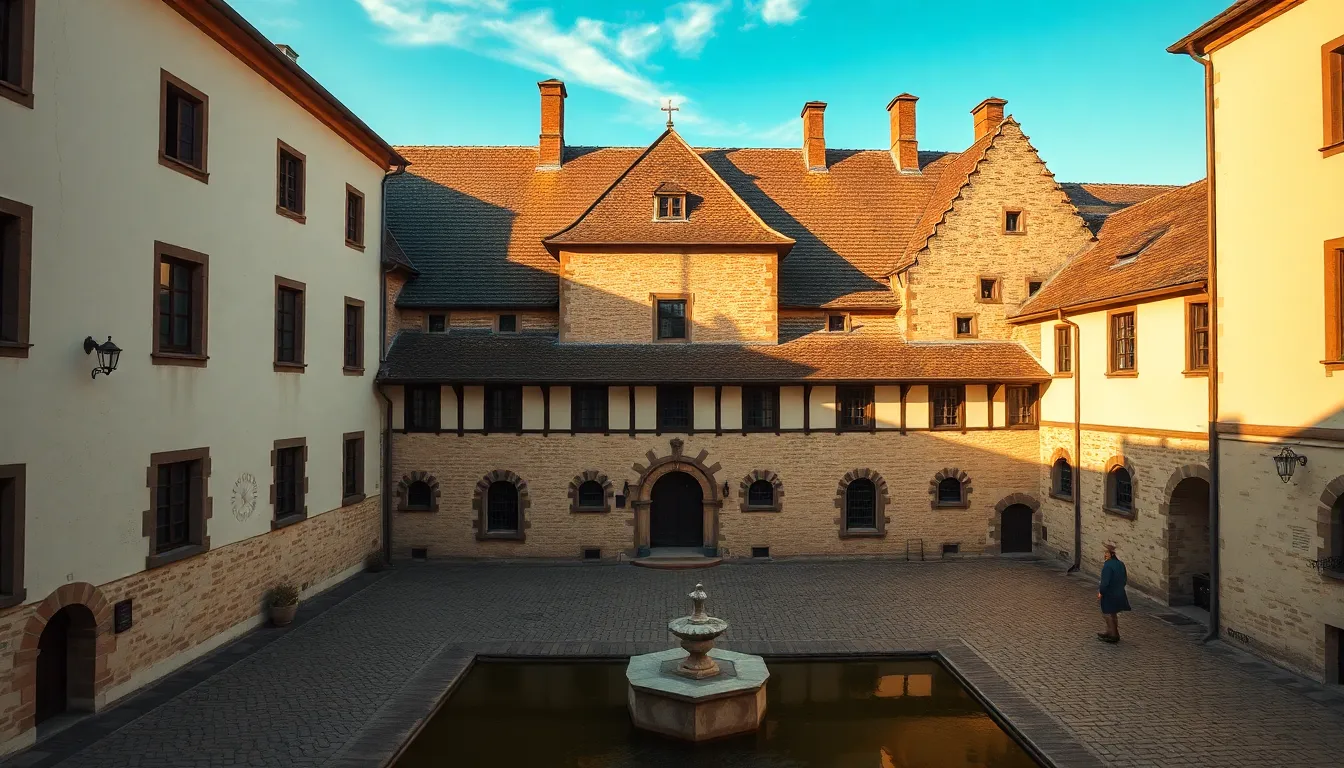
The Judenhof, the Jews’ courtyard, holds the remains of the medieval synagogue, built in the early twelfth century, and the women’s shul added later. The walls stand open to the sky now, but the shape of the space is intact: you can read where the community gathered, where the men prayed, where the women had their own room of worship along the wall.
I find groups respond to the open ruin in a way they do not always respond to a fully intact building. There is nothing to distract from the bones of the thing. You are standing inside the floor plan of a community’s spiritual life, eight hundred years on.
The Oldest Mikveh North of the Alps
The mikveh, built around 1128, is the crown of the Judenhof and among the best-preserved medieval ritual baths in Europe. It is the oldest surviving monumental mikveh north of the Alps. The stairway descends well below ground to reach the groundwater that fills the basin, the living water, mayim chayim, that a mikveh requires.
For a congregation, the mikveh is not an artifact behind glass. It is a piece of Jewish law made physical and permanent. The laws of taharah, of ritual purity, that your community studies and keeps were carried out in this exact space for centuries. Standing at the water’s edge connects your people to halacha across nine hundred years in a way no lecture can match.
The Bishop’s Charter and What It Tells Us
I spend a few minutes with groups on the charter of 1084, because it reveals something most people do not expect about medieval Jewish life. When the bishop of Speyer invited Jewish families to settle and granted them protections, he was not acting out of pure goodwill. He wanted the community for what it could bring to the growing city: trade, skills, connections, taxes. The relationship was a negotiation, and the protections were real but conditional.
That tension runs through the whole medieval Jewish experience in the Rhineland. Communities were valued and protected when it served the rulers who hosted them, and exposed and vulnerable when it did not. The same charter that welcomed Jews to Speyer could not shield the Rhineland communities from the violence that struck during the Crusades a decade later.
I name this for groups because it guards against a sentimental reading of the medieval period. The flourishing was genuine, and so was the precariousness. Both are part of what the Judenhof represents. A community built something lasting here, in stone and in scholarship, while standing on ground that was never fully secure.
How Groups Tour Speyer
Speyer is compact and walkable, and the Judenhof sits at its center, near the city’s famous Romanesque cathedral. A focused Speyer visit, the Judenhof, the synagogue remains, the women’s shul, and the descent into the mikveh, fits comfortably into part of a day, which makes it a natural opening or closing point for a ShUM itinerary.
I always brief a group before the mikveh descent. The staircase is narrow and the steps are uneven and old, so we move slowly and carefully, which suits the moment anyway. I explain what we are about to see, what a mikveh meant in the daily and spiritual life of this community, and then we go down quietly. The descent does not need narration. It speaks for itself.
Speyer connects directly to the rest of the ShUM trail. Most groups pair it with Worms and the Rashi Synagogue and Mainz, the cradle of Ashkenaz, and treat all three as one connected encounter. You can read about touring the ShUM cities together and about the wider arc of Jewish heritage in Germany.
Planning a Speyer Visit for Your Congregation
Heritage Tours builds every Speyer visit around your group’s pace and interests, with proper context before the mikveh descent, unhurried time in the Judenhof, and study sessions where your community wants them. We treat Speyer as the contemplative opening it deserves to be, not a quick stop on the way to somewhere else.
Group leaders travel free with fifteen or more participants, which makes a dedicated ShUM heritage trip reachable for communities of nearly any size. You can see how we structure these journeys on our Germany destination page and our group heritage tours page.
FAQ: Visiting Speyer
What is the Judenhof in Speyer?
The Judenhof is the medieval Jewish courtyard at the heart of Speyer’s old Jewish community. It holds the remains of the early twelfth-century synagogue, the women’s shul, and the famous mikveh. The grounds were inscribed as a UNESCO World Heritage Site in 2021 as part of the ShUM sites.
Why is the Speyer mikveh significant?
Built around 1128, the Speyer mikveh is the oldest surviving monumental mikveh north of the Alps and among the best-preserved medieval ritual baths in Europe. Its stairway descends well below ground to the living groundwater a mikveh requires, and the space was used for the laws of ritual purity for centuries.
Is Speyer worth visiting on its own or only with the other ShUM cities?
Speyer is most rewarding as part of the connected ShUM trail with Worms and Mainz, since the three communities formed a single intellectual world. That said, the Judenhof and mikveh are powerful on their own, and Speyer often serves as the contemplative opening point of a ShUM journey.
How much time does a Speyer visit take?
A focused visit to the Judenhof, the synagogue remains, the women’s shul, and the mikveh fits comfortably into part of a day. The site is compact and walkable, near the city’s cathedral, which makes it an easy opening or closing point for a ShUM itinerary.
Is the mikveh descent suitable for older group members?
The mikveh staircase is narrow with old, uneven steps, so groups move slowly and carefully. It is manageable for most visitors with care, but it is worth briefing the group beforehand and allowing extra time so anyone who needs to take the descent gently can do so.
If a quiet descent into nine centuries of Jewish practice is something you want your congregation to experience, I would be glad to talk through what a Speyer and ShUM journey could look like for your community. Contact us whenever you are ready to begin.