When I want a group to understand where Ashkenazi Judaism actually comes from, I bring them to Mainz. Not Worms, with its famous synagogue, and not Speyer, with its mikveh, much as I love both. Mainz. Because Magenza, as it was known in Hebrew, is where the story starts. This is the city of Rabbenu Gershom, the Light of the Exile, whose rulings still govern the way your congregation lives a Jewish life today. To stand in Mainz is to stand at the source.
Mainz is often the quietest of the three ShUM cities to visit, and in a way that suits it. The greatness here is not in a single grand building. It is in what flowed out of this place across the centuries. Let me help you understand what your group encounters in the cradle of Ashkenaz.
Why Mainz Is Called the Cradle of Ashkenaz
By the tenth and eleventh centuries, Mainz had become the leading center of Jewish learning in the German lands. The yeshiva of Mainz drew students from across Europe, and the rulings issued by its sages spread outward to shape Jewish practice everywhere Ashkenazi Jews settled.
Mainz was one of the three ShUM cities, along with Worms and Mainz’s neighbor Speyer, that together formed the legal and intellectual heart of Ashkenazi Judaism. ShUM is a Hebrew acronym from the three cities’ medieval names, and of the trio, Mainz carries the strongest claim to being where the Ashkenazi tradition first took shape as a distinct world of its own.
I give groups this frame before anything else. The customs, the legal rulings, the patterns of communal life that your congregation inherited as Ashkenazi Jews were not handed down from nowhere. Much of that inheritance was formed in this city.
Rabbenu Gershom: The Light of the Exile
You cannot tell the story of Mainz without Rabbenu Gershom ben Yehudah, known across the generations as Me’or HaGolah, the Light of the Exile. He led the academy at Mainz around the turn of the eleventh century, and his rulings reshaped Jewish life in ways that remain fully active today.
His takkanot included the famous ban on polygamy among Ashkenazi Jews and the prohibition against opening another person’s private mail, rulings so deeply absorbed that most Jews keep them without realizing where they came from. When your congregation studies how Ashkenazi practice diverged and developed, Rabbenu Gershom is at the headwaters, and Mainz is where he taught.
For a learning group, naming this connection on the ground in Mainz turns an abstract chapter of history into something with a location. The Light of the Exile taught here. This is the place.
What Groups See in Jewish Mainz
The Old Jewish Cemetery
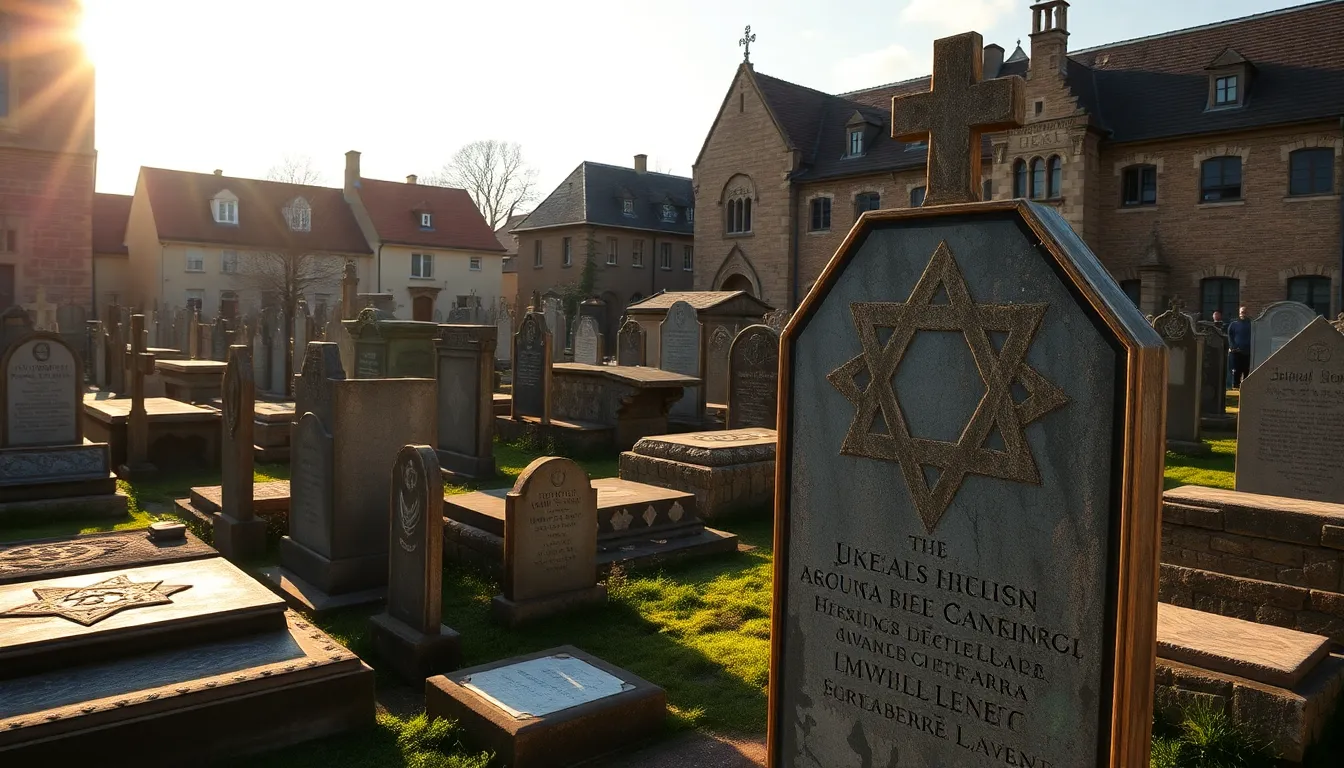
The medieval Jewish cemetery, the Judensand of Mainz, preserves gravestones reaching back centuries, many of them recovered and reset after long periods of disruption and destruction. Among the memory held here are the graves of medieval scholars connected to the academy that made Mainz famous. The cemetery is part of the UNESCO World Heritage inscription granted to the ShUM sites in 2021.
As with any Jewish cemetery, I prepare groups to enter with reverence: quietly, heads covered, with time for reflection. This is a beit chaim, a house of life, and the people remembered here are part of the chain of transmission your congregation stands in.
A Living Community Today
Mainz also carries a chapter of return. A striking modern synagogue now anchors Jewish life in the city, built on the site connected to the community’s earlier history and serving an active congregation today. For a group that has just stood at the medieval cemetery, walking past a living synagogue reframes the whole visit. The story that began here did not end. It continues.
The Mainz Anonymous and the Memory of 1096
There is a sober chapter of the Mainz story that I always make sure a group understands, because it is part of why the city matters and how it has been remembered for nearly a thousand years. In 1096, as the armies of the First Crusade moved through the Rhineland, the Jewish community of Mainz was attacked and largely destroyed. Many of its members died, and the loss was felt across all of Ashkenaz.
The events were recorded in Hebrew chronicles written in the generations that followed, including the account known to scholars as the Mainz Anonymous. These chronicles are among the earliest sustained Jewish historical writing of the medieval period, and they preserved the memory of the community with a care that shaped how Ashkenazi Jews remembered persecution for centuries afterward. The yizkor traditions and the way these communities held their martyrs in liturgical memory trace back in part to events like these.
I share this with groups not to dwell on tragedy but because it is inseparable from the city’s greatness. Mainz produced towering scholarship, and Mainz suffered catastrophic loss, and the same community did both. The memory of 1096 sits alongside the memory of Rabbenu Gershom. To understand Magenza honestly is to hold both at once, the learning and the loss, and to recognize that the tradition carried both forward.
Touring Mainz With a Congregation
Mainz tends to close a ShUM journey, and it closes it well, on a note of origins and continuity. The sites are walkable, the pace is gentle, and the content is contemplative rather than overwhelming. A focused Mainz visit fits comfortably into part of a day, which pairs naturally with the other two cities on the trail.
What Mainz asks of a guide is the ability to make the invisible visible. The greatness of Magenza is not architectural. It is intellectual and spiritual, carried in rulings and learning rather than in a single monument. A good guide names what flowed out of this place, so your group leaves understanding that they have stood at a source point of their own tradition.
Mainz connects directly to the rest of the ShUM trail. Most groups pair it with Speyer’s medieval mikveh and Judenhof and Worms and the Rashi Synagogue, and treat the three as one connected encounter. You can read about touring the ShUM cities together and about the wider arc of Jewish heritage in Germany.
Planning a Mainz Visit for Your Congregation
Heritage Tours builds every Mainz visit to draw out what makes the city the cradle of Ashkenaz: the story of Rabbenu Gershom and the academy, reverent time at the old cemetery, and the quiet power of a living community in the place where the tradition began. We make the invisible greatness of Magenza visible for your group.
Group leaders travel free with fifteen or more participants, which makes a dedicated ShUM heritage trip reachable for communities of nearly any size. You can see how we structure these journeys on our Germany destination page and our group heritage tours page.
FAQ: Visiting Mainz
Why is Mainz called the birthplace of Ashkenaz?
By the tenth and eleventh centuries, Mainz (Magenza) had become the leading center of Jewish learning in the German lands, home to an academy whose rulings spread across Europe and shaped Ashkenazi practice. Of the three ShUM cities, Mainz carries the strongest claim to being where the Ashkenazi tradition first took shape as a distinct world.
Who was Rabbenu Gershom and why does Mainz matter for him?
Rabbenu Gershom ben Yehudah, known as Me’or HaGolah, the Light of the Exile, led the academy at Mainz around the turn of the eleventh century. His rulings, including the ban on polygamy among Ashkenazi Jews, remain active in Jewish life today, and Mainz is where he taught.
What can a group see in Jewish Mainz?
The medieval Jewish cemetery, part of the UNESCO ShUM inscription, holds gravestones reaching back centuries, including scholars connected to the famous academy. A modern synagogue anchors an active Jewish community in the city today, giving the visit both medieval roots and a living present.
Is Mainz part of the ShUM cities?
Yes. Mainz (Magenza) was one of the three ShUM cities, along with Worms and Speyer, that formed the legal and intellectual heart of Ashkenazi Judaism. The ShUM sites, including the Mainz cemetery, received UNESCO World Heritage status in 2021.
Where does Mainz fit in a ShUM itinerary?
Mainz often closes a ShUM journey on a note of origins and continuity. The sites are walkable and the pace is gentle, so a focused visit fits comfortably into part of a day and pairs naturally with Speyer and Worms on the same trail.
If you want your congregation to stand at the source of their own Ashkenazi tradition, I would be glad to talk through what a Mainz and ShUM journey could look like for your community. Contact us whenever you are ready to begin.