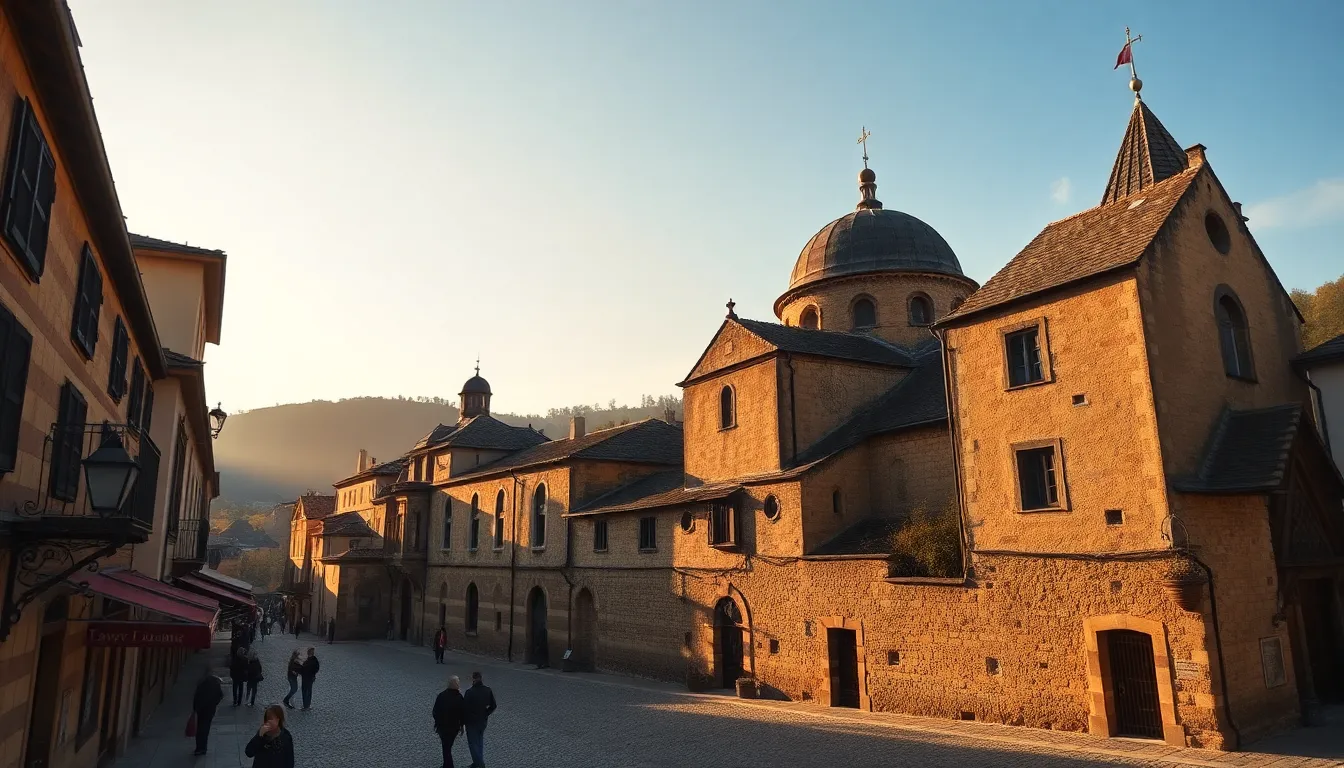
The first time I walked a group through all three ShUM cities in a single trip, a rabbi stopped me on the steps of the Worms cemetery and said something I have never forgotten. He said he had taught the Rhineland academies to his students for thirty years, and he had never once thought of them as a place his own feet could stand. That is what the ShUM cities do to people. They take a thousand years of Ashkenazi scholarship that lives in books and put it under your shoes.
If you lead a congregation that studies the medieval commentators, that davens in a tradition shaped by these communities, I want to help you understand what touring Speyer, Worms, and Mainz together actually involves. Because doing them as a trio is different from visiting any one of them alone. The three were bound together in life, and they are best encountered bound together now.
What ShUM Means and Why These Three Cities Belong Together
ShUM is a Hebrew acronym built from the medieval Hebrew names of the three cities: Shpira for Speyer, Warmaisa for Worms, and Magenza for Mainz. From roughly the tenth century onward, these three Rhine Valley communities formed a single intellectual and legal world. They were close enough to travel between, and their rabbis corresponded, ruled, and studied as a connected body.
The decisions made here, the takkanot ShUM, shaped Jewish law and communal life across all of Ashkenaz. Questions of marriage, communal governance, and the relationship between Jewish communities and the wider world were worked out in these cities and carried outward across Europe. When your congregation studies how Ashkenazi practice took the shape it has, much of that shape was formed right here.
In 2021, UNESCO granted World Heritage status to the ShUM sites: the Speyer Judenhof with its mikveh, the Worms synagogue compound and the Holy Sand cemetery, and the old Jewish cemetery in Mainz. That recognition matters for a practical reason I will come back to. It has protected and stabilized these sites without turning them into crowded attractions.
The Three Cities, One Trail Along the Rhine
Speyer: The Judenhof and the Oldest Mikveh North of the Alps
Speyer is where many groups begin, and it sets the tone. The Judenhof, the medieval Jewish courtyard, holds the remains of the synagogue and women’s shul, and below ground, the mikveh built around 1128. Descending the worn stone stairs into that ritual bath is the moment most groups go quiet. The water is still there, fed by groundwater the way it was nine hundred years ago.
For a congregation, the mikveh is not an artifact. It is a piece of Jewish daily life and law that has not changed in its essence. Standing in the space where that practice was carried out for centuries connects your people to halacha in a way no lecture can.
Worms: The Rashi Synagogue and the Holy Sand
Worms is the emotional center of any ShUM trip. The synagogue, first built in 1034 and tied to Rashi, who studied in this city, was destroyed on Kristallnacht and rebuilt afterward from its own salvaged stones. That rebuilding is part of the story you tell your group. The community honored continuity by raising the building again from what survived.
Then there is the Heiliger Sand, the Holy Sand, the oldest surviving Jewish cemetery in Europe, with tombstones reaching back to the eleventh century. I give Worms more time than either of the other two cities for this reason. Worms deserves an unhurried morning.
Mainz: The Cradle of Ashkenaz
Mainz, Magenza, is where Ashkenazi Jewry’s intellectual story arguably begins. This was the seat of Rabbenu Gershom, the Light of the Exile, whose rulings still govern Jewish practice today. The old Jewish cemetery preserves medieval gravestones, many of them recovered and reset after centuries of disruption. A modern synagogue now anchors Jewish life in the city. Mainz tends to close a ShUM trip on a note of origins, the place the whole story flowed from.
How Groups Actually Tour the ShUM Cities
The three cities sit close together along the Rhine, which is what makes the trio so workable. Speyer, Worms, and Mainz can be visited across two unhurried days, often based out of a single hotel, with the Frankfurt area within easy reach for arrival and departure.
I usually counsel against trying to compress all three into one day. You can technically do it. But these are not sites to rush. The mikveh in Speyer, the cemetery in Worms, the medieval stones in Mainz, each one asks for stillness, and a group moving too fast loses the very thing it came for.
Here is the practical advantage I promised to return to. Because the ShUM cities are not on the standard tourist circuit, your group will often have these sites largely to itself. That is rare in European heritage travel. For a congregation that wants depth over spectacle, the quiet is part of the gift.
For groups continuing onward, the ShUM trail connects naturally to the wider arc of Jewish heritage in Germany, from these medieval roots through the later chapters of the story. Many of our groups pair the ShUM cities with deeper time in Worms itself and a focused study of Rashi and the Rhineland academies.
Building a ShUM Itinerary for Your Congregation
The right ShUM itinerary depends on your community. A group of scholars and serious learners may want extended time in each beit knesset and at each cemetery, with study sessions built into the visits. A multigenerational congregation may want a gentler pace with more context-setting between sites. There is no single correct version.
What I always recommend is treating the three cities as one connected encounter rather than three separate stops. Brief your group before you start. Explain what ShUM meant, how these communities spoke to one another, and what their decisions did for the Jewish world. Then let the sites do their work.
Heritage Tours builds every ShUM itinerary around your congregation’s specific interests and pace. Group leaders travel free with fifteen or more participants, which makes a dedicated medieval heritage trip reachable for communities of nearly any size.
You can see how we structure these journeys on our Germany destination page and our group heritage tours page.
FAQ: Touring the ShUM Cities
What does ShUM stand for?
ShUM is a Hebrew acronym from the medieval names of three Rhine Valley cities: Shpira (Speyer), Warmaisa (Worms), and Magenza (Mainz). Together these communities formed the legal and intellectual heart of Ashkenazi Judaism from roughly the tenth century onward, and their rabbinical rulings shaped Jewish practice across Europe.
How many days do you need to visit all three ShUM cities?
Two unhurried days is a comfortable plan, often based from a single hotel since the cities sit close together along the Rhine. It is possible to compress the trio into one day, but these are sites that reward stillness, and a slower pace lets your group absorb the mikveh, the cemeteries, and the synagogues properly.
Are the ShUM cities a UNESCO World Heritage Site?
Yes. The ShUM sites received UNESCO World Heritage status in 2021, covering the Speyer Judenhof and mikveh, the Worms synagogue compound and Holy Sand cemetery, and the old Jewish cemetery in Mainz. The recognition has protected the sites while keeping them remarkably free of crowds.
Which ShUM city should we spend the most time in?
Most groups give Worms the most time, because it holds both the Rashi Synagogue and the Heiliger Sand, the oldest surviving Jewish cemetery in Europe. Speyer’s mikveh and Mainz’s role as the cradle of Ashkenaz each deserve unhurried visits as well, but Worms tends to be the emotional center of the trip.
Are the ShUM cities appropriate for a multigenerational group?
Yes. The sites are walkable and close together, the pace is flexible, and the content speaks across generations. With a gentle schedule and good context-setting between stops, the ShUM cities work well for congregations that include older members and families.
If the medieval roots of Ashkenaz are something you want your congregation to stand inside rather than only read about, I would be glad to talk through what a ShUM journey could look like for your community. Contact us whenever you are ready to begin.