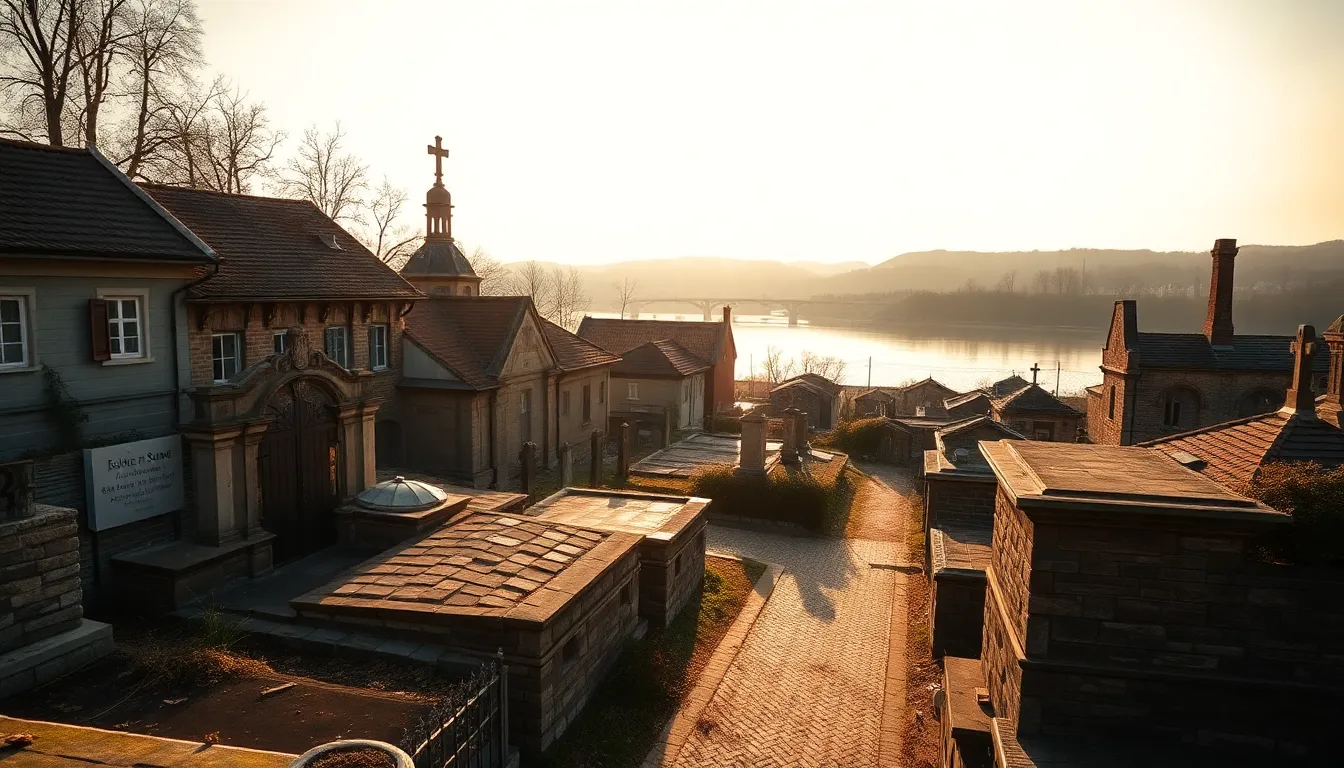
I have stood in a lot of old places with a lot of groups. But the ancient Jewish cemetery in Worms, the Heiliger Sand, “the Holy Sand,” does something to people that I rarely see anywhere else. The oldest tombstones there are nearly a thousand years old. People grow quiet. They reach out and touch the stones. And then someone almost always says: “I had no idea any of this survived.” That is the Rhineland in a sentence. A Jewish civilization that took root along this river more than a thousand years ago, much of it still here to be touched.
I have led faith groups along the Rhine for years, and the river cities, Speyer, Worms, Mainz, and Cologne downstream, give a group something they cannot get anywhere else: the deep medieval roots of European Jewish life, plus one of the great cathedrals of Christendom, strung along a single river. Here is how I plan the trail and what your group should not miss.
Why the Rhineland Is the Deep Root of European Jewish Heritage
Long before the catastrophes of the twentieth century, the Rhine valley was the cradle of Ashkenazi Jewish civilization. Starting in the tenth and eleventh centuries, three cities, Speyer, Worms, and Mainz, became the great centers of Jewish scholarship in northern Europe. Together they were known by the Hebrew acronym ShUM, formed from the initial letters of their medieval Hebrew names: Shpira, Warmaisa, and Magenza. The ShUM cities shaped Jewish law, liturgy, and learning for the whole Ashkenazi world, and in 2021 their key sites were recognized together on the UNESCO World Heritage list.
For a group, walking the ShUM trail is going to the source of a civilization. And downstream, Cologne adds both one of Europe’s greatest cathedrals and its own deep Jewish history, recently uncovered in remarkable archaeological detail. The Rhine ties it all together.
The Trail at a Glance
The geography is friendly. Speyer, Worms, and Mainz sit close together in the southern Rhineland, an easy chain to drive in a day or two. Cologne lies further downstream to the north, a natural extension for groups who want the cathedral and the medieval Jewish quarter being excavated there. Frankfurt makes an excellent gateway, just east of the ShUM cities, and pairs naturally with this trail.
Speyer: The Oldest Stones
Speyer is where I usually begin the ShUM trail, because its remains are among the oldest. The Judenhof, the medieval Jewish courtyard, holds the ruins of the synagogue begun around 1100 and, most strikingly, the mikveh, the ritual bath, one of the oldest and best preserved in Europe. You descend a stone stairway deep below ground to reach the water, and the engineering and the age of it leave groups speechless.
Speyer is also a Christian heritage anchor. The Speyer Cathedral, the Kaiserdom, is one of the largest Romanesque churches in the world and a UNESCO World Heritage site in its own right, the burial place of Holy Roman Emperors. Having the great imperial cathedral and the ancient mikveh in one small city makes Speyer a perfect opening for a group that holds both the Jewish and Christian threads.
Worms: The Holy Sand and the Rashi Synagogue
Worms is the emotional heart of the ShUM trail for most of my groups. The Rashi Synagogue, originally built in 1034 and named for the great commentator Rashi who studied here, was a seat of Jewish learning that shaped thought across the continent. Destroyed on Kristallnacht and again in the war, it was faithfully rebuilt, and the adjacent Rashi House museum tells the community’s long story.
Then there is the Heiliger Sand, the Holy Sand, the oldest surviving Jewish cemetery in Europe, with graves dating back to the eleventh century. Walking among those weathered stones, some nearly a thousand years old, is one of the most moving experiences in all of German heritage travel. I always give groups unhurried time here. For the wider arc of German Jewish history and remembrance, the Germany heritage travel guide sets this trail in its full context.
Mainz: Magenza and the Cathedral City
Mainz, the third ShUM city, was home to towering medieval scholars, including Gershom ben Judah, known as the “Light of the Exile,” whose rulings shaped Ashkenazi practice for centuries. The old Jewish cemetery of Mainz preserves medieval tombstones, some moved and reset over the centuries, including stones connected to these great sages. The modern Mainz New Synagogue, with its striking contemporary architecture rising on the site of a synagogue destroyed in 1938, marks the community’s return.
Mainz is also a major Christian heritage city. Mainz Cathedral, the Romanesque Saint Martin’s Cathedral, has stood at the center of the city for more than a thousand years. And Mainz is the birthplace of Johannes Gutenberg, whose printing press put the scriptures into the hands of ordinary people and made the Reformation possible. The Gutenberg Museum is well worth a stop, and for Christian groups it connects directly to the story I tell in the Wittenberg and Reformation Country guide.
Cologne: The Cathedral and the Buried Jewish Quarter
Cologne, downstream to the north, gives a group two things at once. Cologne Cathedral, the Kölner Dom, is a Gothic masterpiece that took over six hundred years to complete and remains one of the great sacred spaces in Europe. Standing inside, looking up into the vaulting, your group feels the centuries of devotion that built it.
Cologne also has one of the oldest Jewish communities north of the Alps, documented back to Roman times. In the heart of the city, archaeologists have excavated the medieval Jewish quarter, including a synagogue and a mikveh, and a major museum complex called MiQua is bringing that buried world to light. To have the soaring cathedral and the excavated Jewish quarter side by side in one city is the Rhineland’s whole story compressed into a single square. For a fuller modern Jewish picture, the Frankfurt heritage guide makes a good companion to this trail.
Planning a Rhineland Heritage Trail Tour: What Leaders Need to Know
The Rhineland trail is one of the more rewarding heritage journeys in Germany to lead, and the geography helps. I usually plan three to four days: a day for Speyer, a day for Worms and Mainz, and a day or two for Cologne and the cathedral, with Frankfurt as a gateway at one end. A Rhine river segment can be woven in for groups who want time on the water and views of the castle-topped valley between the cities.
Most ShUM sites involve some stairs, especially the deep medieval mikvehs, and the cemeteries are walked on uneven ground, so I pace the days for mixed-age groups. The combination of profound Jewish heritage and great cathedrals means sequencing matters, and I give the cemeteries and the ShUM sites the unhurried time they deserve.
This is where an operator who knows the territory makes the difference. Heritage Tours builds custom itineraries, so a Jewish group can go deep on the ShUM cities and the scholarship that came out of them, while a Christian group can weight the cathedrals of Speyer, Mainz, and Cologne and the Gutenberg story. Mixed groups can hold both threads along the same river. Group leaders with 15 or more participants travel free, which makes building your group easier. Start at our Germany destination page or see how we run group heritage tours.
FAQ: The Rhineland Heritage Trail
What are the ShUM cities and why do they matter?
ShUM is the Hebrew acronym for Speyer, Worms, and Mainz, the three Rhineland cities that became the great centers of Ashkenazi Jewish scholarship from the tenth and eleventh centuries onward. Their synagogues, ritual baths, and cemeteries shaped Jewish law and learning across Europe, and their key sites are recognized together on the UNESCO World Heritage list. They are the deep root of European Jewish heritage.
What is the most moving site on the trail?
For most of my groups it is the Heiliger Sand in Worms, the oldest surviving Jewish cemetery in Europe, with tombstones dating back nearly a thousand years. The medieval mikveh in Speyer and the Rashi Synagogue in Worms are close behind. These are sites that ask for unhurried time and reflection.
How many days do we need for the Rhineland trail?
Plan three to four days. A day for Speyer, a day for Worms and Mainz, and a day or two for Cologne, with Frankfurt as a gateway. You can add a Rhine river segment for time on the water and views of the valley. The southern ShUM cities sit close together, which keeps the days manageable.
Does the trail work for a mixed Jewish and Christian group?
It is one of the best German itineraries for a mixed group. Every city on the trail pairs deep Jewish heritage with major Christian sites: the imperial cathedral and ancient mikveh in Speyer, the cathedral and Gutenberg in Mainz, the Gothic cathedral and excavated Jewish quarter in Cologne. A mixed-faith group can hold both traditions along the same river.
When is the best time to travel the Rhineland trail?
Late spring and early autumn offer the mildest weather for walking the historic cities, cemeteries, and outdoor sites, and the Rhine valley is at its most beautiful then. Summer is pleasant but busier on the river. Winter is cold but quieter, with Cologne’s Christmas markets adding a festive layer in December.
If the Rhineland is calling your community, I would love to help you plan the trail. Every group walks this river differently, and the itinerary should fit yours. Contact us whenever you are ready to start the conversation.