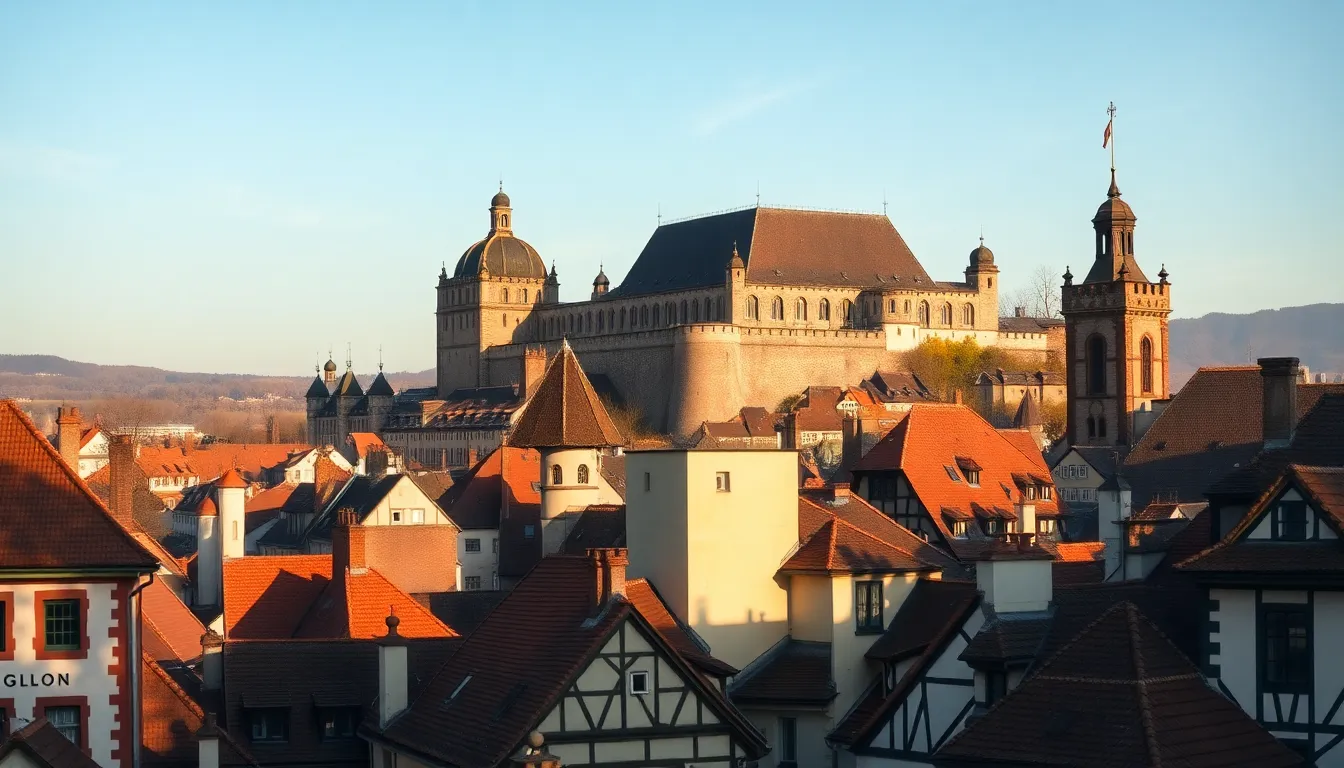
I have stood in the old Nuremberg market square with a group at nine in the morning, watching the Gothic spires catch the light, and stood with that same group in the afternoon on the parade grounds where Hitler held his rallies. Few cities in the world ask you to hold both of those things in one day. Nuremberg does. And if you lead it well, your people will leave understanding something about human nature that no museum can teach them on its own.
I have brought faith groups here for more than twenty years. Nuremberg is not a city you visit for comfort. It is a city you visit because the full arc of history is written into its stones, the medieval glory, the Jewish life, the catastrophe, and the reckoning that followed. This guide is how I help rabbis, pastors, and educators think it through before they bring their congregation.
The Three Nurembergs You Need to Hold at Once
There are really three cities layered on top of each other here, and a thoughtful itinerary touches all three without flattening any of them.
The first is the medieval imperial city, one of the great centers of the Holy Roman Empire, home to artists, craftsmen, and merchants. The second is the city the Nazis chose as the stage for their power, the place where the rally grounds were built and where the race laws were proclaimed. The third is the city of the trials, where the world first put the architects of genocide on record and built the foundation of international law.
You cannot understand the second and third without the first. That is why I always begin in the old town.
The Medieval City: Where to Start
The Imperial Castle and the Old Town
The Kaiserburg, the Imperial Castle, sits on the high sandstone ridge above the city. For centuries every Holy Roman Emperor was required to hold his first imperial assembly here. Standing on the ramparts, looking out over the red rooftops, your group gets the scale of what Nuremberg was: a free imperial city at the heart of European power.
Below the castle, the old town still follows its medieval street plan. Much of what you see was carefully reconstructed after the war, the city was about ninety percent destroyed by Allied bombing, but the reconstruction was done with such care that the spirit of the place survived. Walk the cobbled lanes toward the central market.
The Frauenkirche and the Albrecht Durer House
The Frauenkirche on the main market square is a fourteenth-century Gothic church with a mechanical clock, the Mannleinlaufen, that draws a crowd every day at noon. It is worth timing your morning to catch it.
A short walk away is the house of Albrecht Durer, the artist who made Nuremberg a name across Renaissance Europe. For groups interested in how faith and art intertwined in this period, the Durer house gives a human face to the medieval city. This was a place where devotion and craft were the same impulse.
Jewish Heritage in Nuremberg
Here is a part of the story that often gets lost between the medieval grandeur and the twentieth-century horror. Nuremberg had a Jewish community for centuries, and that community paid a terrible price more than once.
The central market square, the Hauptmarkt where the Frauenkirche stands, was built directly on top of the medieval Jewish quarter after the community was destroyed in the pogrom of 1349. The Frauenkirche itself stands on the site of the former synagogue. When you stand in that square, you are standing on layers of Jewish loss that long predate the twentieth century.
In the modern era, the city’s Jewish community rebuilt and grew, only to be targeted again. Julius Streicher, the publisher of the antisemitic newspaper Der Sturmer, made Nuremberg a center of Nazi propaganda. The synagogue was destroyed in 1938. For a Jewish group, naming this continuity, the medieval pogrom, the modern revival, the second destruction, is essential. It is not one chapter. It is a long memory.
The Nazi-Era Sites: How to Approach Them
The Rally Grounds and the Documentation Center
The Nazi Party Rally Grounds on the southeastern edge of the city are vast and disturbing. This is where the Nuremberg rallies were staged, the choreographed spectacles meant to overwhelm the individual and glorify the regime. The unfinished Congress Hall, modeled on the Roman Colosseum, still stands. So does the Zeppelin Field grandstand where Hitler addressed the crowds.
The Documentation Center Nazi Party Rally Grounds, housed in part of the Congress Hall, is one of the most serious and well-constructed museums of its kind. It does not sensationalize. It explains how a modern, educated society was drawn into this. That is exactly the question a faith group needs to sit with.
When I bring a group here, I prepare them beforehand. I tell them we are not here to gawk at evil as a spectacle. We are here to understand how ordinary people participated in it, because that understanding is the only real protection against it happening again. I build in time afterward for the group to sit together and talk, or to be silent. Do not rush this site.
The Nuremberg Laws
It was in this city, at a 1935 rally, that the Nazi regime proclaimed the race laws that stripped Jews of citizenship and set the legal stage for the Holocaust. Standing in the place where that happened gives the abstraction of history a terrible concreteness. For educators especially, this is a teaching moment that no textbook can match.
The Trials: Where the Reckoning Began
Courtroom 600
After the war, the same city the Nazis had used as their stage became the place where they were held to account. The Nuremberg Trials, held in Courtroom 600 of the Palace of Justice, were the first time an international court tried leaders for crimes against humanity. The principles established here shaped the entire framework of modern international law.
Courtroom 600 is still in use, but it is open to visitors, and there is a permanent exhibition, the Memorium Nuremberg Trials, that walks you through what happened in that room. For a group that has spent the morning at the rally grounds, ending the day in this courtroom is one of the most powerful arcs in any heritage itinerary. The city of the spectacle becomes the city of the verdict. There is a moral shape to that, and your people will feel it.
I always tell groups: this is where the world said, for the first time and on the record, that following orders is not a defense, and that human dignity has a standing in law that no state can erase. For a faith community, that is not a small idea. It is close to the heart of why we believe what we believe.
Planning a Nuremberg Visit With Your Group
Nuremberg works well as a full day or, better, a day and a half. The geography helps you: the old town is walkable and compact, while the rally grounds and the Palace of Justice are short drives out. A good itinerary moves from medieval to modern to the reckoning, in that order, because that order tells the truth about the place.
Nuremberg also pairs naturally with the rest of a Germany heritage journey. It sits within reach of the Bavarian heritage sites and the broader Reformation and Jewish heritage routes covered in our Germany heritage travel guide. Many groups combine it with Augsburg for the Reformation story, or with the Rhineland ShUM cities of Worms and Speyer for the deep Jewish heritage thread.
This is where working with an operator who knows the territory makes the difference. Heritage Tours builds custom itineraries, so a Jewish group can weight the visit toward the Jewish history and the trials, while a Christian group can connect Nuremberg to the wider Reformation route. Mixed groups can hold the whole arc together. You can see how we structure these journeys on our Germany destination page and our group heritage tours page.
Group leaders with 15 or more participants travel free. For a congregation organizing a trip, that math matters from the first planning conversation.
FAQ: Nuremberg Heritage Travel
Is Nuremberg appropriate for a faith-based group tour?
Yes, and it is one of the more meaningful stops in Germany precisely because it holds the full arc of history in one place. The key is preparation. Brief your group before the Nazi-era sites, build in time for reflection, and frame the day as a journey from the medieval city through the catastrophe to the reckoning at the trials. Approached that way, Nuremberg becomes one of the most powerful days of the whole trip.
How much time do I need in Nuremberg?
A full day covers the essentials: the old town and castle in the morning, the rally grounds and Documentation Center in the early afternoon, and Courtroom 600 to close. A day and a half gives your group room to breathe, which I recommend, because these sites carry weight and rushing them does your people a disservice.
How do you handle the Nazi-era sites respectfully with a group?
Prepare your group beforehand so no one is caught off guard by the emotional reality. The Documentation Center is built to inform, not to sensationalize, and I lean into that tone. Afterward, give people time to process, together or alone. Never schedule a lighthearted activity directly after the rally grounds. Treat these places with the gravity they hold and your group will too.
What is the Jewish history of Nuremberg?
Nuremberg had a Jewish community from the Middle Ages. The central market square was built on the site of the medieval Jewish quarter after the pogrom of 1349, and the Frauenkirche stands where the synagogue once stood. In the modern era the community rebuilt, only to be targeted again under the Nazis, with the synagogue destroyed in 1938. Naming that long continuity of loss and revival is central to telling the city’s Jewish story honestly.
Can I combine Nuremberg with other German cities in one trip?
Absolutely. Nuremberg pairs well with the Bavarian sites and connects naturally to the wider Reformation and Jewish heritage routes through Germany. Many groups combine it with Augsburg, the Rhineland ShUM cities, or Dresden. We build the connections to fit your group’s focus.
If Nuremberg is on your mind for your community, I would welcome the chance to talk it through. It is a demanding city, and it rewards groups who come ready to engage with it honestly. Every congregation is different, and the itinerary should reflect yours. Contact us whenever you are ready to start that conversation.