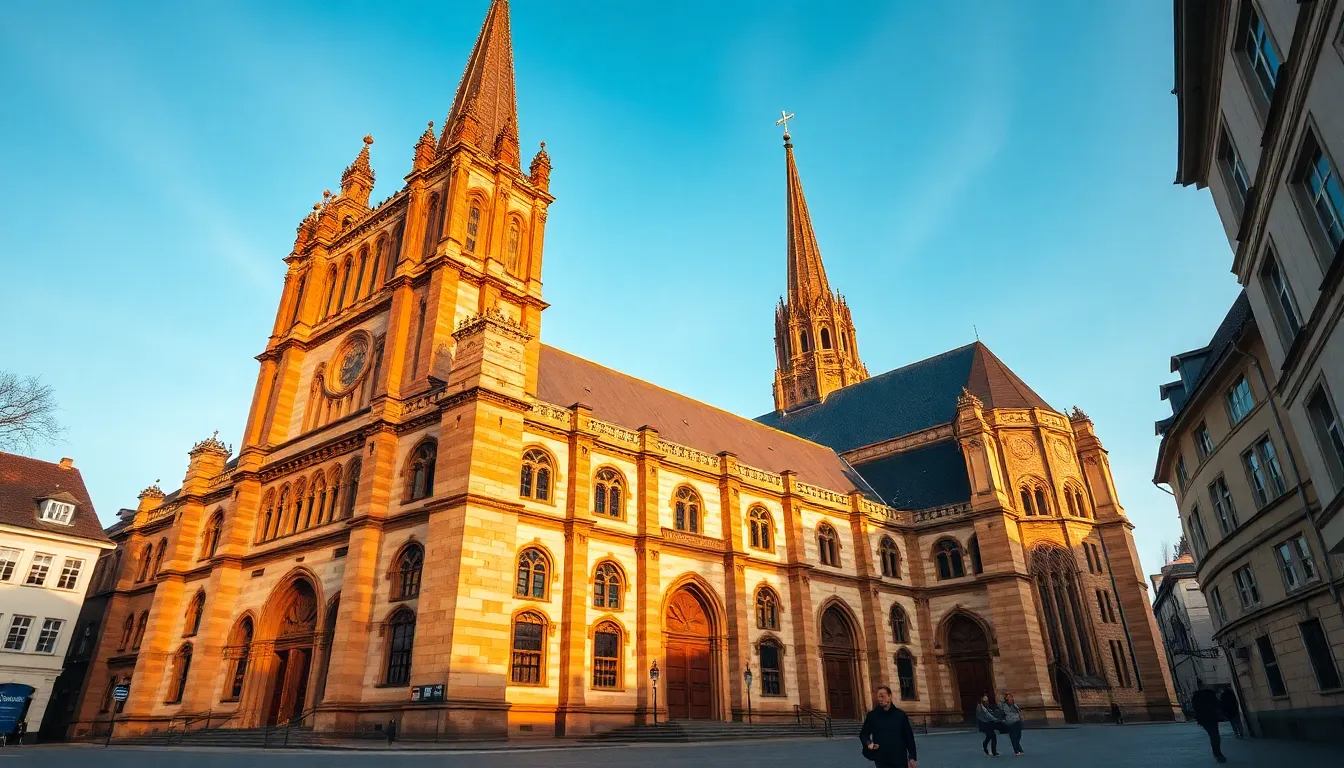
I have a habit when I bring a group to Leipzig. Before we say anything about Bach, before we walk into St Thomas, I take them to stand outside the Nikolaikirche, the St Nicholas Church, and I ask them to be quiet for a minute. Because what happened on that spot in 1989 is, to my mind, one of the great faith stories of the modern world, and most travelers walk right past it without knowing.
Leipzig is a city where the church mattered, and not in the abstract. It mattered to music, through Bach. It mattered to the Reformation, through Luther. And it mattered to the fall of a dictatorship, through ordinary people holding candles and refusing to be afraid. For a group of pastors, rabbis, or educators, this is one of the most quietly powerful stops in all of Germany. Let me show you how I orient a group here.
Why Leipzig Belongs on a Heritage Itinerary
Leipzig is in Saxony, in the east of the country, and for forty years it sat behind the Iron Curtain in communist East Germany. That history is part of why the city feels different from Cologne or Frankfurt. It carries the layered weight of a place that lived through the twentieth century the hard way and came out the other side. The center is compact and easy to walk, which makes it kind to a group, and the major heritage sites cluster within a short radius of the market square.
The thread that runs through Leipzig is faith under pressure. Faith expressed in music. Faith preached at risk. Faith that filled a church week after week until a regime fell. Hold that thread and the city opens up.
St Thomas and Johann Sebastian Bach
Twenty-Seven Years in One Building
Johann Sebastian Bach served as cantor at St Thomas Church, the Thomaskirche, for twenty-seven years, from 1723 until his death in 1750. Most of the sacred music we associate with him, the cantatas, the great Passions, was written for the services in this church and the city’s other churches. When your group stands inside St Thomas, they are standing in the room those works were made for. The St Matthew Passion was first performed in a Leipzig church. The music was not written for a concert hall. It was written for worship, for these walls, for this congregation.
Bach is buried inside St Thomas, his grave set into the floor near the altar. I have watched musicians in my groups stand at that stone with tears in their eyes. It is one of those places where the distance between you and a figure you have only known through their work collapses to nothing.
The Choir That Has Not Stopped
Here is the detail I love most. The St Thomas Boys Choir, the Thomanerchor, which Bach himself directed, still sings. It is one of the oldest choirs in the world, founded around 1212, and it still performs the motets in the church. If your travel dates allow your group to attend, do it. There is no better way to understand what Bach made than to hear a living choir sing it in the building it was written for. Check the choir’s schedule when you plan, since performances follow the school and liturgical year.
The Reformation in Leipzig
Leipzig has its own chapter in the Reformation story, and it is a sharp one. In 1519, two years after Luther posted his theses, he came to Leipzig for a public theological debate, the Leipzig Disputation, against the Catholic theologian Johann Eck. It was here, pressed in argument, that Luther was pushed to state positions that made a final break with Rome unavoidable. Leipzig is where the Reformation hardened from a protest into a rupture.
For a Christian group tracing the Luther story across Germany, Leipzig is a meaningful stop precisely because it is where the line got drawn. I frame it for groups as the moment the argument stopped being repairable.
The Peaceful Revolution of 1989
The Prayers That Brought Down a Wall
This is the part of Leipzig I will not let a group skip. Through the 1980s, the Nikolaikirche held weekly Monday prayers for peace. Under a surveillance state, in a country where dissent was dangerous, people gathered in a church to pray. Over time, the prayers drew more people, and the crowds spilled into the square outside.
On October 9, 1989, around seventy thousand people gathered after the Monday prayers and marched through the city center carrying candles. The regime had security forces in place and the world expected violence. It did not come. The marchers were peaceful, the candles stayed lit, and the soldiers did not fire. Within a month the Berlin Wall fell. One of the leaders of the state later said they had been prepared for everything except candles and prayers.
Standing Where It Happened
I bring groups to the Nikolaikirche and to the square, and I tell them this story slowly, because it deserves it. This is a case where faith communities did not just witness history. They made it, through nonviolence, through gathering, through the simple act of showing up week after week with a candle. For pastors and rabbis leading congregations, this is a story about what a community of faith can be when it holds steady. I have never told it to a group without the room going still.
A Heritage Day in Leipzig
The way I shape it: start at St Thomas in the morning, with Bach, and if the timing works, build the day around a choir performance. Walk to the market square and the old city hall. Spend the heart of the afternoon at the Nikolaikirche and the peaceful revolution sites, including the Contemporary History Forum nearby, which tells the story of life under the East German regime. That sequence moves the group from the eighteenth century through the Reformation to 1989, and it lands on the revolution, which is the right note to end on.
It is a full day, and an emotionally rich one. Leave room in the late afternoon for your group to sit and talk. After the 1989 story, people usually have things to say.
Where Leipzig Fits in a Germany Itinerary
Leipzig sits well alongside the central German heritage cluster. It is within reach of Wittenberg, where the Reformation began, and of the wider Thuringia region to the southwest. A Christian group can build a Reformation corridor that runs from Wittenberg through Leipzig and on toward Erfurt and the Wartburg. Our Thuringia heritage region guide maps that western leg, and the Erfurt heritage guide covers the city where Luther became a monk. For the full national picture, start with our Germany heritage travel guide.
You can see how we build these trips on our Germany destination page, and our group heritage tours page explains how leading a group with us works.
FAQ: Leipzig Heritage Travel
Why is Leipzig important for a faith-based group?
Leipzig holds three faith stories in one walkable city. Bach wrote his sacred music for the services at St Thomas, where he is buried. The Reformation hardened into a final break with Rome at the 1519 Leipzig Disputation. And in 1989, weekly church prayers at the Nikolaikirche grew into the candle marches that helped bring down the East German regime without bloodshed. Few cities carry that range.
Can my group hear the St Thomas Boys Choir that Bach directed?
Often, yes. The Thomanerchor is one of the oldest choirs in the world and still performs motets in St Thomas Church on a regular schedule tied to the school and liturgical calendar. If your travel dates align with a performance, attending is the single best way to understand Bach’s music in the space it was written for. Check the current schedule when you plan the trip.
What happened at the Nikolaikirche in 1989?
Through the 1980s the church held weekly Monday peace prayers under a surveillance state. On October 9, 1989, around seventy thousand people gathered after the prayers and marched peacefully with candles through the city. The expected crackdown never came, and within a month the Berlin Wall fell. It stands as one of the clearest examples of a faith community shaping history through nonviolence.
How does Leipzig connect to the rest of a Germany Reformation tour?
Leipzig pairs naturally with Wittenberg, where Luther posted his theses, and with the Thuringia sites of Erfurt and the Wartburg to the southwest. Many groups build a central German Reformation corridor that runs through all of them. Leipzig adds both the Bach dimension and the 1989 story, which broadens the trip beyond the sixteenth century.
How long should a group spend in Leipzig?
One full day covers St Thomas and Bach, the Reformation history, and the 1989 sites comfortably, since they sit close together in the compact center. If you want to attend a choir performance and spend unhurried time at the Contemporary History Forum, build in a relaxed full day rather than half a day on the way through.
If Leipzig is on your mind for your community, or you are working out how it connects to the wider Reformation trail, I would be glad to help you shape it. The 1989 story in particular lands differently depending on how you frame it, and I have learned a few things about telling it well.
Contact us whenever you are ready to start that conversation.