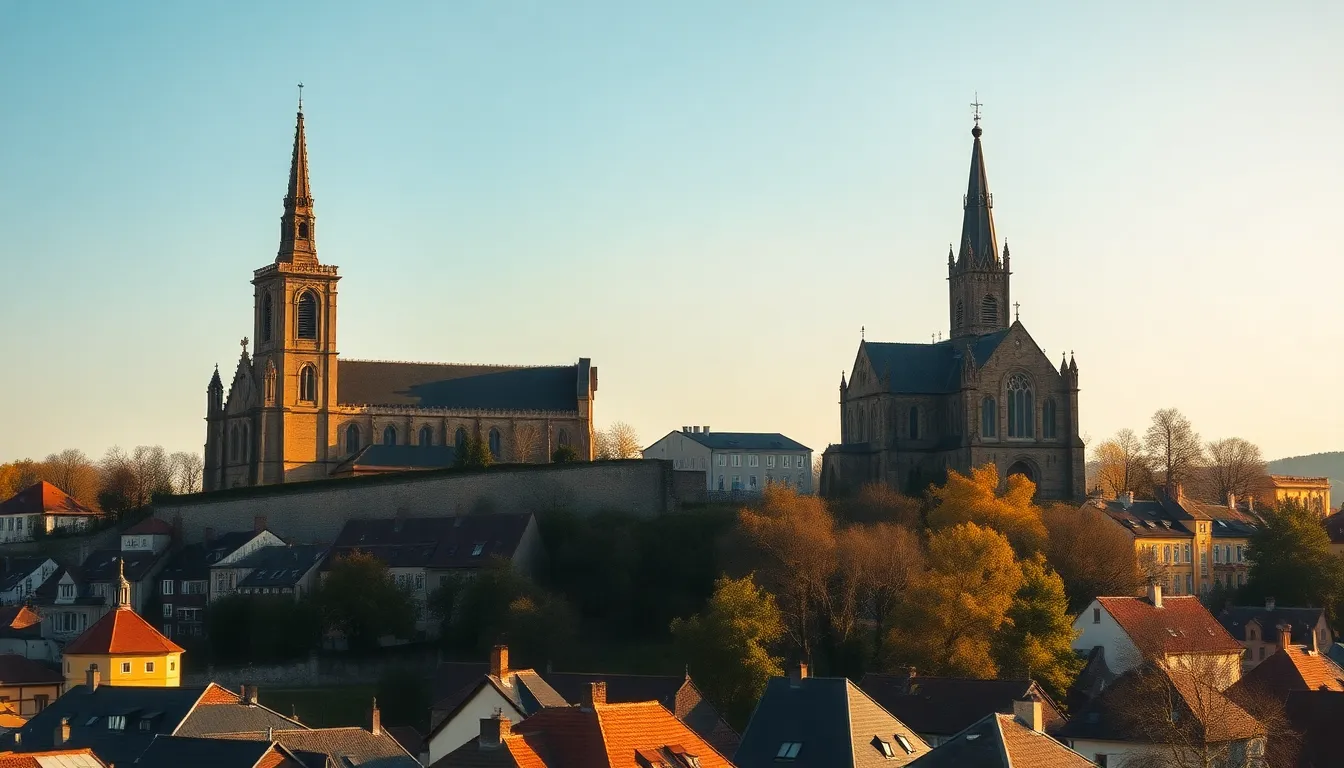
Erfurt is the city where I most often see two halves of a heritage trip click into place at once. In the morning I can stand a group inside the monastery where Martin Luther became a monk, and in the afternoon I can take that same group down into a medieval synagogue that survived seven hundred years because the city forgot it was there. Christian heritage and Jewish heritage, in one walkable medieval town, each preserved at a level you rarely find. For a mixed faith group, Erfurt is close to ideal.
The old town came through the wars of the twentieth century largely intact, which means the medieval city is still here, the bridge lined with houses, the merchant streets, the churches on the hill. It is a beautiful place, and beneath the beauty sit two of the most important faith stories in central Germany. Let me walk you through how I orient a group.
Why Erfurt Earns a Full Day
Erfurt is the capital of Thuringia, in the green heart of Germany, and it was a major medieval trading city, rich on the woad dye trade. That wealth built the churches, the merchant houses, and the Jewish quarter you walk through today. The center is compact and the medieval fabric is unusually complete, which makes it easy on a group. You can cover the Luther sites, the cathedral hill, and the Jewish heritage sites on foot in a single full day, with the famous Merchants’ Bridge in between.
The thread to hold in Erfurt is that this is a city of beginnings. Luther’s monastic life began here. And the Jewish community here was, for a time, one of the most important in the German lands. Both stories start in these streets.
Luther in Erfurt: Where the Reformer Was Formed
The Augustinian Monastery
Martin Luther came to Erfurt as a student and entered the Augustinian monastery here in 1505 after, by his own account, a terrifying thunderstorm convinced him to become a monk. He lived in this monastery, prayed in its church, and was ordained a priest here. The years he spent in Erfurt were the years his theology began to take shape, in the cell, in the choir stalls, in the long wrestling with sin and grace that would later become the Reformation.
When your group walks into the Augustinian Monastery, the Augustinerkloster, they are in the place where Luther was formed as a young monk, before Wittenberg, before the theses, before any of it. I find this is where Christian groups feel closest to the human Luther, the anxious young man, rather than the towering reformer. The monastery is still a working religious site and a place of education, and standing in its quiet church is a different experience from the busy Reformation landmarks elsewhere.
Why Erfurt Comes Before Wittenberg in the Story
I tell groups to think of Erfurt as the first chapter. Wittenberg is where the Reformation broke into the open in 1517, but Erfurt is where the man who started it learned to think, to pray, and to doubt. For a pastor building a Luther itinerary, putting Erfurt early in the trip gives the later sites their depth. You meet Luther the monk before you meet Luther the reformer, which is the order it actually happened.
The Medieval Jewish Story: The Old Synagogue
A Synagogue Hidden in Plain Sight
Here is the Erfurt story that stops groups in their tracks. The Old Synagogue, the Alte Synagoge, is one of the oldest synagogue buildings in Europe still standing, with parts dating to around 1100. It survived for a remarkable and painful reason. After the Jewish community was destroyed in a massacre in 1349, during the persecutions that followed the Black Death, the building was sold and repurposed, used over the centuries as a storehouse and even a restaurant. Hidden behind later walls, its medieval origins were forgotten, and because it was forgotten, it was never torn down. It was only rediscovered and recognized in the twentieth century.
So your group stands inside a medieval synagogue that survived precisely because the city stopped seeing it as a synagogue. That irony is heavy, and I let it land. This is one of the very few places in Germany where a medieval Jewish house of worship still stands largely intact.
The Erfurt Treasure and the Medieval Mikveh
Inside the Old Synagogue is the Erfurt Treasure, a hoard of gold, silver, and coins buried by a Jewish family during the 1349 persecution and never reclaimed, because the family did not survive. Among it is an extraordinary medieval Jewish wedding ring, gold and elaborate, one of only a handful known in the world. I have watched groups stand silent in front of that ring. It carries the whole story in a single object, a wedding, a hope for a future, buried in fear and never recovered.
Nearby, the medieval mikveh, the ritual bath, was excavated by the river and can be visited, which deepens the picture of the complete Jewish community that lived here. Together, the synagogue, the treasure, and the mikveh form a body of medieval Jewish heritage that earned Erfurt a place on the UNESCO World Heritage list.
A Heritage Day in Erfurt
The shape I use: start at the Augustinian Monastery in the morning with Luther, while the day is fresh. Walk up to the cathedral hill, the Domberg, where the cathedral and St Severus church stand together above the city, a striking sight and a strong Christian heritage stop. Cross the Merchants’ Bridge, the Krämerbrücke, the medieval bridge lined with houses, on the way to lunch. Spend the afternoon at the Old Synagogue, the Erfurt Treasure, and the mikveh.
That sequence moves from Christian heritage in the morning to Jewish heritage in the afternoon, with the beauty of the medieval town threaded through. It is a full and balanced day. After the Old Synagogue and the wedding ring, give your group time to sit and process. The 1349 story asks something of people.
Where Erfurt Fits in a Germany Itinerary
Erfurt is the natural hub of the Thuringia heritage region, and it pairs directly with the Wartburg and Eisenach to the west, where Luther translated the New Testament in hiding. Our Thuringia heritage region guide maps the whole green-heart cluster and shows how Erfurt anchors it. To the northeast, the Leipzig heritage guide picks up Bach, the Reformation disputation, and the 1989 peaceful revolution. For the full national picture, including how the Jewish, Reformation, and Christian threads connect across the country, start with our Germany heritage travel guide.
You can see how we build these journeys on our Germany destination page, and our group heritage tours page explains how leading a group with us works.
FAQ: Erfurt Heritage Travel
Why is Erfurt good for a mixed Jewish and Christian group?
Few cities hold both stories at this depth in one walkable town. Christian travelers center on the Augustinian Monastery, where Luther became a monk, and the cathedral hill. Jewish travelers center on the Old Synagogue, one of the oldest in Europe, the Erfurt Treasure, and the medieval mikveh. A mixed group can experience Christian heritage in the morning and Jewish heritage in the afternoon without leaving the medieval center.
What makes the Erfurt Old Synagogue so significant?
It is one of the oldest synagogue buildings still standing in Europe, with parts dating to around 1100. It survived because, after the 1349 massacre of the Jewish community, it was repurposed and its origins were forgotten, so it was never demolished. Standing inside a medieval synagogue that survived by being hidden is a rare and sobering experience, and it earned Erfurt a UNESCO World Heritage listing.
What is the Erfurt Treasure?
It is a hoard of gold, silver, and coins buried by a Jewish family during the 1349 persecution and never reclaimed, because the family did not survive. Its most famous piece is an elaborate gold medieval Jewish wedding ring, one of only a few known in the world. Displayed inside the Old Synagogue, it carries the human weight of the whole story in a single object.
Why visit Erfurt before Wittenberg on a Luther trip?
Erfurt is where Luther became a monk, was ordained, and began to form his theology, years before he posted his theses in Wittenberg in 1517. Visiting Erfurt early in a Luther itinerary lets your group meet the young, searching monk before the public reformer, which gives the later sites more depth. It follows the order Luther’s own life actually took.
How long should a group spend in Erfurt?
One full day covers the Luther monastery, the cathedral hill, the Old Synagogue, the treasure, and the mikveh comfortably, since the medieval center is compact and walkable. Build in time in the late afternoon for reflection after the Jewish heritage sites. If you are basing yourself in Erfurt to explore the wider Thuringia region, you may stay longer and day-trip from here.
If Erfurt is on your itinerary, or you are working out how it anchors a Thuringia leg, I would be glad to help you shape it. Holding the Luther story and the medieval Jewish story in one day takes some care, and I have learned how to pace it so neither one gets shortchanged.
Contact us whenever you are ready to start that conversation.