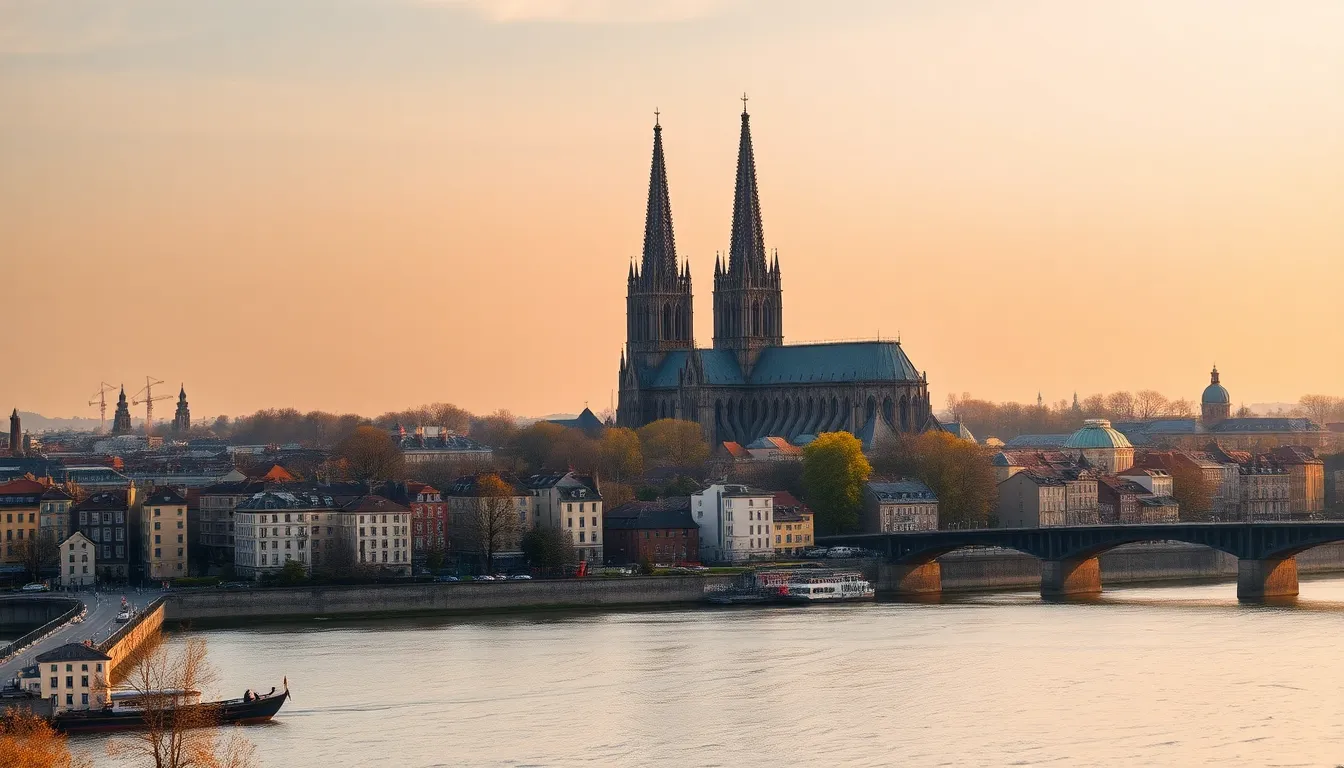
The first time I brought a group to Cologne, we came in by train, and the cathedral was simply there the moment we stepped out of the station. No build-up, no walk through narrow streets to reach it. You exit the platform and the two great towers are right on top of you. I have watched dozens of groups have that same reaction, and it never gets old.
Cologne rewards a group that knows what it is looking at. Most visitors give the city an afternoon, photograph the cathedral, and move on. For a faith community, that is a missed opportunity. Under this city sits one of the oldest continuous Jewish stories in Europe, and above it stands one of the great cathedrals of the Christian world. I want to walk you through how I orient a group here so your people leave with the full picture, not just a postcard.
Cologne in One Paragraph for the Group Leader
Cologne is a Roman foundation on the Rhine, more than two thousand years old. That age is the thing to hold onto, because it explains everything else. Rome built here, the church grew here on Roman bones, and a Jewish community settled here in late antiquity and stayed, on and off, for a thousand years. The old town is compact and walkable, which is a real gift when you are leading a group with mixed mobility. You can cover the cathedral, the Jewish quarter, and the riverfront on foot in a single full day.
Cologne Cathedral: More Than a Photo Stop
What to Tell Your Group Before You Walk In
Cologne Cathedral took more than six hundred years to finish. Construction began in 1248, stopped for centuries, and was only completed in 1880 to the original medieval plans. When your group stands at the base of those towers, they are looking at a building that medieval masons started and Victorian engineers completed, faithful to a drawing that survived the gap. I tell groups that detail before we go in, because it changes how they see the place. This is not a monument that was built and left alone. It is a six-century act of persistence.
Inside, the thing to find is the Shrine of the Three Kings, a gilded reliquary behind the high altar that is the largest of its kind in the Western world. For Christian groups, this is the heart of the cathedral. The relics drew pilgrims here through the Middle Ages and made Cologne one of the great pilgrimage cities of Europe, alongside Rome and Santiago.
A Practical Note on the Crowds
The cathedral is the most visited landmark in Germany. If you want your group to have a quieter encounter, go early. The doors open in the morning before the day-trip crowds arrive, and a group standing in that space before the noise builds will feel something the midday visitors miss. I always schedule the cathedral first thing.
The Oldest Jewish Community North of the Alps
A Community That Predates Almost Everything
Here is what most guides skip entirely. Cologne is home to the oldest documented Jewish community in Germany, and one of the oldest north of the Alps. A Roman imperial decree from the year 321 mentions Jews in Cologne, which means Jewish life here is older than the cathedral, older than most of Christian Europe as we know it. For a Jewish group, that fact reframes the whole visit. This is not a story that begins with persecution. It begins with permanence.
The medieval Jewish quarter sat right next to the city hall, in the very center of civic life. That location tells you something about how integrated the community once was. The quarter held a synagogue, a mikveh, a bakery, a hospital, and a community hall. It was a complete world.
The Mikveh You Can Still Descend Into
One of the most affecting moments I build into a Cologne day is the medieval mikveh, the ritual bath, which survives beneath the square in front of the city hall. You descend a stone staircase into a chamber that reaches down to the level of the Rhine groundwater, so the bath fills naturally. It dates to around the twelfth century. Standing at the bottom, in the cool and the quiet, your group is occupying a space where Jewish women descended for ritual purification eight hundred years ago. There are few places in Germany where you can stand inside the living detail of medieval Jewish life like this.
The MiQua: The Museum That Brings It All Together
The newest reason to bring a group to Cologne is the MiQua, the Jewish Museum in the Archaeological Quarter. It is built directly over the excavated remains of the medieval Jewish quarter and the Roman governor’s palace beneath it. The concept is a continuous walk through layers of the city, from the Roman foundations up through the Jewish quarter, all under one roof and all in situ.
This matters for a group because it solves a problem I run into everywhere in Germany: the hardest thing about teaching Jewish heritage is that so much of it was erased, and you are often pointing at an empty lot and asking people to imagine. The MiQua does the imagining for you. The walls are right there. If your travel dates align with its opening, I build the day around it. Check current opening status when you plan, since major museums of this kind sometimes phase their public access.
A Full Heritage Day in Cologne
Here is the shape I use. Cathedral first thing in the morning, while it is quiet. Then walk the few minutes to the city hall square for the mikveh and the archaeological quarter. Lunch in the old town. Afternoon at the MiQua if it is open, or the Roman-Germanic Museum if you want to ground the group in the city’s ancient origins. Late afternoon along the Rhine promenade, which gives everyone a chance to slow down and let the day settle.
That is a full, rich day without rushing. Cologne is not a place where you need to sprint. The sites sit close together, which is exactly why it works so well as a single anchored stop on a longer Germany itinerary.
Where Cologne Fits in a Germany Itinerary
Cologne pairs naturally with the Rhine Valley Jewish heartland. From here, the ShUM cities of Worms, Speyer, and Mainz are within reach to the south, which lets a Jewish group build a Rhine corridor of medieval Jewish history with Cologne as the northern anchor. For a fuller picture of how the country’s heritage threads connect, our Germany heritage travel guide lays out the whole map. If your itinerary runs east, the Erfurt heritage guide and the Thuringia heritage region pick up the Reformation and the medieval Jewish story in central Germany.
You can also see how we structure these journeys on our Germany destination page, and our group heritage tours page explains how the group leader experience works.
FAQ: Cologne Heritage Travel
How much time does a group need in Cologne?
One full day covers the cathedral, the medieval Jewish quarter, the mikveh, and the MiQua comfortably, because everything sits within a short walk in the old town. If you want to add the Roman-Germanic Museum or spend unhurried time along the Rhine, a second half-day is worth it. I would not try to compress Cologne into a quick photo stop. The depth here rewards a proper day.
Is Cologne worth it for a Jewish heritage group specifically?
Yes, and more than most leaders expect. Cologne holds the oldest documented Jewish community in Germany, with roots reaching back to the year 321. The surviving medieval mikveh and the MiQua museum, built over the excavated Jewish quarter, let your group stand inside the physical remains of that world rather than imagining an erased one. That is rare in Germany.
What is the MiQua and why does it matter?
The MiQua is the Jewish Museum in the Archaeological Quarter, built directly over the excavated medieval Jewish quarter and the Roman governor’s palace beneath it. It lets a group walk through the actual layers of the city, Roman and medieval, in place. Because so much Jewish heritage in Germany was destroyed, a site where the original walls survive is unusually powerful for teaching.
Can a Christian group and a Jewish group both find depth in Cologne?
They can, which is one of the reasons I like the city for mixed groups. Christian travelers center on the cathedral, the Shrine of the Three Kings, and the city’s history as a major medieval pilgrimage center. Jewish travelers center on the ancient community, the mikveh, and the MiQua. Both stories sit within the same few blocks, so a mixed group experiences both in a single day.
When is the best time to visit Cologne?
Late spring and early autumn give you mild weather and lighter crowds for the outdoor walking. The cathedral and old town draw heavy day-trip traffic in summer, so if you travel then, start early in the morning. Winter is quieter and atmospheric, though shorter daylight hours compress the day.
If Cologne is on your itinerary, or if you are weighing it against the Rhine cities to the south, I would be glad to help you think it through. The right shape for a Cologne day depends on your group and what you want them to carry home from it.
Contact us whenever you are ready to start that conversation.