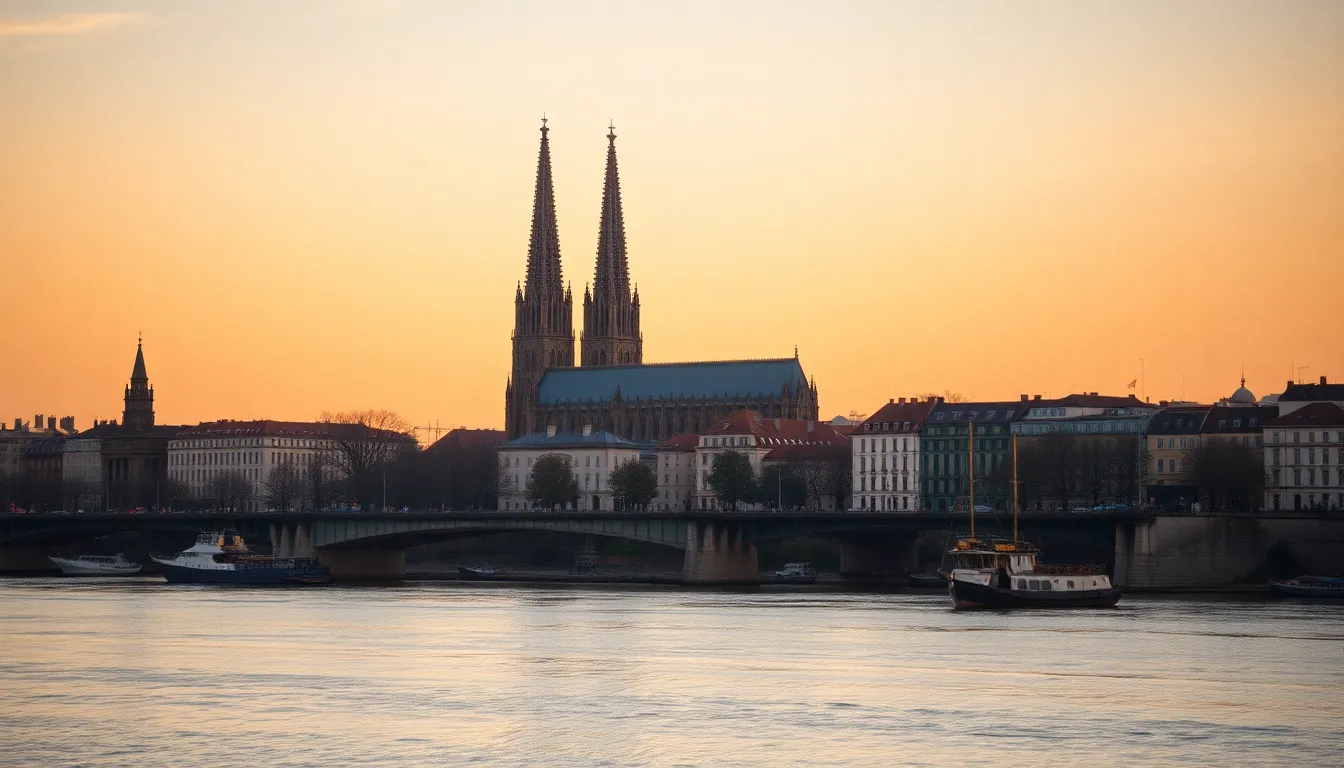
The first sight of Cologne Cathedral does something to people that I have never been able to fully prepare them for. You come up out of the train station, and there it is, immediately, almost on top of you, two black stone spires climbing into the sky out of a busy modern city. Groups go quiet. Someone usually says it does not look real. I have watched seasoned pastors who have visited cathedrals across Europe stop on the steps and just look up. Cologne does that. It is one of the few buildings on earth that still feels too big for the human beings standing under it, which is, of course, exactly what its builders intended.
I want to give group leaders a guide that goes beyond “it is very large and very old,” because Cologne Cathedral is a teaching opportunity if you know what you are looking at. The scale is theology. The shrine inside is a story your group will recognize. And the way you time your visit makes the difference between fighting crowds and standing in something close to silence.
A Building Across Six Centuries
Construction of the present Gothic cathedral began in 1248. It was meant to be one of the greatest churches in Christendom, and the ambition nearly broke it. Work continued for centuries, then stopped almost entirely in the 1500s, leaving the cathedral unfinished for some three hundred years. A medieval crane sat frozen on top of one of the towers, visible across the city, a symbol of a dream that had stalled.
In the nineteenth century, a wave of national and religious enthusiasm revived the project. Using the original medieval plans, which had remarkably survived, builders finally completed the cathedral. It was finished in 1880, more than six hundred years after the first stone was laid. When it was completed, its twin spires made it briefly the tallest building in the world, and they still rise about 157 meters above the Rhine.
Why the Timeline Matters for a Group
I always make sure my groups sit with that span of time. Six hundred years. The people who laid the foundation in 1248 knew, with certainty, that they would never see this building finished. Their children would not see it finished. Their great-great-grandchildren would not see it finished. They built anyway, for a glory they trusted would come long after them. For a faith group, that is the sermon of Cologne Cathedral before you even step inside. It is a building about patience, about faith in things unseen, about working for what you will not live to enjoy. I have seen that idea move people more than any single object in the church.
It is worth adding that the cathedral survived the Second World War while the city around it was flattened by bombing. It was hit repeatedly and damaged, but it stood, its spires rising over a ruined Cologne in photographs that became famous. The building’s survival felt to many like a sign. It has been a UNESCO World Heritage site since 1996.
The Shrine of the Three Kings
At the heart of Cologne Cathedral, behind the high altar, stands the reason it was built so grand in the first place: the Shrine of the Three Kings, the Magi of the Christmas story.
In 1164, relics said to be those of the three wise men were brought to Cologne from Milan. Whatever one concludes about the relics themselves, their arrival transformed Cologne into one of the most important pilgrimage destinations in medieval Europe, on a level with a small number of the greatest shrines. The flood of pilgrims, and the prestige, are precisely why the city set out to build a cathedral worthy of them. The Magi made Cologne, and Cologne built the cathedral for the Magi.
The Shrine Itself
The shrine that holds the relics is a masterpiece of medieval goldsmithing, a large gilded reliquary shaped like a basilica, covered in gold, jewels, and figures, crafted in the decades around 1200. It is considered one of the greatest works of its kind anywhere. For a group, this is a natural place to teach. The Magi are the figures in the Christmas story who came from the East following a star, the first Gentiles to worship the newborn Christ. Standing before their shrine, you can talk about the journey of the wise men, the meaning of their gifts, and the long human longing to follow a light toward God. It connects the soaring stone overhead to a story your people have heard since childhood.
Reading the Cathedral With Your Group
Beyond the shrine, point a few things out so the visit is more than wandering.
The stained glass spans centuries, from medieval windows to a striking modern window installed in recent years, made of thousands of small colored squares that scatter light across the interior. Some traditional visitors found it surprising, but it photographs beautifully and gives you a way to talk about how a living church keeps creating across eras rather than freezing in one. The Gero Cross, a large carved crucifix from around the year 970, is one of the oldest surviving monumental crucifixes in the Western world and a genuinely moving object. And for the able-bodied in your group, the climb up the south tower, well over five hundred steps, rewards you with a view across the Rhine and the city. I make the tower optional and never push older travelers up it.
Timing and Practical Advice
Here is the practical heart of it. Cologne Cathedral is one of the most visited landmarks in Germany, drawing enormous crowds. Mid-day, it can feel more like a railway concourse than a place of prayer. The fix is simple: go early. A group that arrives close to opening, before the day-tripper crowds and tour buses arrive, experiences a different building, quieter, with morning light coming through the glass and room to actually feel the space. I have said this in our Germany spiritual sites guide and I will say it again here, because it is the single most important tip I give. Cologne in the early morning is sacred. Cologne at noon is a crowd.
Be mindful too that this is a working cathedral with daily Mass and prayer. Sections may be closed to visitors during services, which is not an obstacle but an opportunity. If your group can attend or quietly observe a service, the cathedral stops being a monument and becomes what it was built to be.
Cologne sits in western Germany on the Rhine and fits well into many itineraries. It pairs naturally with a Reformation journey as a contrast, the great medieval Catholic cathedral alongside the Protestant story told at Worms and along the Luther pilgrimage route. For a group, holding both together, the soaring medieval church and the Reformation that followed, makes the whole arc of German Christian history come alive.
FAQ: Cologne Cathedral
How long did it take to build Cologne Cathedral?
More than six hundred years. Construction began in 1248, stalled for roughly three centuries in the late medieval period, and was finally completed in 1880 using the surviving original plans. The people who began it knew they would never see it finished, which is part of what makes it so moving for faith groups.
What is the Shrine of the Three Kings?
It is a large gilded medieval reliquary behind the high altar, said to hold the relics of the three wise men, or Magi, of the Christmas story. The relics were brought to Cologne in 1164 and turned the city into one of medieval Europe’s great pilgrimage destinations, which is why such a vast cathedral was built.
What is the best time for a group to visit Cologne Cathedral?
Early morning, close to opening, before the day-tripper crowds and tour buses arrive. Mid-day can feel overwhelmingly crowded. An early visit gives your group quiet, morning light through the windows, and room to take in the scale of the space.
Is Cologne Cathedral still an active church?
Yes. It is the seat of the Archbishop of Cologne and holds daily Mass and prayer services. Some areas may be closed to visitors during services. If your group can attend or quietly observe a service, it experiences the cathedral as a living place of worship rather than only a monument.
Did Cologne Cathedral survive World War II?
Yes, though not unscathed. The cathedral was struck repeatedly during the heavy Allied bombing that destroyed most of the surrounding city, and it was damaged, but it remained standing. Photographs of the cathedral rising above the ruins of Cologne became famous, and many saw its survival as deeply symbolic.
Cologne is one of those places where, with a little framing, a building does the preaching for you. If you want help working it into a heritage itinerary, whether as a Reformation contrast or a stop in its own right, I would be glad to talk it through. Group leaders travel free with fifteen or more participants. Start with our Germany destination page, see how our group heritage tours work, and contact us when you are ready.