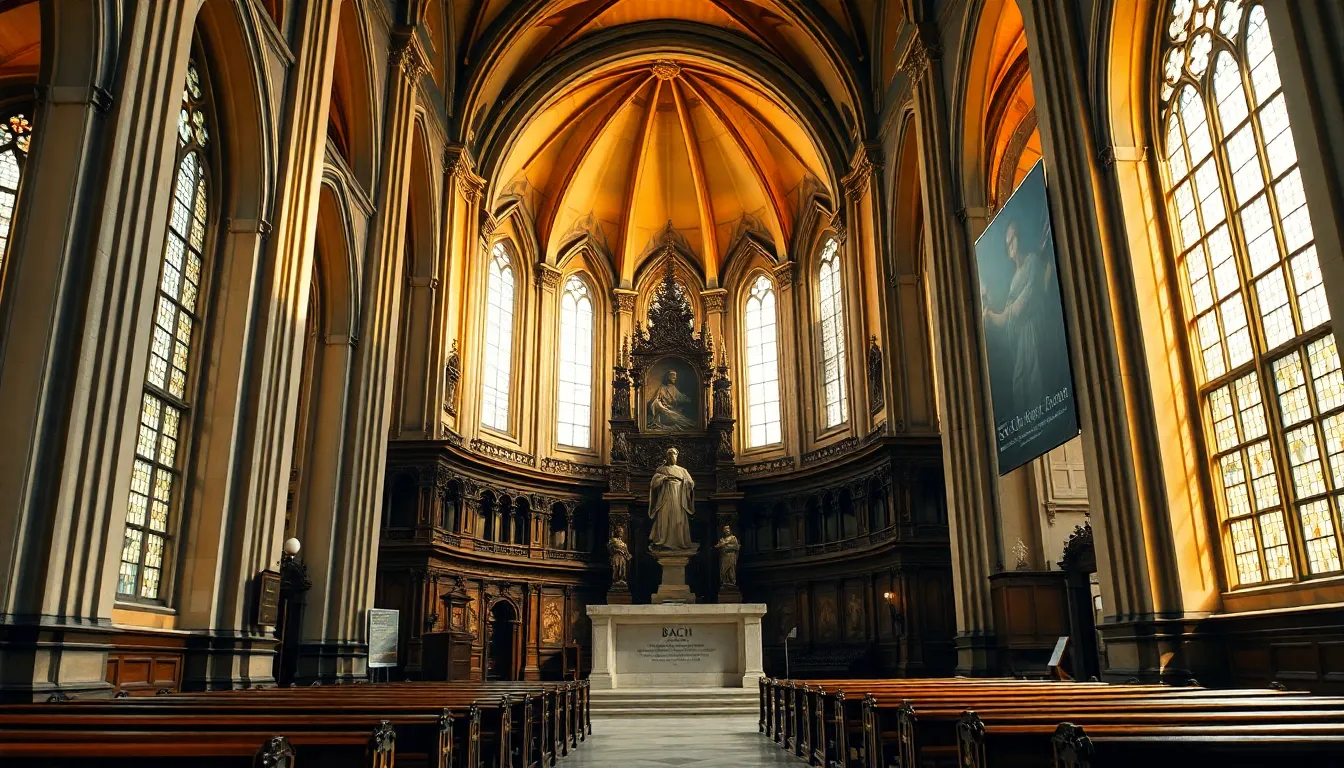
There is a moment that happens almost every time I bring a group into St Thomas Church in Leipzig. We walk up the nave, and there in the floor near the altar is a simple bronze slab with two words on it, Johann Sebastian Bach. People go quiet. Some of them reach down and touch it. For a faith group, especially one that has sung Bach in worship without ever thinking about where it came from, standing on that spot does something words cannot.
Leipzig is where Bach spent the last twenty-seven years of his life, from 1723 until his death in 1750, and where he wrote a staggering amount of the church music the Christian world still sings. If your group cares about how faith and music meet, this city is essential. After more than twenty years of leading these trips, Leipzig remains one of my favorite places to watch a group’s understanding deepen. Let me show you why.
Bach’s Job in Leipzig
It helps to understand what Bach actually was in Leipzig, because it was not “famous composer.” He was the Thomaskantor, the cantor of St Thomas, a church and school position. That meant he was responsible for the music in the city’s principal churches, he taught Latin and music at the St Thomas School, and he was on the hook to produce music for the liturgical calendar week after week after week.
I find groups are genuinely moved when they grasp the workload. In his first few years in Leipzig, Bach composed cantatas at a furious pace, producing cycle after cycle of works tied to the readings for each Sunday and feast day. A new cantata, rehearsed and performed, often inside a single week. This was not art made at leisure. It was sacred music made under deadline, for worship, by a working church musician who signed many of his manuscripts with the letters SDG, Soli Deo Gloria, to God alone be the glory.
What a Cantata Actually Is
For groups who are not classical music people, I keep this simple. A Bach church cantata is a multi-movement piece of music written to be performed in the worship service, built around the Scripture readings and the theme of that particular Sunday. It uses choir, soloists, and orchestra, and it often weaves in a Lutheran chorale, a hymn the congregation would have known. So the cantata is not a concert piece dropped into church. It is preaching in music, tied directly to the Word being read that day.
Once a group understands that, the music stops being background and becomes theology they can hear. The two great Passion settings Bach wrote in Leipzig, the St John Passion and the St Matthew Passion, are the towering examples, dramatic musical retellings of the suffering and death of Christ, written for Good Friday worship.
St Thomas Church
St Thomas Church, the Thomaskirche, is the heart of any Bach visit. The church itself is older than Bach by centuries, with Gothic bones, and Martin Luther preached here in 1539 when the Reformation came to Leipzig, so the building already carried weight before Bach ever arrived.
Today Bach’s remains lie beneath that bronze slab in the chancel. His body was moved here in the twentieth century, and the grave has become a place of quiet pilgrimage for musicians and believers from all over the world. I encourage groups to take their time at it rather than rush a photograph. There is a difference between seeing the grave and standing with it.
The church also holds a Bach window and other memorials, and outside, in front of the building, stands the well-known Bach statue, a favorite group photo spot. But the real encounter is inside, on the floor, at that slab.
Hearing the Music Where It Was Made
Here is the thing I push hardest for when planning a Leipzig day. Try to hear music in the church, not just see the church. St Thomas continues an unbroken tradition of music, and the famous boys’ choir still sings there. If you can time your visit to a service or a Motette, one of the regular choral services that have been part of St Thomas life for centuries, your group will hear sacred music in the exact acoustic Bach wrote for. I have watched groups who were polite about the history become genuinely undone when the music actually started. The space was built for that sound, and it shows.
The Thomanerchor
The St Thomas Boys Choir, the Thomanerchor, is one of the oldest choirs in the world, with roots going back to the thirteenth century, long before Bach. Bach led this choir as part of his cantor duties, and the same institution continues today, with boys living, studying, and singing as part of the school connected to the church.
For a faith group, the Thomanerchor is a living thread. The boys who sing the Motette on a Friday evening are part of an unbroken line that includes the choristers Bach himself trained and wrote for. When I explain this to a group, the continuity is what lands. This is not a recording. It is not a re-enactment. It is the same choir, in the same church, singing into the same stone. Few places in Christian heritage offer that kind of unbroken living connection between a historic figure and what you can witness today.
The Bach Museum and the Wider City
Across the small square from St Thomas sits the Bach Museum, housed in a building connected to the Bose family, friends of the Bachs. It is well done and worth ninety minutes for a group, with manuscripts, instruments of the period, and exhibits that make the cantor’s working life concrete. For groups who want to understand how Bach actually worked, the museum fills in what the church alone cannot.
Leipzig has more for a faith and music group beyond Bach, too. St Nicholas Church, the Nikolaikirche, is both another Bach venue and, much later, the church where the peaceful prayer meetings of 1989 helped bring down the East German regime, a powerful twentieth-century chapter of faith and public life. Pairing St Thomas and St Nicholas gives a group two very different views of what a church can do in a city’s history.
Planning a Bach Day in Leipzig
A focused Bach day in Leipzig is very doable. St Thomas Church, the grave, the Bach statue, and the Bach Museum cluster together in the historic center, all within a short, flat walk. Add St Nicholas Church and you still have a comfortable single day. For groups that want depth, build in a full day and try hard to anchor it around a service or a Motette so the music is part of the experience and not just the buildings.
Leipzig pairs naturally with the rest of the Reformation and Bach heartland in central Germany. It sits within easy reach of Wittenberg and of the Thuringian towns where Bach was born and started his career, so it rarely travels alone on an itinerary.
For the Bach story before Leipzig, his birthplace and early posts, read our guide to Bach in Thuringia. For the wider Reformation country, see Philip Melanchthon and Wittenberg and the Reformation site-by-site guide. The full German Christian heritage route is laid out in our Germany spiritual sites guide.
You can learn more about how we build these journeys on our Germany destination page, and our group heritage tours page explains the group leader experience, including that group leaders travel free with fifteen or more participants.
FAQ: Bach in Leipzig and St Thomas
Why is Leipzig important for Bach heritage?
Leipzig is where Bach lived and worked from 1723 until his death in 1750 as cantor of St Thomas Church. He composed most of his church cantatas and both surviving Passion settings there, and he is buried in St Thomas. It is the central city for anyone tracing Bach’s sacred music.
Can groups hear the St Thomas Boys Choir today?
Yes. The Thomanerchor, the St Thomas Boys Choir Bach once led, still sings regularly, including at the weekly Motette services. Timing a group visit to coincide with a service lets you hear sacred music in the same church and acoustic Bach wrote for, performed by an unbroken centuries-old institution.
What is a Bach cantata?
A Bach church cantata is a multi-movement work for choir, soloists, and orchestra, written to be performed in worship and built around the Scripture readings and theme of a specific Sunday or feast. It often weaves in a Lutheran chorale, making the music a form of preaching tied directly to the Word.
Where is Bach buried?
Bach is buried inside St Thomas Church in Leipzig, beneath a simple bronze slab in the chancel near the altar. His remains were moved there in the twentieth century, and the grave is now a place of quiet pilgrimage for musicians and Christians from around the world.
How much time should a group spend in Leipzig for Bach?
A full day covers it well: St Thomas Church and the grave, the Bach statue, the Bach Museum across the square, and St Nicholas Church, all within a short flat walk in the historic center. Anchoring the day around a service or Motette makes the visit far richer than the buildings alone.