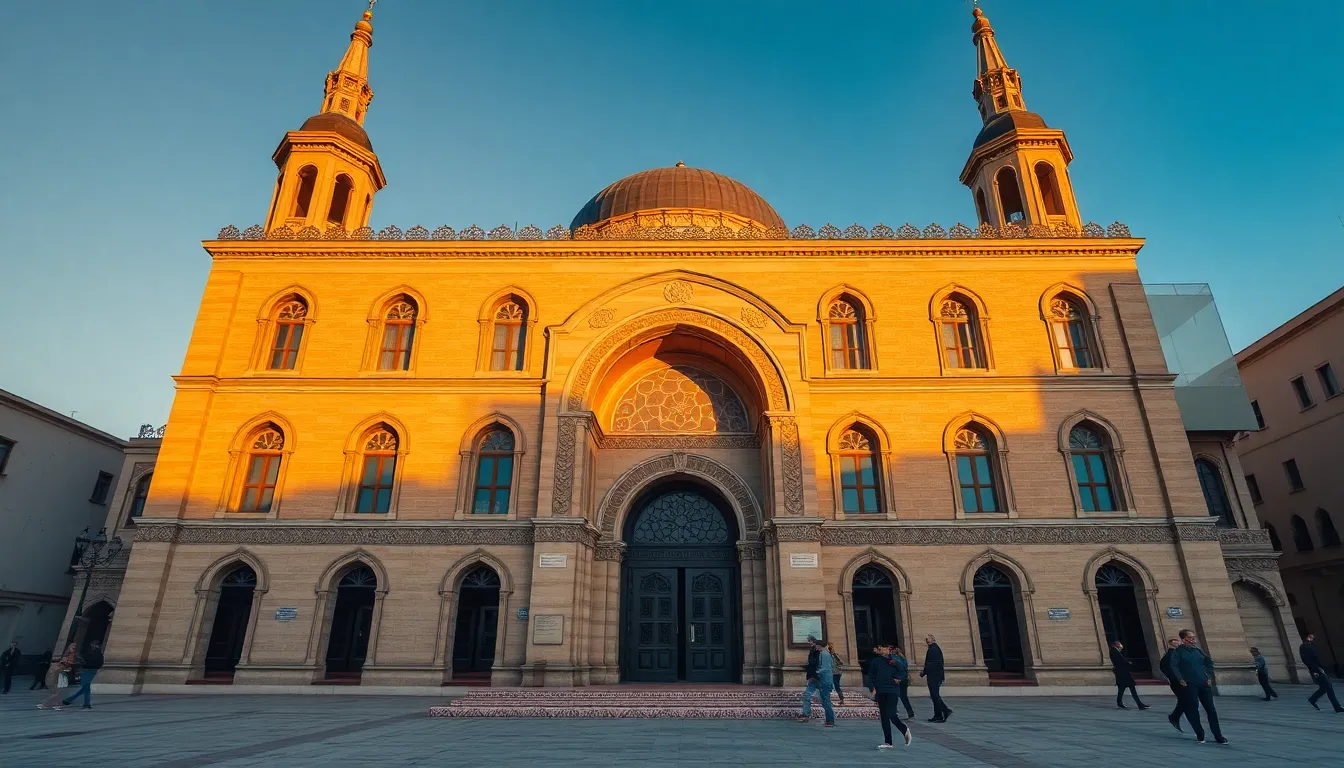
On one of my early trips to Egypt, an older woman in our group, whose family had left Cairo in the 1950s, asked me if we could find the synagogue her grandfather had prayed in. We did. She stood in the doorway and wept, not from sadness exactly, but from the shock of seeing that it was still there. “I thought it was all gone,” she said. It is not all gone. That is the thing I most want group leaders to understand.
I have spent more than two decades bringing Jewish groups to Egypt, and the surviving synagogues are the physical anchors of the whole journey. This guide is a heritage map: a guided survey of the synagogues that still stand across Cairo, Alexandria, and beyond, what each one holds, and how a group experiences them today.
How to Read This Map
Egypt once held dozens of synagogues. Cairo alone had a Jewish community of tens of thousands well into the twentieth century, with houses of worship across the city. Alexandria had its own dense Jewish life. As that community departed in the decades after 1948 and 1956, most synagogues were closed, repurposed, or fell into ruin.
What survives today is a smaller set of buildings, some grand and restored, some quiet and worn, each carrying a different chapter of the story. I have organized them by region. A well-built group itinerary will not reach every one, but understanding the full map helps a group leader choose which chapters their community most wants to read.
Cairo: The Heart of Surviving Jewish Egypt
Cairo holds the densest concentration of surviving Jewish heritage in Egypt, and most groups center their journey here.
Ben Ezra Synagogue
If a group sees only one synagogue in Egypt, it is Ben Ezra, in the Coptic Quarter of Old Cairo. It is one of the oldest synagogues in the world still standing, with origins traced to the ninth century CE and a site that may have held Jewish prayer even earlier. Tradition holds it as the place where baby Moses was found in the bulrushes.
Ben Ezra is world-famous for a different reason, though. In 1896, the scholar Solomon Schechter discovered the Cairo Geniza here, a storage room that had accumulated close to 300,000 Jewish documents over roughly a thousand years. Letters, contracts, prayers, shopping lists, the everyday paper of medieval Jewish life. The discovery rewrote our understanding of the medieval Jewish world. To stand in Ben Ezra is to stand at the source of that revelation. We cover the Geniza and its meaning in depth in our main guide to Jewish heritage in Egypt.
Sha’ar Hashamayim, the Adly Street Synagogue
A short distance away, in downtown Cairo, stands Sha’ar Hashamayim, also called the Adly Street Synagogue or the Ismailia Synagogue. Built in 1905, it is a grand building in Moorish Revival style, and it speaks of a completely different moment than Ben Ezra. This was the synagogue of the prosperous, cosmopolitan Cairo of the early twentieth century, the era of the Levantine city when Cairo had a substantial Jewish professional and mercantile class.
It remains the principal functioning synagogue in Cairo. The small remaining Jewish community gathers here on the holidays. It is maintained, dignified, and open to visitors with advance coordination. For many groups, the contrast between the ancient Ben Ezra and the grand, more recent Sha’ar Hashamayim tells the whole story of how long and how deeply Jews lived in this city.
The Maimonides Synagogue
In the old Jewish quarter of Cairo, Haret el-Yahud, stands the synagogue connected to the memory of Maimonides, the Rambam, who lived in Cairo and led Egyptian Jewry in the twelfth century. Restored in recent years after a long period of decay, it preserves the presence of one of the greatest figures in all of Jewish history at the heart of the old quarter.
For groups who have studied the Rambam, this is among the most moving stops in Egypt. We devote a full guide to his Egyptian years and this synagogue in our piece on Maimonides in Cairo.
The Lesser-Known Cairo Synagogues
Beyond these three, Cairo holds a number of smaller and less-visited Jewish sites, some restored, some not, scattered through the old quarter and the city. These include synagogues tied to specific communities and families, and they tell the more intimate, granular story of Jewish Cairo. For groups with a serious interest in the full picture, these lesser-known sites add real depth. We survey them in our guide to Jewish Cairo beyond Ben Ezra.
Alexandria: The Eliyahu Hanavi Synagogue
Alexandria was, for centuries, the intellectual center of Egyptian Jewry, the city of Philo and the Septuagint, where Jews once made up a substantial share of the population. Very little of that ancient world survives physically. But one great synagogue still stands.
The Eliyahu Hanavi Synagogue, in downtown Alexandria, traces its origins to 1354 and was rebuilt in 1850 after damage. It is one of the oldest synagogues in the world still standing, and it is a vast and beautiful space, far larger than the small remaining community could ever fill. The Egyptian government undertook a major restoration of the building, completed in recent years, and it reopened in dignified condition.
To visit Eliyahu Hanavi is to feel the weight of absence and presence at once. The building was made for a community of thousands. Today it stands largely empty, beautifully restored, a monument to a Jewish Alexandria that has gone. For groups traveling to Alexandria, it is the anchor of the Jewish heritage there, and a place where the scale of what was lost becomes physically real.
Beyond Cairo and Alexandria
Jewish life in Egypt was not confined to the two great cities. Smaller communities existed in towns across the Delta and elsewhere, and a few traces survive. Most of these sites are not part of a standard group itinerary, both because of their condition and their remoteness, but they are part of the honest map.
Worth knowing for any group is the ancient Jewish presence at Elephantine Island near Aswan, in the far south. This is not a synagogue in the medieval sense but the site of a Jewish military colony and temple from the fifth century BCE, one of the oldest chapters of Jewish life anywhere in Egypt. Groups traveling to Aswan can visit the island, and we cover it fully in our guide to the ancient Jewish temple at Elephantine.
Visiting the Synagogues: What to Expect
A few things every group leader should understand before planning visits to Egypt’s synagogues.
Access and Coordination
The principal sites, Ben Ezra, Sha’ar Hashamayim, the Maimonides Synagogue, and Eliyahu Hanavi in Alexandria, are maintained and open to visitors, but group visits require advance coordination, particularly if you want to hold a religious service or ceremony. This is not difficult, but it is not spontaneous. Heritage Tours handles all of this coordination as a matter of course, including proper notice to custodial authorities and, where a group wants to pray, arrangements for a minyan.
Security at these sites is real and visible, reflecting their significance. This is normal, and groups should not be alarmed by it. It is part of how these precious buildings are protected.
Reading a Context
Jewish travelers in Egypt do not typically display overt religious symbols in public the way they might in Israel. This is not about fear. It is about reading a context with respect. Inside the synagogues, groups pray and study freely. In the streets between them, our groups dress modestly and move with the quiet dignity these places deserve.
The Value of Context Over Access
Here is the thing I tell every group leader. Any tour company can get you through the door of Ben Ezra. What makes the difference is what you bring to the visit. A synagogue without its story is just an old building. With the story, with a guide who understands the Geniza, who knows the Rambam, who can tell your community what these walls held, the visit becomes something your people will carry for the rest of their lives. That context is the real work, and it is what we do.
FAQ: The Synagogues of Egypt
How many synagogues are still standing in Egypt?
A smaller set of Egypt’s once-numerous synagogues survives today. The principal ones open to visitors are Ben Ezra Synagogue, Sha’ar Hashamayim, and the Maimonides Synagogue in Cairo, along with the Eliyahu Hanavi Synagogue in Alexandria. Several lesser-known Jewish sites also survive in Cairo’s old quarter in varying condition. Most of Egypt’s synagogues closed or fell into ruin after the community departed in the decades following 1948 and 1956, but the surviving buildings have increasingly been restored and maintained.
What is the oldest synagogue in Egypt?
Ben Ezra Synagogue in Old Cairo is one of the oldest synagogues in the world still standing, with origins traced to the ninth century CE and a site that may have held Jewish prayer even earlier. The Eliyahu Hanavi Synagogue in Alexandria traces its origins to 1354 and is also among the oldest surviving synagogues anywhere. Older still, though not a synagogue in the medieval sense, was the Jewish temple at Elephantine Island near Aswan, dating to the fifth century BCE.
Can tourists visit the synagogues of Egypt?
Yes, the principal synagogues are maintained and open to visitors with advance coordination. Group visits, especially those wishing to hold a service or ceremony, require notice to the custodial authorities. Heritage Tours arranges all of this coordination for Jewish groups. Security at these sites is real and visible, which is normal given their significance. Visitors should expect to provide advance details and to move through the sites with appropriate reverence.
Which synagogue should a group visit if they can only see one?
Ben Ezra Synagogue in Old Cairo. It is one of the oldest in the world still standing, it is tied by tradition to the finding of baby Moses, and it is the place where the Cairo Geniza was discovered in 1896, one of the greatest archival discoveries in history. For most Jewish groups, Ben Ezra is the single most resonant synagogue site in Egypt, both for its antiquity and for the story of the Geniza that emerged from it.
Is the Eliyahu Hanavi Synagogue in Alexandria worth a visit?
Yes, for groups traveling to Alexandria it is the anchor of the Jewish heritage there. The building traces its origins to 1354, was rebuilt in 1850, and underwent a major government restoration completed in recent years. It is vast and beautiful, built for a community of thousands that has now almost entirely gone. The experience of standing in that grand, largely empty, beautifully restored space is one of the most powerful encounters with both the presence and the absence of Jewish Alexandria.
If you are a rabbi or group leader thinking about which of Egypt’s synagogues your community most wants to stand in, I would be glad to help you build the map that fits your people. Every congregation reads this story a little differently. Learn more at our Egypt heritage destination page, see how group heritage tours work, and reach out whenever you are ready to talk it through.