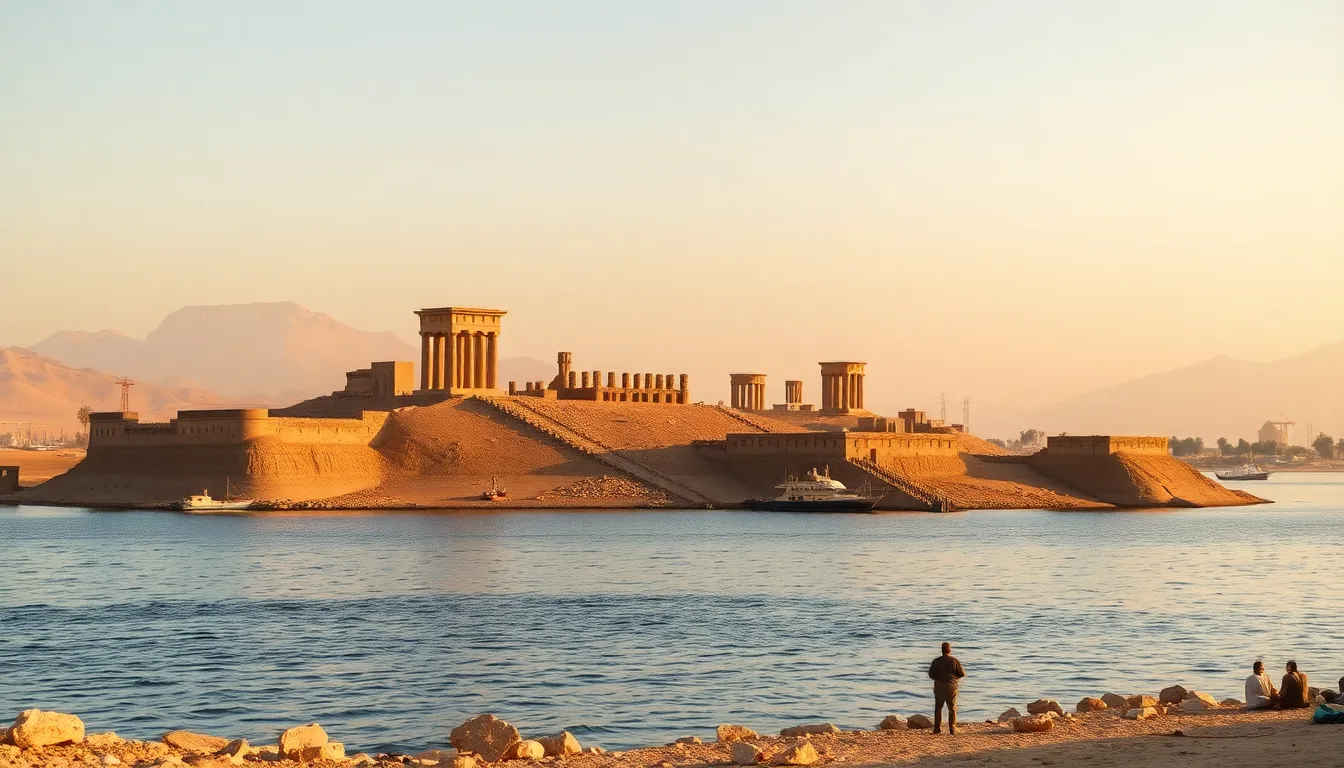
On Elephantine Island, I once watched a group of educated, well-read Jewish travelers, people who knew their history, stand in genuine astonishment. They had never heard of this place. And here, on a small island in the Nile at the far southern edge of Egypt, was the trace of a Jewish community that built its own temple, observed Passover, and wrote letters to Jerusalem, all in the fifth century BCE. “How did we not know about this?” one of them asked. It is the question I hear most often at Elephantine.
I have been bringing Jewish groups to Egypt for more than two decades, and Elephantine is one of the least-known and most remarkable stops I share with them. This guide is for rabbis, educators, and travelers who want to understand the ancient Jewish garrison and temple at Aswan, and why standing there does something to people.
Where and What Elephantine Is
Elephantine is a small island in the Nile at Aswan, on Egypt’s southern frontier, the historic border with Nubia. In antiquity it was a strategic outpost, a garrison town guarding the edge of Egypt. The name comes from its ancient role in the ivory trade.
What makes it extraordinary for Jewish travelers is this: from at least the sixth century BCE through the late fifth century BCE, and possibly earlier, Elephantine was home to a Jewish military colony. These were Jewish soldiers, with their families, serving in the armed forces of the Persian Empire, which ruled Egypt at the time. They lived on the island as a distinct community, and they left behind a record of their lives so detailed that we know their names, their disputes, their marriages, and their prayers.
This was not a community of exiles passing through. It was a settled, organized Jewish population at the southern edge of the ancient world, living a recognizably Jewish life two and a half thousand years ago.
The Temple They Built
Here is the detail that stops groups in their tracks. The Jews of Elephantine built their own temple to the God of Israel, on the island, and worshipped there.
This is striking for a reason that anyone familiar with the Bible will feel immediately. The Temple in Jerusalem was meant to be the central, and ultimately the only, place of sacrificial worship. Yet here, far to the south in Egypt, a Jewish community maintained its own temple where it offered sacrifices. The Elephantine temple appears to have predated the religious reforms that strictly centralized worship in Jerusalem, or to have existed in tension with them. It is a window into a moment when Jewish practice was more varied than the later, more unified tradition would suggest.
The temple was destroyed around 410 BCE, attacked by local priests of the Egyptian god Khnum, whose own cult center was on Elephantine and who appear to have come into conflict with the Jewish community. The destruction set off a remarkable exchange of letters, because the Elephantine Jews wrote to the authorities in Jerusalem and in Samaria asking for support to rebuild. We have those letters. We have the request, and we have the eventual permission to rebuild, granted on the condition that the rebuilt temple offer only certain sacrifices, a careful diplomatic compromise preserved in the documents.
The Elephantine Papyri
The reason we know any of this is one of the great archival treasures of Jewish history: the Elephantine Papyri. Discovered in the late nineteenth and early twentieth centuries, these are documents written in Aramaic, the everyday language of the community, on papyrus, that survived in Egypt’s dry climate for two and a half thousand years.
What do they contain? The texture of a whole life. Personal letters. Marriage contracts. Property deeds and loan agreements. Records of disputes brought before the community. Official correspondence with Persian and Jewish authorities. The letters about the temple’s destruction and rebuilding. And, movingly, references to the observance of Jewish practice, including what scholars read as an instruction concerning the proper observance of Passover and the Festival of Unleavened Bread, sent from the imperial administration, the so-called Passover Letter.
I find that the papyri move groups even more than the island itself. There is a marriage contract from Elephantine that lays out the rights of a Jewish woman with a specificity that feels startlingly modern. There are letters between family members about ordinary money and property. Reading about a Jewish woman in the fifth century BCE asserting her rights, or a soldier writing home, collapses the distance between us and them. These were not legendary figures. They were people, with the same concerns we have, living a Jewish life at the edge of the ancient world.
A Window Into Early Jewish Diaspora Life
Elephantine matters because of what it tells us about the Jewish diaspora at its very beginnings. We tend to think of the diaspora as something that came later, after the destruction of the Second Temple in 70 CE. But Elephantine shows organized Jewish communities living far from the Land of Israel, maintaining their identity, their practice, and their connection to Jerusalem, centuries before that.
It also shows a community in real conversation with the powers around it. The Elephantine Jews served a Persian empire, worshipped the God of Israel, corresponded with both Jerusalem and Samaria, and negotiated with local Egyptian priesthoods. They held their identity while fully engaged with their world, a pattern that would repeat across all the centuries of Jewish diaspora history to come. In that sense, Elephantine is not just an ancient curiosity. It is the early template of how Jews have lived as a minority among the nations ever since. We trace where this fits in the longer story in our history of Egypt’s Jewish community.
The community eventually vanished from the historical record, sometime in the late fifth or fourth century BCE, under circumstances that are still not fully understood. The papyri simply stop. What happened to these families, where they went, we do not know. That silence is part of what makes the place haunting.
Visiting Elephantine Today
I want to be honest with groups about what the visit is. Elephantine is not a heavily developed or heavily interpreted tourist site in the way the great temples of Egypt are. There are archaeological remains on the island, including an open-air museum and excavated areas, and the location itself, an island in the Nile at Aswan, is genuinely beautiful. But you will not find a grand reconstructed Jewish temple or extensive signage telling the Jewish story.
In a strange way, that is part of its power. There is no spectacle to distract from the act of imagination the place asks of you. Standing on the island, looking at the Nile flowing around it, knowing that Jewish families lived here, built a temple here, observed Passover here, twenty-five centuries ago, is a quiet and profound experience. A good guide makes all the difference, because the story has to be carried in, not read off a sign. With the story in hand, the island speaks.
Aswan itself is one of the most beautiful places in Egypt, and Elephantine fits naturally into an Aswan visit. Groups traveling to the south of Egypt for the great sites of the region can include Elephantine as a deeply meaningful Jewish stop, one almost no other travelers will know to seek out. It pairs especially well with a fuller survey of Egypt’s Jewish heritage, which we map in our guide to the synagogues of Egypt.
FAQ: The Jewish Temple at Elephantine
What was the Jewish community at Elephantine?
It was a Jewish military colony living on Elephantine Island in the Nile at Aswan, in southern Egypt, from at least the sixth century BCE through the late fifth century BCE. The community was made up of Jewish soldiers and their families serving the Persian Empire, which then ruled Egypt. They lived as a distinct, organized Jewish population, built their own temple to the God of Israel, observed Jewish practice including Passover, and corresponded with the authorities in Jerusalem.
Did the Jews at Elephantine really build their own temple?
Yes. The Jewish community at Elephantine built and maintained its own temple to the God of Israel on the island, where it offered sacrifices. This is striking because the Temple in Jerusalem was meant to be the central place of such worship. The Elephantine temple either predated the strict centralization of worship in Jerusalem or existed in tension with it. It was destroyed around 410 BCE by local Egyptian priests of the god Khnum, after which the community wrote to Jerusalem and Samaria seeking permission to rebuild, which was eventually granted.
What are the Elephantine Papyri?
They are a collection of documents written in Aramaic on papyrus by the Jewish community at Elephantine, discovered in the late nineteenth and early twentieth centuries and preserved by Egypt’s dry climate for over two thousand years. They include personal letters, marriage contracts, property deeds, legal disputes, official correspondence, the letters concerning the temple’s destruction and rebuilding, and references to Jewish observance including Passover. They give us one of the most intimate windows we have into Jewish daily life in antiquity.
Can you visit Elephantine Island today?
Yes. Elephantine is an island in the Nile at Aswan with archaeological remains, excavated areas, and an open-air museum, and it fits naturally into a visit to Aswan in southern Egypt. It is not a heavily interpreted tourist site, and there is no grand reconstructed Jewish temple, so the story has to be brought to it by a knowledgeable guide. Standing on the island, knowing that a Jewish community lived and worshipped there twenty-five centuries ago, is a quiet and profound experience. Heritage Tours includes it as a meaningful Jewish stop on Aswan itineraries.
Why is Elephantine so important for Jewish history?
It is one of the earliest clear windows we have into organized Jewish diaspora life, showing a community maintaining its identity, practice, and connection to Jerusalem far from the Land of Israel, centuries before the destruction of the Second Temple in 70 CE. It reveals that early Jewish practice was more varied than the later unified tradition suggests, and it shows a community fully engaged with the powers around it while holding its own identity, a pattern that would define Jewish diaspora life ever after. It is, in effect, an early template of how Jews have lived among the nations.
If you are bringing a group to the south of Egypt and want them to encounter one of the oldest and least-known chapters of our story, I would be glad to help you build Elephantine into the journey. Almost no other travelers will know to seek it out, and that is part of why it lands so deeply. Learn more at our Egypt heritage destination page, see how group heritage tours work, and reach out whenever you are ready.