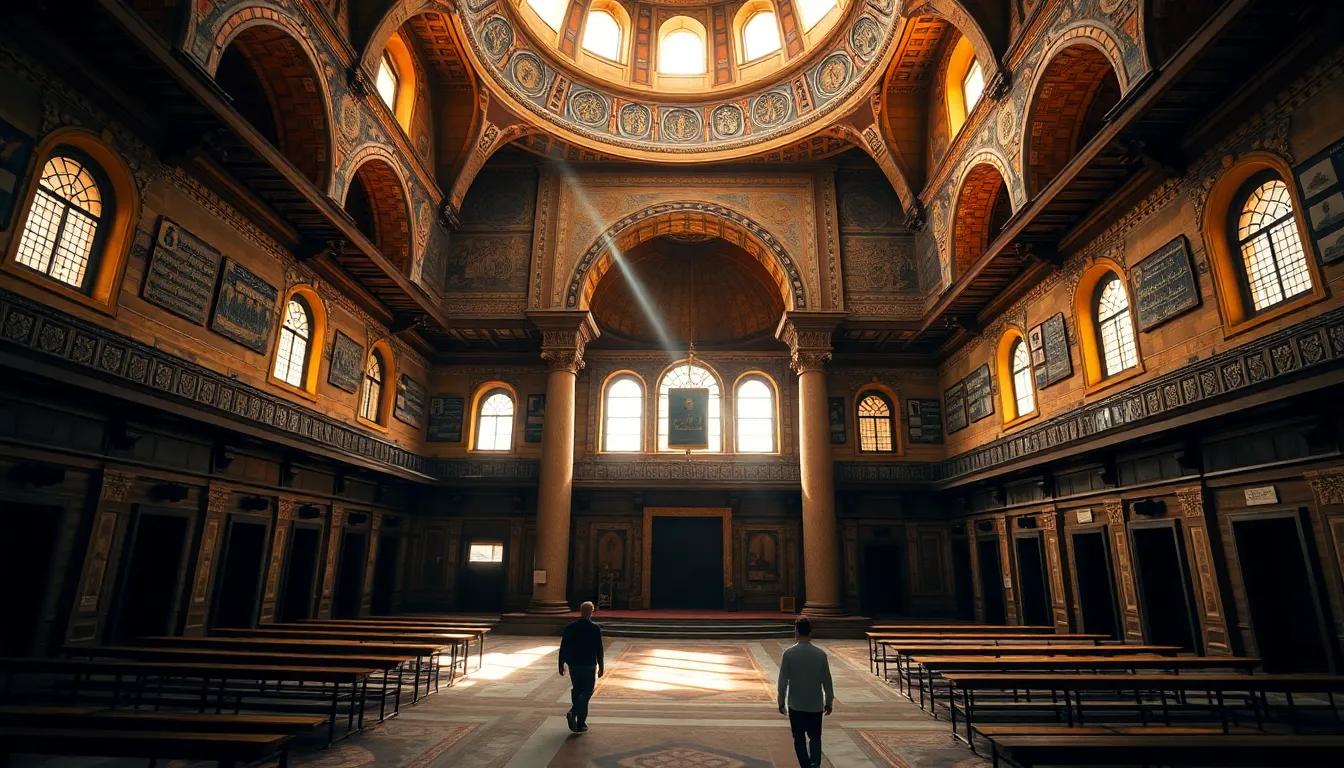
The first time I brought a group to the Maimonides Synagogue in Old Cairo, a rabbi in our group stood in the center of the room and did not move for a long while. When he finally spoke, he said one sentence. “He prayed here.” That was all. And it was everything.
I have been leading Jewish heritage groups to Egypt for more than two decades, and I have watched many sites move people. But there is something specific about standing where the Rambam stood. For anyone who has studied the Mishneh Torah, or wrestled with the Guide for the Perplexed, or recited the Thirteen Principles of Faith, Maimonides is not a distant historical figure. He is a teacher. And his classroom, his hospital, his community, were here, in Cairo, for the last decades of his life.
This guide is for rabbis, educators, and Jewish travelers who want to understand the Rambam’s Egyptian years and what it means to walk that ground today.
Who Was Maimonides
Moses ben Maimon, known in Hebrew by the acronym Rambam and in the wider world as Maimonides, was born in Córdoba, in Muslim Spain, in 1138. He was a physician, a philosopher, an astronomer, and one of the most consequential codifiers of Jewish law in all of history. The phrase carved on many memorials captures how the tradition remembers him: “From Moses to Moses, there arose none like Moses.”
His life was shaped by displacement. When the Almohad dynasty conquered Córdoba and ended the relative tolerance Jews had known there, the family fled. They wandered through Spain and North Africa for years, eventually settling for a time in Fez, in present-day Morocco. After a period in the Land of Israel, the family arrived in Egypt around 1166, and it was in Egypt that Maimonides spent the rest of his life and produced the work that made him immortal.
To understand Maimonides in Egypt, you have to hold both halves of the man. He was the supreme legal authority of his generation, the man to whom communities across the Mediterranean wrote for rulings. And he was a working physician who rose to serve the court of Saladin’s vizier. He did both at once, often exhausted, sometimes overwhelmed, always serving.
Why the Rambam Came to Egypt
The Egypt Maimonides arrived in was a center of Jewish life with deep roots. Fustat, the original Islamic capital that became part of greater Cairo, held a thriving Jewish community with institutions, courts, and synagogues, including the Ben Ezra Synagogue whose geniza would later reveal so much about this exact world.
Egypt under the Fatimids and then under Saladin’s Ayyubid dynasty offered something the family had not found in Almohad Spain: a place where a Jewish scholar could live openly, build a community, and rise to prominence. It was not a place without tension, but it was a place where Jewish life could flourish, and flourish it did.
Maimonides did not seek leadership when he arrived. He sought stability. But the community recognized what it had, and within a few years he had become the Nagid, the head of the Jewish community of Egypt, a position of both spiritual and civil authority.
The Tragedy That Changed His Life
There is a part of this story that I always share gently with groups, because it explains so much about the man.
Maimonides did not originally earn his living from medicine or from his role as a scholar. His younger brother David was a merchant who traded in precious stones, and David’s work supported the entire family, freeing Maimonides to study and write. The arrangement let one of the greatest minds in Jewish history devote himself to scholarship.
Then David drowned in a shipwreck in the Indian Ocean, carrying the family’s fortune with him. Maimonides was shattered. In a letter that survives, he wrote that for a full year he lay on his bed, stricken with grief and illness, unable to function. He described David as his joy, the brother who grew up on his knees.
It was after this loss that Maimonides turned fully to medicine as a profession. The greatest legal mind of his age became a working doctor, in part, because grief had taken the brother who had made his scholarship possible. There is a dignity in that turn that I find hard to put into words. He carried his sorrow into a life of service.
Maimonides the Physician
Maimonides became one of the most respected physicians in the Islamic world. He served in the court of al-Fadil, the vizier of Saladin, and tradition holds that he treated members of the royal household. His medical reputation reached far beyond Egypt.
We have his own description of his days, and it is staggering. In a famous letter to his translator Samuel ibn Tibbon, he described leaving Fustat early each morning to attend the court in Cairo, returning home in the afternoon faint with hunger, only to find his courtyard filled with patients waiting, Jews and non-Jews, rich and poor. He treated them until night, sometimes lying down from sheer exhaustion while still giving instructions. By Shabbat he barely had strength to meet with the community.
That was the daily reality of the man whose legal code Jews still study line by line eight centuries later. He wrote the Mishneh Torah and the Guide for the Perplexed in the margins of a punishing medical practice and the responsibilities of communal leadership.
His medical writings survive too. He wrote treatises on asthma, on poisons and their antidotes, on regimen and health, much of it remarkably practical and humane. He emphasized prevention, moderation, the connection between mental and physical wellbeing. A physician reading Maimonides today still finds wisdom in him.
The Mishneh Torah and the Guide for the Perplexed
Whatever else he did, Maimonides is remembered above all for two monumental works, both completed during his Egyptian years.
The Mishneh Torah is a comprehensive code of all Jewish law, organized systematically across fourteen books, written in clear Hebrew. Before Maimonides, a Jew seeking a ruling had to navigate the vast and often contradictory sea of the Talmud. Maimonides set out to make the entire law accessible, organized, and clear. The ambition was breathtaking, and the achievement reshaped Jewish learning permanently. To this day, the study of Rambam is a pillar of the yeshiva world.
The Guide for the Perplexed, written in Judeo-Arabic, is a different kind of book entirely. It is a work of philosophy addressed to the believer who is also a thinker, the person caught between the truths of the tradition and the truths of reason. It influenced not only Jewish thought but Christian and Islamic philosophy as well. Thomas Aquinas read Maimonides. The conversation he started has never stopped.
Both works carry the fingerprint of Egypt. They were written by a man who lived among Muslim philosophers and physicians, who thought in Arabic as easily as in Hebrew, who was fully a part of the intellectual world around him while remaining wholly rooted in his own tradition. Egypt made that possible.
The Maimonides Synagogue in Old Cairo
The synagogue that bears his name stands in the heart of the old Jewish quarter of Cairo, Haret el-Yahud. It is called the Rav Moshe Synagogue, or simply the Maimonides Synagogue.
For Jewish travelers, this is the emotional center of the Maimonides story on the ground. Tradition holds that this is the site connected to where Maimonides prayed and studied, and the building became a place of pilgrimage for centuries. Sephardic Jews in particular would come to spend the night in a room associated with the Rambam, in the hope of healing, a practice tied to his enduring reputation as both a holy man and a physician.
The synagogue fell into severe disrepair over the twentieth century as the community departed and the building suffered from a rising water table and neglect. In recent years it underwent a significant restoration, and the building was returned to a dignified state. When our groups visit today, they find a space that has been cared for, that honors what it holds.
What a Group Experiences There
I will be honest with you about what the visit is and what it is not. This is not a grand cathedral of a synagogue. It is a historic building in a dense old quarter of Cairo, and getting there means walking through living streets where ordinary Egyptian life goes on around you. That walk is part of it. You are moving through the same lanes the Rambam’s community moved through.
Inside, what people feel is presence. Groups often want to learn a piece of Rambam there, even a few lines, even just the Thirteen Principles. I encourage it. There is no more fitting place on earth to study his words than the ground where he taught them.
Access requires advance coordination, which Heritage Tours arranges as a matter of course. For the fuller picture of Cairo’s Jewish sites, including the lesser-known ones that surround this synagogue, see our guide to Jewish Cairo beyond Ben Ezra.
Where Maimonides Is Buried
Here the story takes a turn that surprises many groups. Maimonides died in Egypt in 1204, but he is not buried there.
According to tradition, his remains were carried to the Land of Israel and buried in Tiberias, where his tomb remains a major site of pilgrimage to this day. The man who spent his most productive years in Egypt rests in the Galilee. For groups that travel both to Egypt and to Israel, there is something powerful in tracing that arc: studying the Rambam where he wrote, and then standing at his grave in the land he loved.
This is part of why I often tell rabbis that Egypt and Israel belong together in a Jewish heritage journey. The story does not stay in one place. It moves, the way the man himself moved, the way our whole people has moved.
FAQ: Maimonides in Egypt
Where did Maimonides live in Egypt?
Maimonides lived in Fustat, the old Islamic capital that is now part of Old Cairo, from around 1166 until his death in 1204. This was the same area that held the Ben Ezra Synagogue and a thriving medieval Jewish community. He served as the head of Egyptian Jewry and as a court physician, traveling daily between his home in Fustat and the seat of government in Cairo. The Maimonides Synagogue in the old Jewish quarter, Haret el-Yahud, preserves his memory at the heart of that world.
Can you visit the Maimonides Synagogue in Cairo?
Yes. The Maimonides Synagogue, also called the Rav Moshe Synagogue, was restored in recent years and is accessible to visitors with advance coordination. It sits in the historic Jewish quarter of Old Cairo. Heritage Tours arranges access for Jewish groups, including the proper notice to custodial authorities. Many groups choose to study a short text of the Rambam during their visit, which the setting makes deeply meaningful.
Why is Maimonides buried in Israel and not Egypt?
Maimonides died in Egypt in 1204, but according to long-standing tradition his remains were brought to the Land of Israel and buried in Tiberias, in the Galilee, where his tomb is a major pilgrimage site today. The tradition reflects both his own connection to the Land of Israel, where his family had lived for a period before settling in Egypt, and the broader Jewish longing to be buried in the holy land. Groups traveling to both Egypt and Israel can study his work where he wrote it and visit his grave where he rests.
What did Maimonides write while in Egypt?
His two greatest works were completed during his Egyptian years. The Mishneh Torah, a comprehensive code of all Jewish law in clear Hebrew, and the Guide for the Perplexed, a philosophical work written in Judeo-Arabic that reconciled faith and reason. He produced both while working as a court physician and leading the Egyptian Jewish community, often in conditions of physical exhaustion. He also wrote numerous medical treatises and a vast body of responsa, legal rulings sent to communities across the Mediterranean.
Was Maimonides a doctor as well as a rabbi?
Yes, and the two roles were inseparable in his life. He turned fully to medicine as a profession after his brother David, who had supported the family through trade, died in a shipwreck. Maimonides rose to serve in the court of Saladin’s vizier and became one of the most respected physicians of his era, writing influential medical treatises. He treated patients of all backgrounds at his home in Fustat after returning from court each day, often working until late into the night.
If you are a rabbi or educator who has taught the Rambam and wants your community to stand where he stood, I would be glad to talk it through with you. Tracing the life of Maimonides on the ground in Egypt is one of the most meaningful things a Jewish group can do. Learn more at our Egypt heritage destination page, see how group heritage tours work, and reach out when you are ready to begin the conversation.