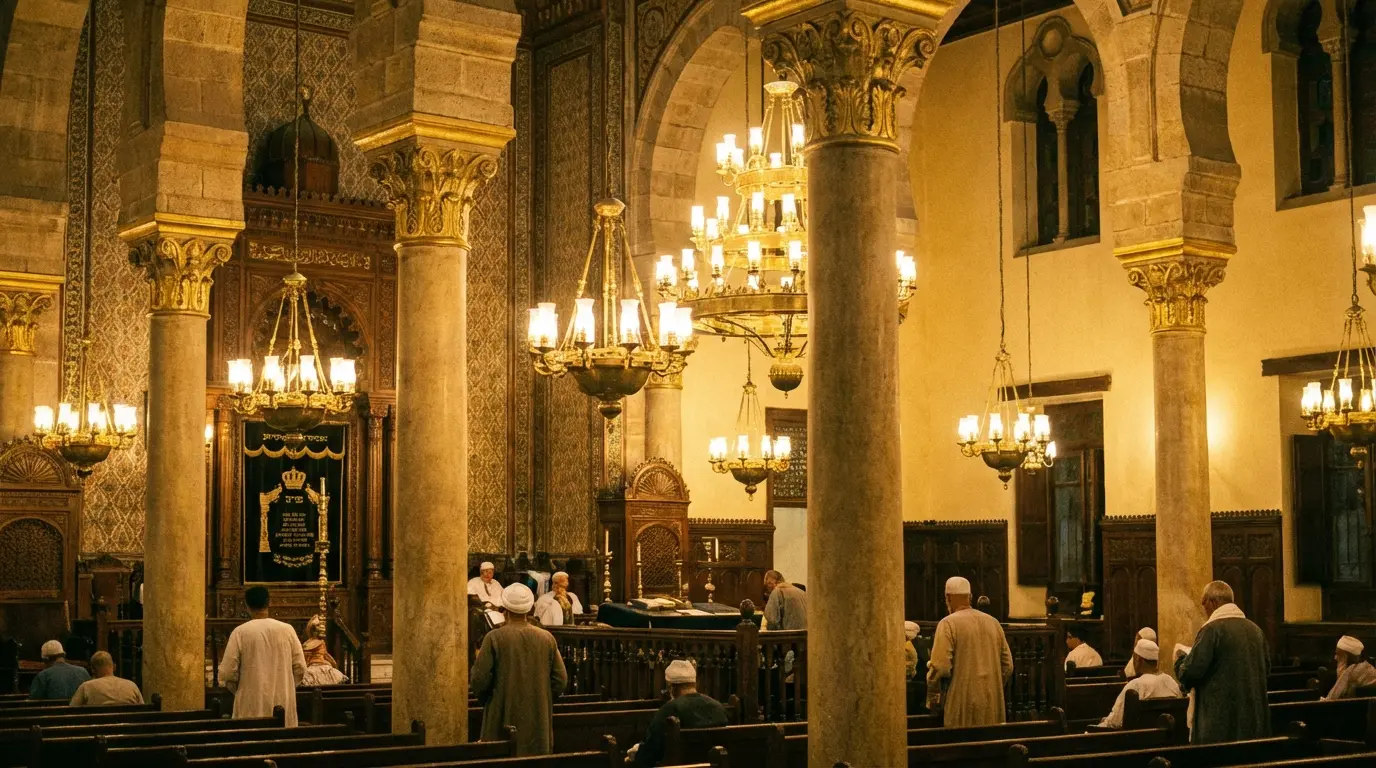
My grandfather was a Chief Rabbi, and when I was a child he told me something I’ve never forgotten. He said, “Dina, Egypt is not just a chapter in the Torah. It is the chapter. Without Egypt, there is no Jewish people.” I did not fully understand what he meant until I stood inside Ben Ezra Synagogue in Cairo for the first time, in a courtyard that has held Jewish prayer for over a thousand years, and felt something shift in me that I cannot quite put into words.
I have been bringing Jewish groups to Egypt for more than two decades. And I will tell you honestly: no other destination I work with carries the same emotional and spiritual weight for Jewish travelers. Israel is home. Egypt is the origin story.
This guide is for rabbis, synagogue leaders, and Jewish heritage travelers who want to understand what Egypt holds, and why a visit there is not tourism. It is an encounter with the roots of who we are.
Egypt and the Jewish People: A 3,000-Year Story
The Jewish relationship with Egypt spans three thousand years of recorded history, and it is not a simple relationship. Egypt was the house of bondage. Egypt was also the land where a young Moses was raised in Pharaoh’s court, where Joseph saved a civilization from famine, where a remarkable Jewish community thrived through the Ptolemaic era and the medieval period and into the twentieth century.
To walk through Egypt as a Jewish traveler is to hold all of that at once. The bitterness and the beauty. The exile and the survival. The departure that made us who we are, and the communities that stayed and built something extraordinary long after.
When groups ask me where in the world they will feel Jewish history most viscerally, I tell them: go to Israel first, and then go to Egypt. Israel is where the story lives. Egypt is where it began.
The Exodus: The Foundation of Jewish Identity
There is almost no event in human religious history that has done more to shape a people’s identity than the Exodus from Egypt. It is woven into daily Jewish prayer, into the Passover Seder, into the ethical foundations of the Torah. “You shall not oppress the stranger, because you were strangers in the land of Egypt” appears in one form or another dozens of times in scripture. Egypt is the reason that commandment exists.
Where the Enslaved Israelites Worked and Lived
The ancient city of Pi-Ramesses, identified by many scholars with the biblical city of Rameses where the Israelites labored, is located in the eastern Nile Delta region. Today the archaeological site of Qantir, near the modern town of Faqus, contains the remains of what was once one of the largest cities in the ancient world. Excavations have uncovered mudbrick structures consistent with the type of construction described in Exodus, as well as evidence of Semitic laborers in the region during the New Kingdom period.
The site itself is not a tourist destination in the conventional sense. There are no grand temples, no dramatic ruins preserved for visitors. But standing there, in the flat delta landscape, looking at the soil that may have been shaped by Israelite hands, does something to you. Our groups stand there quietly. Nobody needs to say very much.
Memphis, the ancient capital, and the nearby step pyramid at Saqqara are also part of the story. The region gives you a sense of the Egyptian civilization that held an entire people in its grip, and against which Moses stood and demanded freedom.
The Route Out of Egypt: What We Know
The exact route of the Exodus remains debated among archaeologists and biblical scholars, and I will not pretend otherwise. What I can tell you is that the landscape of the eastern Delta, the Sinai Peninsula, and the area around the traditional site of Mount Sinai holds layers of significance that are real and profound regardless of where exactly the Israelites walked. We cover the Sinai dimension separately when planning group itineraries, as Sinai access requires its own coordination today.
The Ancient Jewish Colony at Elephantine
One of the least-known and most remarkable chapters in Jewish history happened not in Cairo, but at Elephantine, a small island in the Nile near modern Aswan at Egypt’s southern border. A Jewish military colony existed there from at least the sixth century BCE through the fourth century BCE, and possibly earlier.
These were Jewish soldiers serving the Persian administration in Egypt. They built a Temple. They observed Passover. They wrote letters to the high priest in Jerusalem. And then they disappeared from the historical record, sometime in the late fourth century BCE, under circumstances that are still not fully understood.
What the Papyri Tell Us About Jewish Life in Egypt
What makes Elephantine extraordinary is that they left their documents behind. The Elephantine Papyri, discovered in the late nineteenth and early twentieth centuries, include personal letters, property contracts, marriage documents, and official correspondence from this community. They are written in Aramaic and they give us an intimate window into the daily life of Jews living in Egypt two and a half thousand years ago.
Reading about a Jewish woman in Elephantine writing to her brother about a property dispute in the fifth century BCE is disorienting in the best way. The details are so specific. So human. So recognizable.
When Heritage Tours groups travel to Aswan, we include Elephantine Island as a stop. It is not heavily interpreted for tourists, which is actually part of what makes it powerful. You are standing on ground where Jewish families built a life at the edge of the ancient world.
Ben Ezra Synagogue: One of the World’s Oldest
If there is one site in Egypt that every Jewish traveler should see in their lifetime, it is Ben Ezra Synagogue in the Coptic Quarter of Old Cairo.
The synagogue’s origins are traced to the ninth century CE, though the site itself may have held Jewish prayer even earlier. The tradition holds that this is the place where baby Moses was found in the bulrushes, although the Nile has shifted considerably in the intervening millennia. What is not tradition but documented history is that this building has served as a witness to over a thousand years of Jewish life in Cairo.
Ben Ezra is a beautiful building. The carved woodwork, the layered history visible in its architecture, the quiet of the courtyard. But the reason Jewish groups come here is not the architecture.
The Cairo Geniza Discovery That Changed Jewish Scholarship
In 1896, a Scottish scholar named Solomon Schechter came to Ben Ezra Synagogue and found something that scholars now consider one of the greatest archival discoveries in history. The geniza, which is a storage room where Jewish communities deposit worn sacred texts rather than destroy them, had been accumulating documents for close to a thousand years. Schechter and the synagogue’s leadership arranged for the collection to be brought to Cambridge University, where it now forms the Cambridge Geniza Collection.
What was in those documents? Nearly everything. Letters between merchants across the medieval Mediterranean world. Marriage contracts. Court records. Biblical commentaries. Medical prescriptions. Shopping lists. The complete text of the Hebrew book of Ben Sira, which had been known only in Greek translation for centuries. Business correspondence between Jewish traders in India, Spain, Tunisia, and Egypt, revealing a medieval Jewish commercial network of extraordinary reach and sophistication.
The Cairo Geniza did not just add to our knowledge of medieval Jewish life. It rewrote it. The world S.D. Goitein reconstructed from these documents in his five-volume work “A Mediterranean Society” is a revelation: a Jewish community deeply embedded in its world, cosmopolitan, literate, commercially active, spiritually engaged. It overturned the idea that medieval Jews lived in isolated, persecuted poverty. They were part of the world.
What Visitors Experience There Today
Ben Ezra is open to visitors, though it requires advance coordination to visit as a Jewish group that wants to pray or hold a ceremony there. Heritage Tours handles this coordination, including proper notice to the custodial authorities and, where appropriate, arrangements for a minyan.
The Coptic Quarter in which Ben Ezra is situated is one of the most layered historical areas in Cairo. Within a few blocks you have Christian churches dating to the earliest centuries of the faith, the ruins of a Roman fortress, and this synagogue. For groups interested in the shared heritage of the Abrahamic faiths in Egypt, the Coptic Quarter offers an extraordinary concentration in a small area.
The Jewish Quarter of Cairo: Haret el-Yahud
Old Cairo’s Jewish Quarter, known as Haret el-Yahud, was once home to a dense, vibrant Jewish community. Today it is a quiet residential neighborhood with few visible markers of its past. But for a group walking through it with someone who knows what to look for, it speaks.
The streets retain their old configuration. The buildings, though changed, occupy the same footprints as the structures of a century ago. Some Jewish families lived in this quarter continuously from the medieval period through the mid-twentieth century. To walk it is to try to hear a community that has almost entirely gone.
The Other Synagogues: Sha’ar Hashamayim and the Adly Street Synagogue
Beyond Ben Ezra, Cairo has a second significant synagogue still standing. Sha’ar Hashamayim, also known as the Adly Street Synagogue or the Ismailia Synagogue, was built in 1905 and served the more prosperous Sephardic Jewish community of downtown Cairo in the early twentieth century. It is a grand building, Moorish Revival in style, and it speaks of a different moment in Cairo’s Jewish history: the era of the Levantine cosmopolitan city, when Cairo had a substantial Jewish professional and mercantile class.
The synagogue is maintained by Egypt’s small remaining Jewish community and is open for visits, again with advance coordination. During Jewish holidays, the few remaining Jews in Cairo gather here.
The Jewish Cemetery of Bassatine
One of the oldest Jewish cemeteries in the world is located in Cairo. The Bassatine cemetery, believed to date to the ninth century, holds the graves of Cairo’s Jews across more than a millennium. It has suffered from neglect and encroachment over the decades, and restoration efforts have been ongoing. For a group visiting Egypt with a serious interest in the full story of Jewish life there, Bassatine is part of that story. It is not an easy visit, but important ones rarely are.
Alexandria’s Jewish Heritage
Cairo holds the physical heart of Egypt’s Jewish heritage today, but Alexandria was, for centuries, its intellectual center. The city Alexander founded in 331 BCE attracted a large Jewish population within a generation of its founding, and by the first century CE, Jews made up a substantial portion of the city’s population, perhaps as much as two-fifths by some ancient estimates.
Philo of Alexandria and the Jewish Intellectual Tradition
The most famous Jewish Alexandrian is Philo of Alexandria, the philosopher who lived roughly from 20 BCE to 50 CE and spent his life attempting to reconcile Jewish scripture with Greek philosophy. He wrote in Greek. He thought in the categories of Plato and Aristotle. And he produced a body of work that would influence early Christian theology as profoundly as it influenced Jewish thought.
Philo is in some ways the ancestor of every Jewish intellectual engagement with the wider world. The attempt to hold both the particular and the universal, to be deeply rooted in Jewish tradition while in full conversation with the ideas of the surrounding culture. Alexandria made that possible.
The city was also home to the Septuagint, the Greek translation of the Hebrew Bible, which tradition says was produced in Alexandria by seventy-two scholars under Ptolemy II. Whether or not that specific story is accurate, what is true is that Alexandria is where Jewish scripture became accessible to the Greek-speaking world, with consequences for both Judaism and Christianity that still echo today.
What Remains of Jewish Alexandria Today
Honest answer: very little in a physical sense. The ancient Jewish community left almost no standing structures. The Jewish population of Alexandria, which was substantial through the nineteenth century and into the first half of the twentieth, is now essentially gone.
One synagogue remains: the Eliyahu Hanavi Synagogue, built in 1354 and rebuilt in 1850, which stands in downtown Alexandria and is one of the oldest synagogues in the world still standing. It is maintained and open for visits, and it is one of those places where you feel the weight of absence as much as the weight of presence.
Alexandria itself is worth visiting for Jewish heritage travelers for what it represents as much as for what physically remains. The idea of Alexandria, the cosmopolitan city where Jewish life flourished within a great and diverse civilization, is itself part of the Jewish story.
The 20th Century Egyptian Jewish Community: A Story of Exodus and Loss
There is a second Exodus in the Jewish story of Egypt, and it happened within living memory.
At the beginning of the twentieth century, Egypt had a Jewish population of around 80,000 to 100,000, concentrated primarily in Cairo and Alexandria. They were bankers, lawyers, doctors, merchants, artists. Many families had been in Egypt for generations, in some cases for centuries. They spoke Arabic, French, Italian, Ladino, and Judeo-Arabic. They were Egyptian in culture, Jewish in faith, and deeply embedded in the fabric of the country’s modern life.
The establishment of the State of Israel in 1948 and the Suez Crisis of 1956 brought this community’s history to an end with terrible speed. In the years following 1948, anti-Jewish sentiment in Egypt intensified sharply. Jewish property was seized, businesses were nationalized, and emigration became the only realistic option for most families. By the time of the 1967 Six-Day War, Egypt’s Jewish community had been reduced to a few hundred people.
Today, estimates put the number of Jews living in Egypt at fewer than ten, mostly elderly women. A community that stretched back in some form to the time of the Pharaohs has nearly vanished within a single lifetime.
For a Jewish group visiting Egypt, this dimension of the story is important not to skip. The Cairo that Jewish travelers walk through today was also the Cairo of these 80,000 people. Their synagogues, their cemeteries, their neighborhoods. Their story is part of what you are inheriting when you make this journey.
Visiting Jewish Sites in Egypt Today: Practical Guidance
People sometimes ask me whether it is safe for Jewish groups to visit Egypt. I understand why they ask, and I want to answer honestly rather than dismiss the question.
Egypt is not Israel. It is a Muslim-majority country with complicated political relationships to both Israel and the broader Jewish world. That context is real. And within that context, Jewish heritage travelers visit Egypt regularly, including synagogue groups, and they do so with meaningful experiences and without incident.
The key is proper preparation, proper context, and working with people who know the ground.
Access, Permissions, and What to Expect
Ben Ezra Synagogue and Sha’ar Hashamayim are maintained and accessible to visitors. Both require advance notice for group visits, particularly if you want to hold religious services or ceremonies. The Bassatine cemetery requires coordination. Elephantine Island is accessible as part of a standard Aswan visit.
Jewish travelers in Egypt do not typically display overt religious symbols publicly, as they might in Israel. This is not about fear, it is about reading a context. Our groups dress modestly and comfortably. They visit synagogues and sacred sites with reverence. They engage with the Egyptian people, who are genuinely hospitable to visitors, with curiosity and respect.
The relationship between Egypt and Israel has changed considerably since the Abraham Accords period and the evolving normalization conversations in the region. Cairo is a city of 20 million people with a long tradition of welcoming travelers. Your group will be treated well.
How Heritage Tours Handles Jewish Site Visits
We arrange all coordination for Jewish site access in advance. For Ben Ezra, we handle contact with the custodial authorities. For Sha’ar Hashamayim, same. For Bassatine, we arrange access and, where appropriate, the guidance of someone who knows the cemetery well.
More than the access, though, what we provide is context. Any group can book a tour to Cairo. What Heritage Tours does is bring the story to life in a way that makes the visit transformative. Our guides understand the Cairo Geniza. They know the Elephantine story. They can stand with your group in Haret el-Yahud and help them feel what that neighborhood once was.
We also handle hotel pickup and dropoff in Cairo, so your group is never trying to navigate an unfamiliar major city on their own. For more on what a full Egypt heritage trip looks like, see our Egypt heritage destination page and our guide to planning a group tour to Egypt.
FAQ: Jewish Heritage Travel to Egypt
What is the Ben Ezra Synagogue and how old is it?
Ben Ezra Synagogue in Old Cairo is one of the oldest synagogues in the world still standing. The building dates to the ninth century CE, though the site may have held Jewish prayer even earlier. It is located in the Coptic Quarter of Old Cairo and is maintained and accessible to visitors. The synagogue became world-famous in 1896 when scholar Solomon Schechter discovered the Cairo Geniza, a storage room containing nearly 300,000 documents accumulated over roughly a thousand years, which transformed scholarly understanding of medieval Jewish life.
What is the Cairo Geniza and why is it significant?
The Cairo Geniza is a collection of close to 300,000 Jewish manuscript fragments discovered in a storage room of Ben Ezra Synagogue in 1896. Jewish law forbids the destruction of documents containing the name of God, so communities deposit worn texts in a geniza. This particular geniza had been accumulating documents since roughly the tenth century. The collection includes legal documents, personal letters, religious texts, and business correspondence, and it provides the most detailed picture we have of medieval Jewish life anywhere in the world. Scholar S.D. Goitein spent forty years studying the Geniza documents and produced a five-volume work, “A Mediterranean Society,” that fundamentally changed our understanding of the medieval Jewish world. The bulk of the collection is held at Cambridge University Library.
Are Jewish sites in Egypt accessible and safe to visit today?
Yes. Jewish heritage travelers, including synagogue groups and rabbis, visit Egypt regularly. The key Jewish sites, including Ben Ezra Synagogue, Sha’ar Hashamayim in downtown Cairo, Elephantine Island in Aswan, and the Eliyahu Hanavi Synagogue in Alexandria, are maintained and open to visitors with appropriate advance coordination. Heritage Tours handles all coordination for Jewish site visits. Egypt is a safe destination for group travel when organized properly, and Egyptian hospitality toward visitors is genuine and warm.
Where did the Israelites live in ancient Egypt?
The Bible places the Israelite settlements in the region of Goshen, in the eastern Nile Delta. The city of Rameses, where the Bible says the Israelites labored, is associated by many scholars with the archaeological site of Qantir in the Delta, the location of the ancient city of Pi-Ramesses, capital of Ramesses II. Excavations at Qantir have found evidence of Semitic populations in the region during the period associated with the biblical narrative. The site is not dramatically preserved, but visiting the Delta region and understanding the landscape gives Egypt’s biblical story a physical reality that is genuinely moving.
What remains of the Jewish community in Egypt today?
Very little, and that itself is part of the story. Egypt’s Jewish population, which numbered 80,000 to 100,000 in the early twentieth century and had roots in the country stretching back thousands of years, effectively departed in the years following 1948 and 1956. Today fewer than ten Jews are believed to remain in Egypt, all elderly. The synagogues, cemeteries, and neighborhoods that survive are maintained largely through international preservation efforts. Visiting these sites today means bearing witness to a community that thrived for millennia and is now almost gone, and that act of witness matters.
If you are a rabbi or synagogue leader thinking about bringing your community to Egypt, I would love to talk with you. Not to sell you a trip, but to help you understand what this journey can be for your group. There is nothing else like it. Reach out through our Egypt heritage destination page and let’s have a conversation.